Department of Medicine, Division of Pulmonary, Allergy and Critical Care Medicine, Duke University Medical Center, Durham, North Carolina, USA.
BMC Med Genomics. 2011 Oct 5;4:70. doi: 10.1186/1755-8794-4-70.
The accurate diagnosis of idiopathic pulmonary fibrosis (IPF) is a major clinical challenge. We developed a model to diagnose IPF by applying Bayesian probit regression (BPR) modelling to gene expression profiles of whole lung tissue.
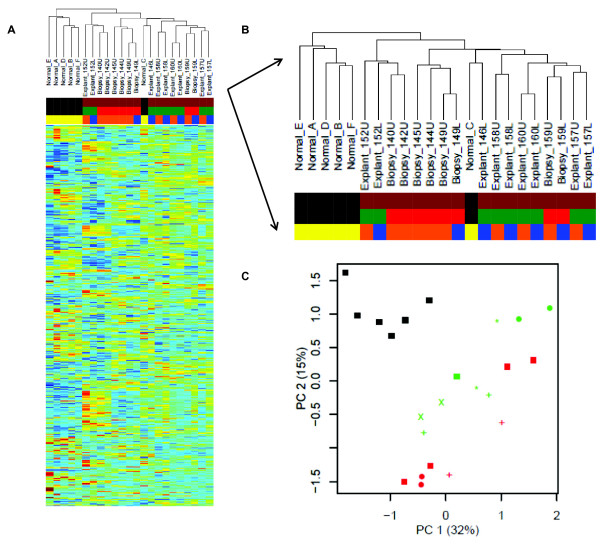
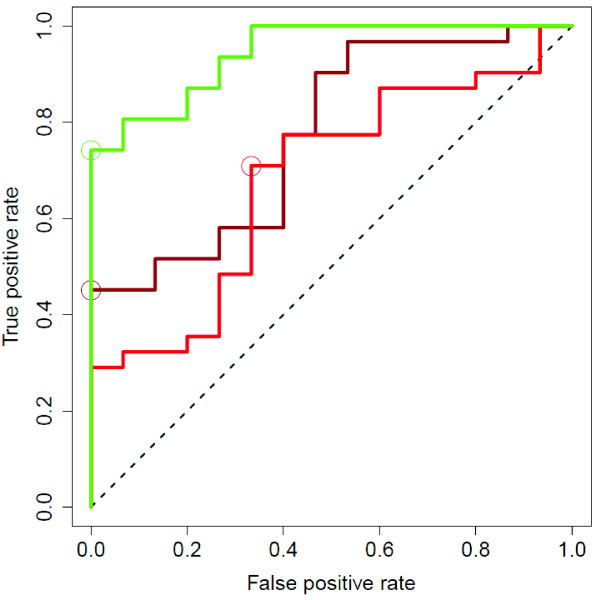
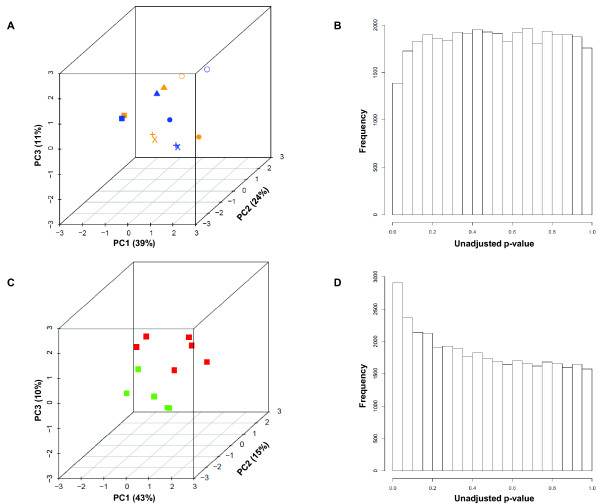
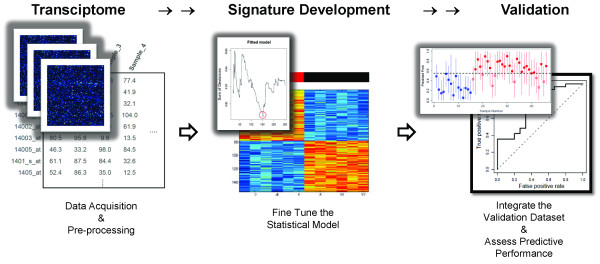
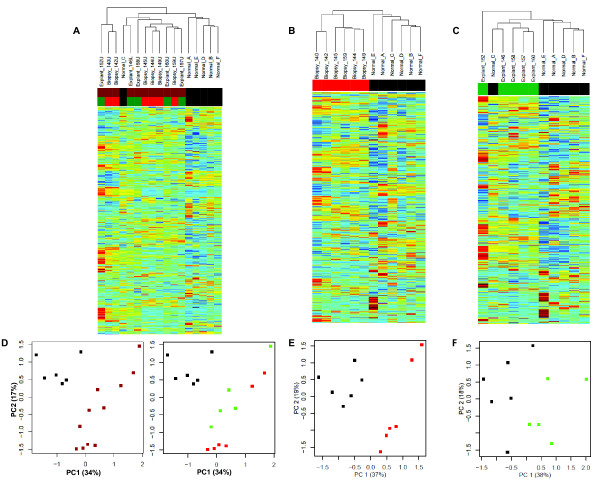
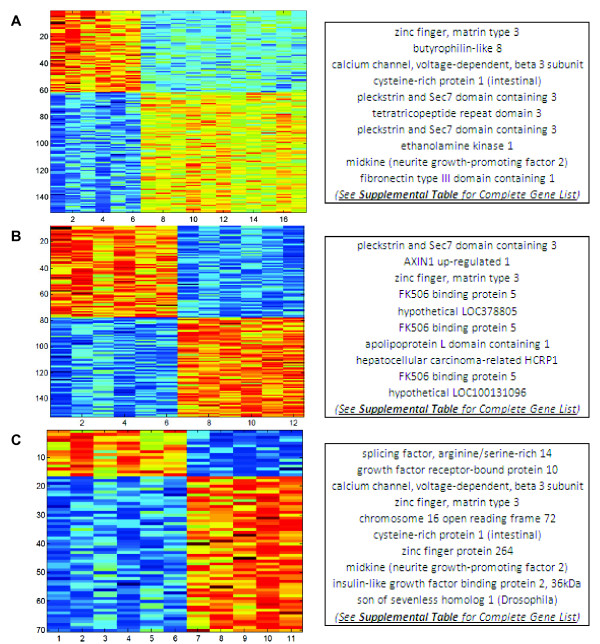
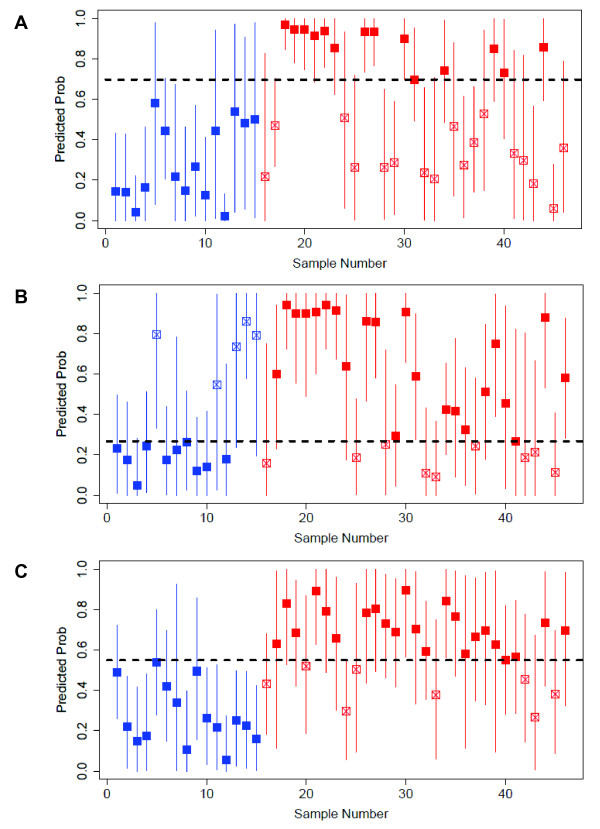
Whole lung tissue was obtained from patients with idiopathic pulmonary fibrosis (IPF) undergoing surgical lung biopsy or lung transplantation. Controls were obtained from normal organ donors. We performed cluster analyses to explore differences in our dataset. No significant difference was found between samples obtained from different lobes of the same patient. A significant difference was found between samples obtained at biopsy versus explant. Following preliminary analysis of the complete dataset, we selected three subsets for the development of diagnostic gene signatures: the first signature was developed from all IPF samples (as compared to controls); the second signature was developed from the subset of IPF samples obtained at biopsy; the third signature was developed from IPF explants. To assess the validity of each signature, we used an independent cohort of IPF and normal samples. Each signature was used to predict phenotype (IPF versus normal) in samples from the validation cohort. We compared the models' predictions to the true phenotype of each validation sample, and then calculated sensitivity, specificity and accuracy.
Surprisingly, we found that all three signatures were reasonably valid predictors of diagnosis, with small differences in test sensitivity, specificity and overall accuracy.
This study represents the first use of BPR on whole lung tissue; previously, BPR was primarily used to develop predictive models for cancer. This also represents the first report of an independently validated IPF gene expression signature. In summary, BPR is a promising tool for the development of gene expression signatures from non-neoplastic lung tissue. In the future, BPR might be used to develop definitive diagnostic gene signatures for IPF, prognostic gene signatures for IPF or gene signatures for other non-neoplastic lung disorders such as bronchiolitis obliterans.
特发性肺纤维化(IPF)的准确诊断是一项重大的临床挑战。我们通过对整个肺组织的基因表达谱进行贝叶斯概率回归(BPR)建模,开发了一种诊断 IPF 的模型。
从接受外科肺活检或肺移植的特发性肺纤维化(IPF)患者中获取整个肺组织。对照取自正常器官供体。我们进行了聚类分析以探索数据集之间的差异。同一患者不同肺叶获得的样本之间没有发现显著差异。在活检与移植之间获得的样本之间发现了显著差异。在对完整数据集进行初步分析后,我们选择了三个子集来开发诊断基因特征:第一个特征是从所有 IPF 样本(与对照相比)开发的;第二个特征是从活检获得的 IPF 样本子集开发的;第三个特征是从 IPF 移植体开发的。为了评估每个特征的有效性,我们使用了 IPF 和正常样本的独立队列。每个特征都用于预测验证队列中样本的表型(IPF 与正常)。我们将模型的预测与每个验证样本的真实表型进行比较,然后计算了敏感性、特异性和准确性。
令人惊讶的是,我们发现所有三个特征都是合理有效的诊断预测指标,测试的敏感性、特异性和整体准确性略有差异。
本研究代表了首次在整个肺组织上使用 BPR;以前,BPR 主要用于开发癌症的预测模型。这也是第一个独立验证的 IPF 基因表达特征的报告。总之,BPR 是从非肿瘤性肺组织开发基因表达特征的有前途的工具。将来,BPR 可能用于开发 IPF 的明确诊断基因特征、IPF 的预后基因特征或其他非肿瘤性肺疾病(如细支气管炎闭塞性)的基因特征。