Brodie Laboratory for Craniofacial Genetics, College of Dentistry, University of Illinois at Chicago, Chicago, Illinois, United States of America.
PLoS One. 2011;6(10):e24952. doi: 10.1371/journal.pone.0024952. Epub 2011 Oct 3.
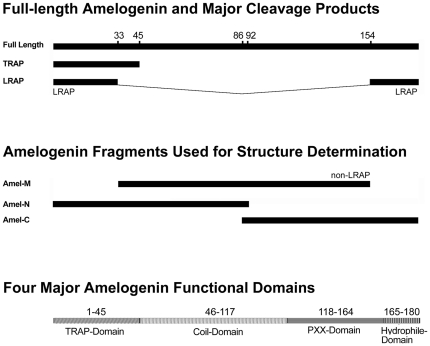
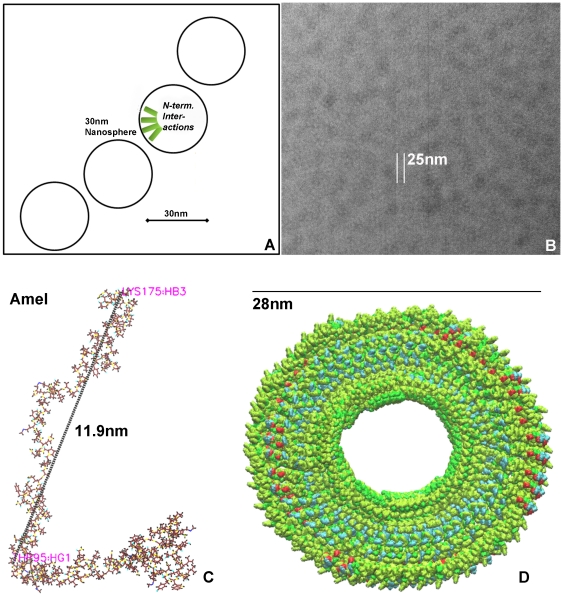
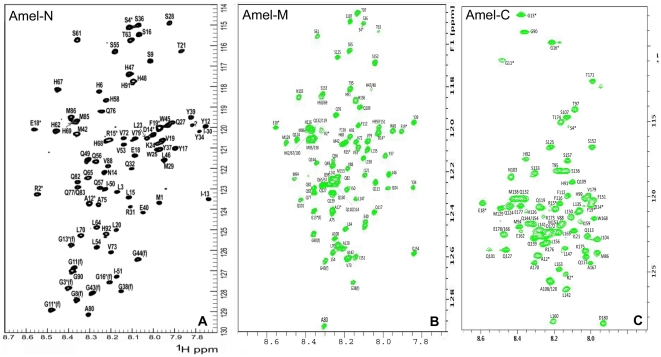
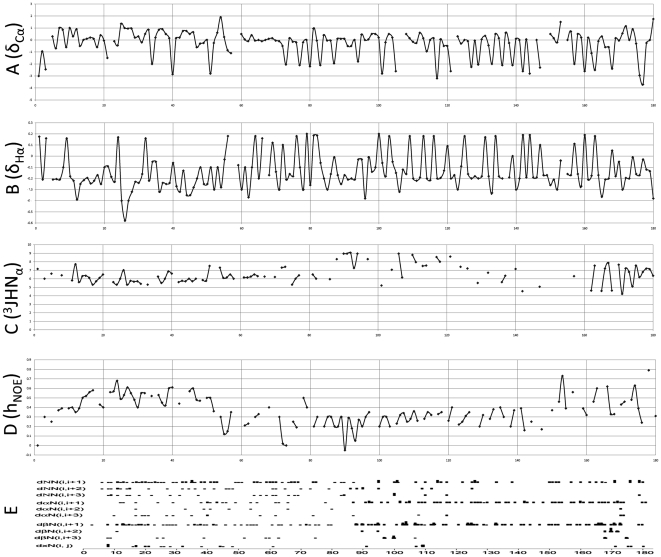
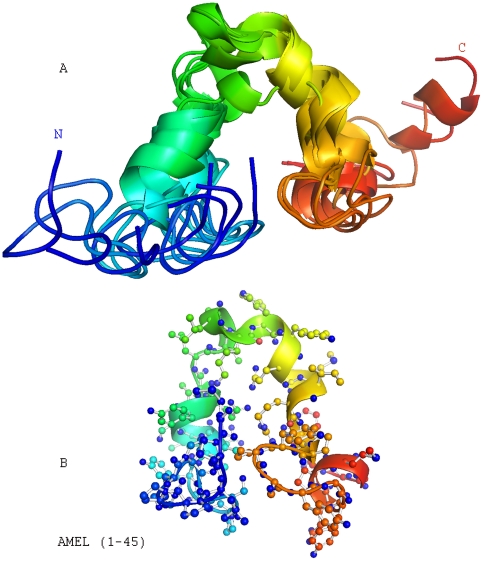
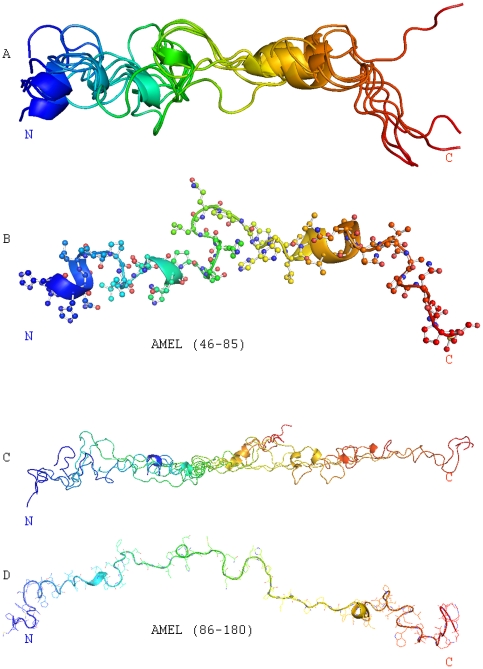
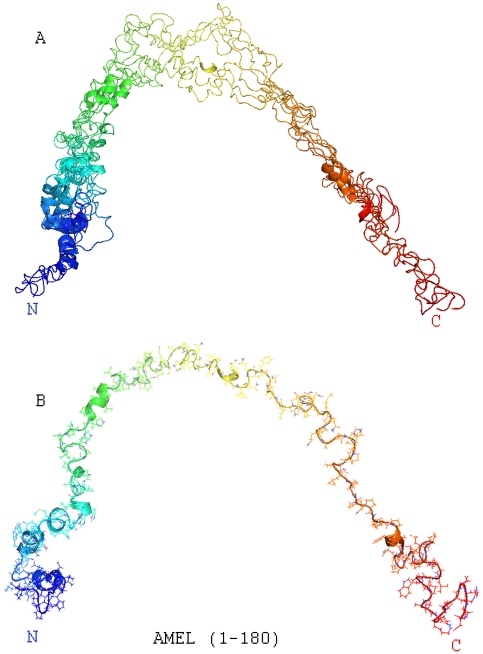
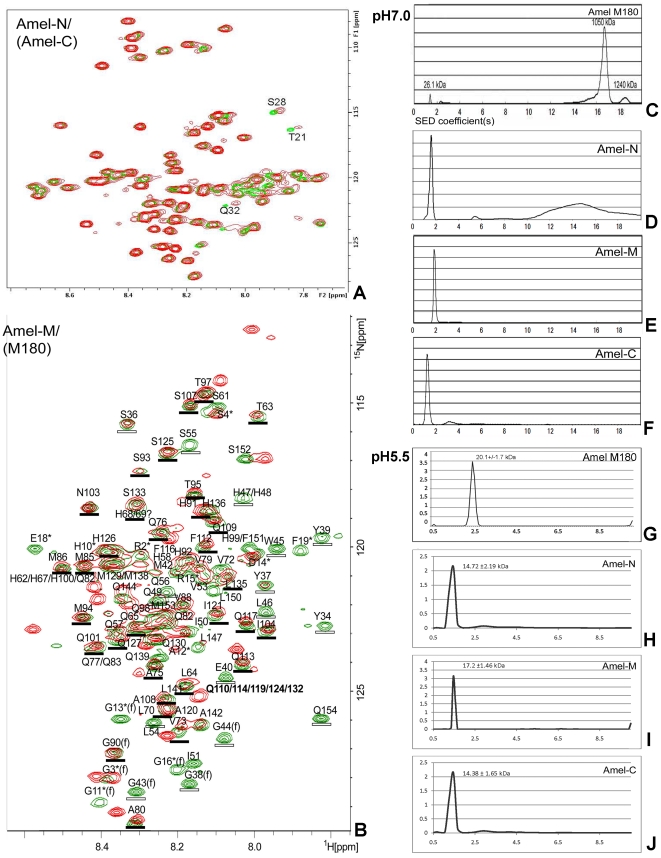
Tooth enamel, the hardest material in the human body, is formed within a self-assembled matrix consisting mostly of amelogenin proteins. Here we have determined the complete mouse amelogenin structure under physiological conditions and defined interactions between individual domains. NMR spectroscopy revealed four major amelogenin structural motifs, including an N-terminal assembly of four α-helical segments (S9-V19, T21-P33, Y39-W45, V53-Q56), an elongated random coil region interrupted by two 3(10) helices (∼P60-Q117), an extended proline-rich PPII-helical region (P118-L165), and a charged hydrophilic C-terminus (L165-D180). HSQC experiments demonstrated ipsilateral interactions between terminal domains of individual amelogenin molecules, i.e. N-terminal interactions with corresponding N-termini and C-terminal interactions with corresponding C-termini, while the central random coil domain did not engage in interactions. Our HSQC spectra of the full-length amelogenin central domain region completely overlapped with spectra of the monomeric Amel-M fragment, suggesting that the central amelogenin coil region did not involve in assembly, even in assembled nanospheres. This finding was confirmed by analytical ultracentrifugation experiments. We conclude that under conditions resembling those found in the developing enamel protein matrix, amelogenin molecules form complex 3D-structures with N-terminal α-helix-like segments and C-terminal PPII-helices, which self-assemble through ipsilateral interactions at the N-terminus of the molecule.
牙釉质是人体中最坚硬的物质,由主要由釉原蛋白组成的自组装基质形成。在这里,我们在生理条件下确定了完整的小鼠釉原蛋白结构,并定义了各个结构域之间的相互作用。NMR 光谱揭示了四个主要的釉原蛋白结构基序,包括四个α-螺旋段(S9-V19、T21-P33、Y39-W45、V53-Q56)的 N 端组装、由两个 3(10) 螺旋中断的长延伸无规卷曲区(~P60-Q117)、延伸的脯氨酸丰富的 PPII-螺旋区(P118-L165)和带电荷的亲水 C 端(L165-D180)。HSQC 实验证明了单个釉原蛋白分子末端结构域之间的同侧相互作用,即 N 端与相应的 N 端相互作用,C 端与相应的 C 端相互作用,而中央无规卷曲结构域不发生相互作用。我们全长釉原蛋白中央结构域区域的 HSQC 谱与单体 Amel-M 片段的谱完全重叠,这表明中央釉原蛋白卷曲区域不参与组装,即使在组装的纳米球中也是如此。这一发现通过分析超速离心实验得到了证实。我们得出的结论是,在类似于牙釉质蛋白基质中发现的条件下,釉原蛋白分子形成具有 N 端α-螺旋样片段和 C 端 PPII-螺旋的复杂 3D 结构,通过分子 N 端的同侧相互作用自组装。