Shoklo Malaria Research Unit, Mae Sod.
Clin Infect Dis. 2011 Nov;53(10):977-84. doi: 10.1093/cid/cir631.
Chloroquine (CQ) remains the treatment of choice for Plasmodium vivax malaria. Initially confined to parts of Indonesia and Papua, resistance of P. vivax to CQ seems to be spreading, and alternative treatments are required.
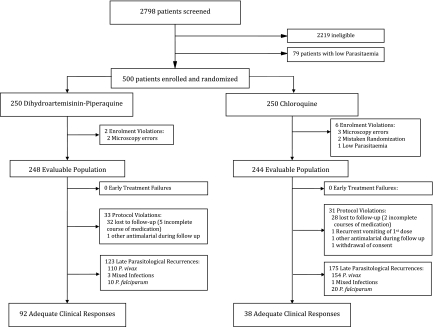
We conducted a randomized controlled study to compare the efficacy and the tolerability of CQ and dihydroartemisinin-piperaquine (DP) in 500 adults and children with acute vivax malaria on the Northwestern border of Thailand.
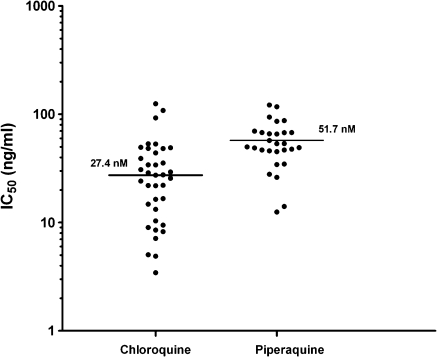
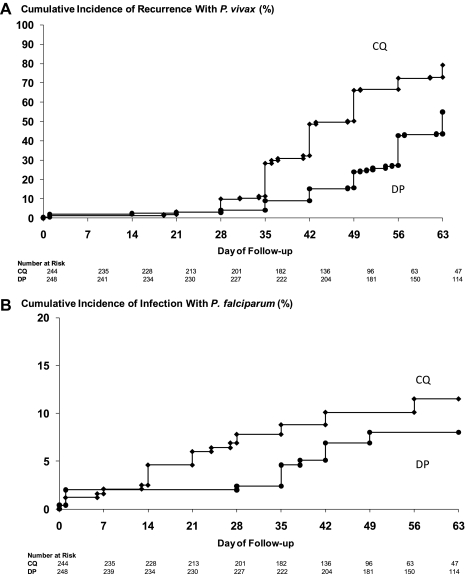
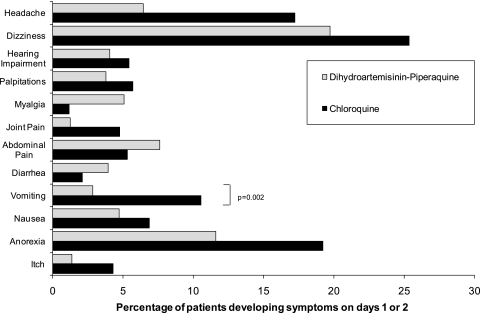
Both drugs were well tolerated. Fever and parasite clearance times were slower in the CQ than in the DP group (P < .001). By day 28, recurrent infections had emerged in 18 of 207 CQ recipients compared with 5 of 230 treated with DP (relative risk, 4.0; 95% confidence interval [CI], 1.51-10.58; P = .0046). The cumulative risk of recurrence with P. vivax at 9 weeks was 79.1% (95% CI, 73.5%-84.8%) in patients treated with CQ compared with 54.9% (95% CI, 48.2%-61.6%) in those receiving DP (hazard ratio [HR], 2.27; 95% CI, 1.8-2.9; P < .001). Children <5 years old were at greater risk of recurrent P. vivax infection (74.4%; 95% CI, 63.2%-85.6%) than older patients (55.3% [95% CI, 50.2%-60.4%]; HR, 1.58 [95% CI, 1.1-2.2]; P = .005). In vitro susceptibility testing showed that 13% of the tested isolates had a CQ median inhibitory concentration >100 nmol/L, suggesting reduced susceptibility.
The efficacy of CQ in the treatment of P. vivax infections is declining on the Thai-Myanmar border. DP is an effective alternative treatment.
氯喹(CQ)仍然是治疗间日疟原虫的首选药物。最初局限于印度尼西亚和巴布亚部分地区,现在看来,间日疟原虫对 CQ 的耐药性正在蔓延,需要替代治疗。
我们在泰国西北部边境进行了一项随机对照研究,比较了 500 名成人和儿童急性间日疟患者使用 CQ 和双氢青蒿素-哌喹(DP)的疗效和耐受性。
两种药物均耐受良好。CQ 组的发热和寄生虫清除时间比 DP 组慢(P<0.001)。到第 28 天,207 名 CQ 组中有 18 名出现复发性感染,而 230 名 DP 组中只有 5 名(相对风险,4.0;95%置信区间[CI],1.51-10.58;P=0.0046)。接受 CQ 治疗的患者在第 9 周时发生间日疟复发的累积风险为 79.1%(95%CI,73.5%-84.8%),而接受 DP 治疗的患者为 54.9%(95%CI,48.2%-61.6%)(风险比[HR],2.27;95%CI,1.8-2.9;P<0.001)。年龄<5 岁的儿童比年龄较大的患者(55.3%[95%CI,50.2%-60.4%])更易发生间日疟复发(74.4%[95%CI,63.2%-85.6%];HR,1.58[95%CI,1.1-2.2];P=0.005)。体外药敏试验显示,13%的检测分离株 CQ 半数抑制浓度(IC50)>100nmol/L,提示敏感性降低。
在泰国-缅甸边境,CQ 治疗间日疟原虫感染的疗效正在下降。DP 是一种有效的替代治疗方法。