Computer Science Department, KAIST, Republic of Korea.
Neuroimage. 2012 Feb 1;59(3):2217-30. doi: 10.1016/j.neuroimage.2011.09.085. Epub 2011 Oct 8.
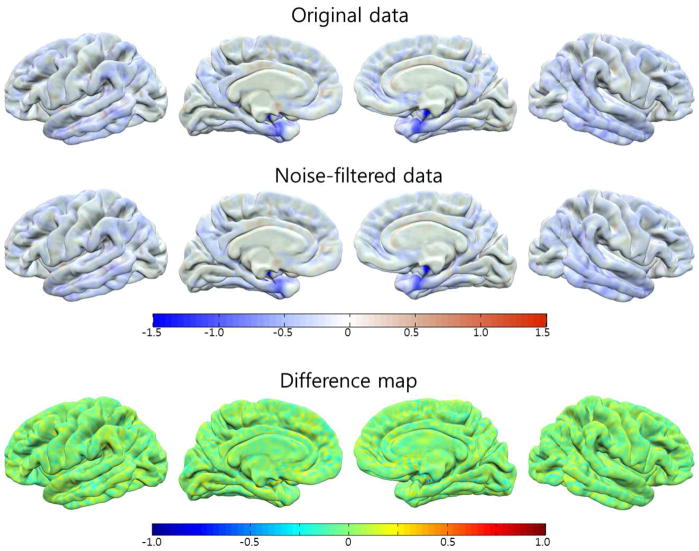
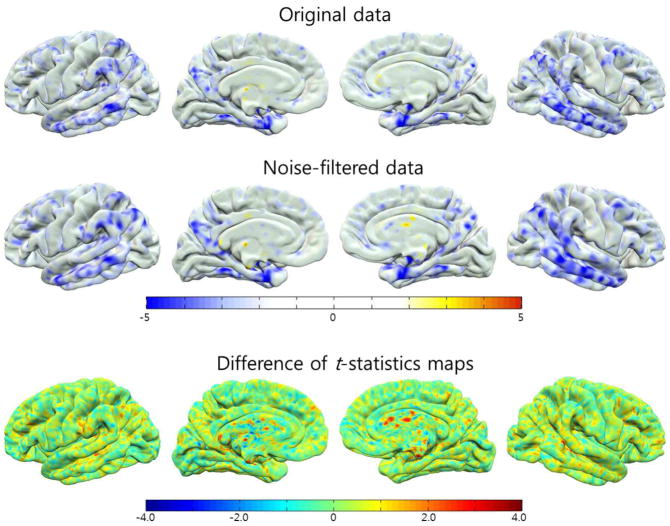
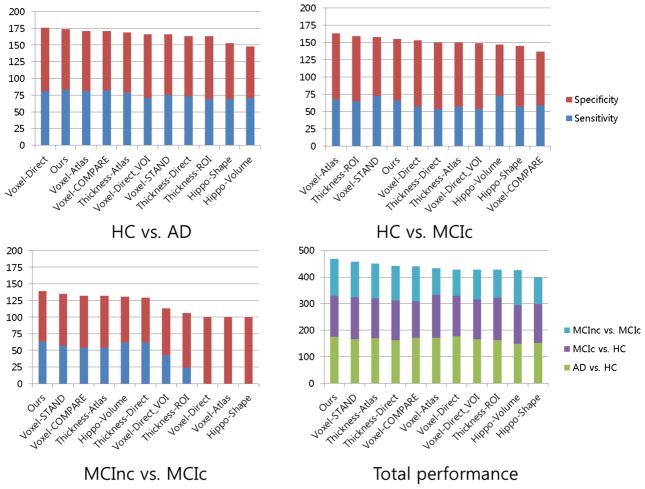
Patterns of brain atrophy measured by magnetic resonance structural imaging have been utilized as significant biomarkers for diagnosis of Alzheimer's disease (AD). However, brain atrophy is variable across patients and is non-specific for AD in general. Thus, automatic methods for AD classification require a large number of structural data due to complex and variable patterns of brain atrophy. In this paper, we propose an incremental method for AD classification using cortical thickness data. We represent the cortical thickness data of a subject in terms of their spatial frequency components, employing the manifold harmonic transform. The basis functions for this transform are obtained from the eigenfunctions of the Laplace-Beltrami operator, which are dependent only on the geometry of a cortical surface but not on the cortical thickness defined on it. This facilitates individual subject classification based on incremental learning. In general, methods based on region-wise features poorly reflect the detailed spatial variation of cortical thickness, and those based on vertex-wise features are sensitive to noise. Adopting a vertex-wise cortical thickness representation, our method can still achieve robustness to noise by filtering out high frequency components of the cortical thickness data while reflecting their spatial variation. This compromise leads to high accuracy in AD classification. We utilized MR volumes provided by Alzheimer's Disease Neuroimaging Initiative (ADNI) to validate the performance of the method. Our method discriminated AD patients from Healthy Control (HC) subjects with 82% sensitivity and 93% specificity. It also discriminated Mild Cognitive Impairment (MCI) patients, who converted to AD within 18 months, from non-converted MCI subjects with 63% sensitivity and 76% specificity. Moreover, it showed that the entorhinal cortex was the most discriminative region for classification, which is consistent with previous pathological findings. In comparison with other classification methods, our method demonstrated high classification performance in both categories, which supports the discriminative power of our method in both AD diagnosis and AD prediction.
通过磁共振结构成像测量的脑萎缩模式已被用作诊断阿尔茨海默病 (AD) 的重要生物标志物。然而,脑萎缩在患者之间存在差异,并且通常对 AD 不具有特异性。因此,AD 分类的自动方法由于脑萎缩的复杂和可变模式,需要大量的结构数据。在本文中,我们提出了一种使用皮质厚度数据进行 AD 分类的增量方法。我们通过流形谐波变换将受试者的皮质厚度数据表示为其空间频率分量。该变换的基函数是从拉普拉斯-贝尔特拉米算子的本征函数中得到的,这些本征函数仅依赖于皮质表面的几何形状,而不依赖于在其上定义的皮质厚度。这有助于基于增量学习对个体进行分类。一般来说,基于区域特征的方法不能很好地反映皮质厚度的详细空间变化,而基于顶点特征的方法对噪声敏感。采用顶点皮质厚度表示,我们的方法通过滤除皮质厚度数据的高频分量,同时反映其空间变化,仍然可以对噪声具有鲁棒性。这种折衷方案导致 AD 分类的准确性很高。我们利用阿尔茨海默病神经影像学倡议 (ADNI) 提供的 MR 体积来验证该方法的性能。我们的方法将 AD 患者与健康对照 (HC) 受试者区分开来,敏感性为 82%,特异性为 93%。它还将在 18 个月内转为 AD 的轻度认知障碍 (MCI) 患者与未转为 MCI 的受试者区分开来,敏感性为 63%,特异性为 76%。此外,它表明内嗅皮层是分类最具区分性的区域,这与之前的病理学发现一致。与其他分类方法相比,我们的方法在两个类别中均表现出较高的分类性能,这支持了我们的方法在 AD 诊断和 AD 预测中的区分能力。