Tagawa Masatoshi, Kawamura Kiyoko, Li Quanhai, Tada Yuji, Hiroshima Kenzo, Shimada Hideaki
Division of Pathology and Cell Therapy, Chiba Cancer Center Research Institute, 666-2 Nitona, Chuo-ku, Chiba 260-8717, Japan.
Clin Dev Immunol. 2011;2011:479013. doi: 10.1155/2011/479013. Epub 2011 Oct 16.
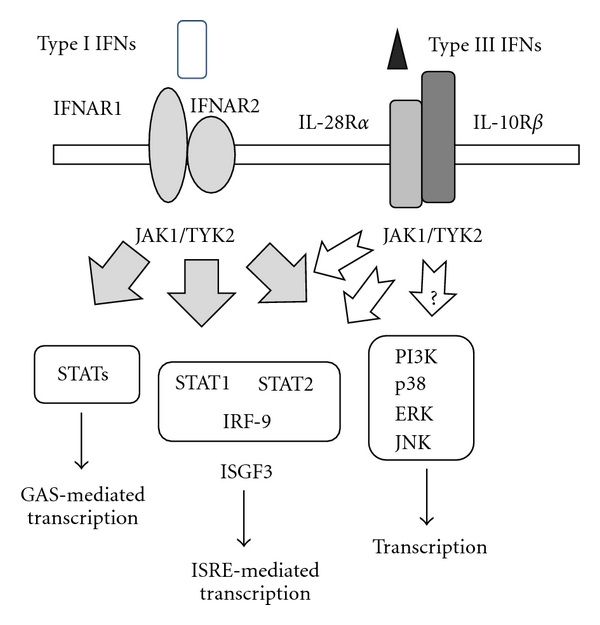
Recently identified interleukin-28 and -29 belong to a novel type III interferon (IFN) family, which could have distinct biological properties from type I and II IFNs. Type I IFNs, IFN-α/β, have been clinically applied for treating a certain kind of malignancies for over 30 years, but a wide range of the adverse effects hampered the further clinical applications. Type III IFNs, IFN-λs, have similar signaling pathways as IFN-α/β and inhibits proliferation of tumor cells through cell cycle arrest or apoptosis. Restricted patterns of type III IFN receptor expression in contrast to ubiquitously expressed IFN-α/β receptors suggest that type III IFNs have limited cytotoxicity to normal cells and can be a possible anticancer agent. In this paper, we summarize the current knowledge on the IFN-λs-mediated tumor cell death and discuss the functional difference between type I and III IFNs.
最近发现的白细胞介素-28和-29属于一种新型III型干扰素(IFN)家族,其生物学特性可能与I型和II型干扰素不同。I型干扰素IFN-α/β已临床应用于治疗某些恶性肿瘤30多年,但广泛的不良反应阻碍了其进一步的临床应用。III型干扰素IFN-λs具有与IFN-α/β相似的信号通路,并通过细胞周期停滞或凋亡抑制肿瘤细胞增殖。与普遍表达的IFN-α/β受体相比,III型干扰素受体表达模式受限,这表明III型干扰素对正常细胞的细胞毒性有限,可能是一种潜在的抗癌药物。在本文中,我们总结了目前关于IFN-λs介导的肿瘤细胞死亡的知识,并讨论了I型和III型干扰素之间的功能差异。