Department of Psychiatry, University of California-San Diego School of Medicine, La Jolla, CA 92103, USA.
J Int Neuropsychol Soc. 2012 Jan;18(1):128-33. doi: 10.1017/S135561771100124X. Epub 2011 Oct 12.
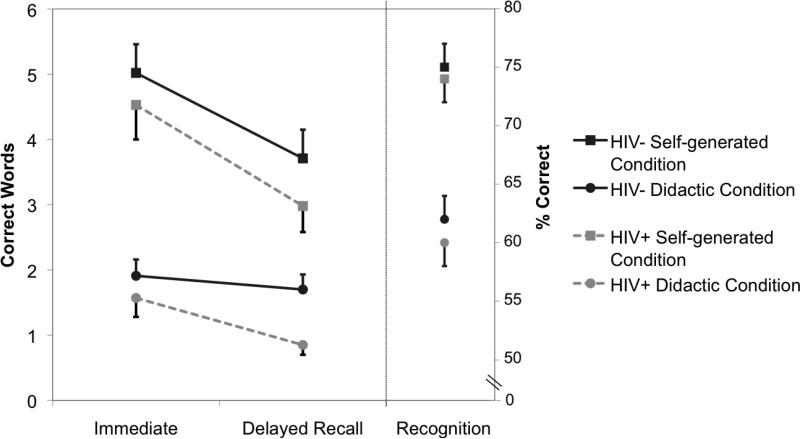
Despite the prevalence of HIV-associated episodic memory impairment and its adverse functional impact, there are no empirically validated cognitive rehabilitation strategies for HIV-infected persons. The present study examined the self-generation approach, which is theorized to enhance new learning by elaborating and deepening encoding. Participants included 54 HIV-infected and 46 seronegative individuals, who learned paired word associates in both self-generated and didactic encoding experimental conditions. Results revealed main effects of HIV serostatus and encoding condition, but no interaction. Planned comparisons showed that both groups recalled significantly more words learned in the self-generation condition, and that HIV+ individuals recalled fewer words overall compared to their seronegative counterparts at delayed recall. Importantly, HIV+ participants with clinical memory impairment evidenced similar benefits of self-generation compared to unimpaired HIV+ subjects. Self-generation strategies may improve verbal recall in individuals with HIV infection and may, therefore, be an appropriate and potentially effective cognitive rehabilitation tool in this population.
尽管 HIV 相关的间歇性记忆障碍普遍存在,并对其功能产生不良影响,但目前尚无针对 HIV 感染者的经实证验证的认知康复策略。本研究探讨了自我生成方法,该方法通过阐述和深化编码来增强新的学习。参与者包括 54 名 HIV 感染者和 46 名血清阴性个体,他们在自我生成和教学编码实验条件下学习成对的单词关联。结果显示 HIV 血清状态和编码条件存在主要影响,但无交互作用。计划比较显示,两组在自我生成条件下学习的单词回忆明显更多,与血清阴性对照组相比,HIV+个体在延迟回忆时总体上回忆的单词更少。重要的是,有临床记忆障碍的 HIV+参与者与未受影响的 HIV+受试者一样,自我生成策略也能带来类似的益处。自我生成策略可能会改善 HIV 感染者的言语回忆,因此,对于该人群而言,这可能是一种合适且具有潜在效果的认知康复工具。