Department of Entomology, Max Planck Institute for Chemical Ecology, Jena, Germany.
PLoS One. 2011;6(10):e26676. doi: 10.1371/journal.pone.0026676. Epub 2011 Oct 27.
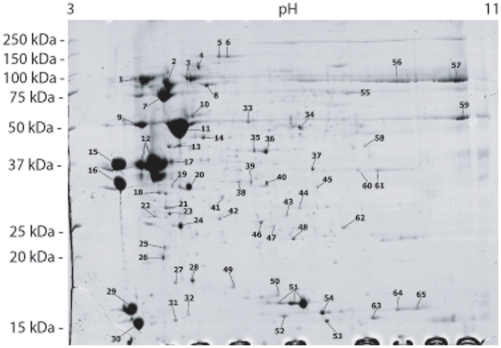
Although the importance of insect saliva in insect-host plant interactions has been acknowledged, there is very limited information on the nature and complexity of the salivary proteome in lepidopteran herbivores. We inspected the labial salivary transcriptome and proteome of Helicoverpa armigera, an important polyphagous pest species. To identify the majority of the salivary proteins we have randomly sequenced 19,389 expressed sequence tags (ESTs) from a normalized cDNA library of salivary glands. In parallel, a non-cytosolic enriched protein fraction was obtained from labial salivary glands and subjected to two-dimensional gel electrophoresis (2-DE) and de novo peptide sequencing. This procedure allowed comparison of peptides and EST sequences and enabled us to identify 65 protein spots from the secreted labial saliva 2DE proteome. The mass spectrometry analysis revealed ecdysone, glucose oxidase, fructosidase, carboxyl/cholinesterase and an uncharacterized protein previously detected in H. armigera midgut proteome. Consistently, their corresponding transcripts are among the most abundant in our cDNA library. We did find redundancy of sequence identification of saliva-secreted proteins suggesting multiple isoforms. As expected, we found several enzymes responsible for digestion and plant offense. In addition, we identified non-digestive proteins such as an arginine kinase and abundant proteins of unknown function. This identification of secreted salivary gland proteins allows a more comprehensive understanding of insect feeding and poses new challenges for the elucidation of protein function.
虽然昆虫唾液在昆虫-植物互作中的重要性已得到认可,但有关鳞翅目食草昆虫唾液蛋白质组的性质和复杂性的信息却非常有限。我们检查了棉铃虫(Helicoverpa armigera)的唇腺转录组和蛋白质组,棉铃虫是一种重要的多食性害虫。为了鉴定大多数唾液蛋白,我们从唾液腺的一个标准化 cDNA 文库中随机测序了 19389 个表达序列标签(EST)。同时,从唇腺中获得了一个非细胞质富集的蛋白质级分,并进行了二维凝胶电泳(2-DE)和从头肽测序。该程序允许比较肽和 EST 序列,并使我们能够从分泌性唇唾液 2-DE 蛋白质组中鉴定出 65 个蛋白质斑点。质谱分析显示蜕皮激素、葡萄糖氧化酶、果糖酶、羧酸/胆碱酯酶和一种在棉铃虫中肠蛋白质组中先前检测到的未鉴定蛋白。一致的是,它们对应的转录物是我们 cDNA 文库中最丰富的转录物之一。我们确实发现了唾液分泌蛋白的序列鉴定存在冗余,表明存在多个同工型。正如预期的那样,我们发现了几种负责消化和植物防御的酶。此外,我们还鉴定了非消化蛋白,如精氨酸激酶和大量功能未知的蛋白。这些分泌唾液腺蛋白的鉴定可以更全面地了解昆虫的取食,并为阐明蛋白质功能提出了新的挑战。