University of Arizona College of Medicine, Tucson, AZ 85724, USA.
Cephalalgia. 2011 Dec;31(16):1595-600. doi: 10.1177/0333102411427600. Epub 2011 Nov 2.
The mechanisms contributing to the pain of migraine are poorly understood although activation of afferent nociceptors in the trigeminovascular system has been proposed as a key event. Prior studies have shown that dural-afferent nociceptors are sensitive to both osmotic and mechanical stimuli. Based on the sensitivity to these stimuli we hypothesized that dural afferents express the osmo/mechano-sensitive channel transient receptor-potential vanilloid 4 (TRPV4).
These studies used in vitro patch-clamp electrophysiology of trigeminal neurons retrogradely labeled from the dura to examine the functional expression of TRPV4. Additionally, we used a rat headache model in which facial/hind paw allodynia following dural stimulation is measured to determine whether activation of meningeal TRPV4 produces responses consistent with migraine.
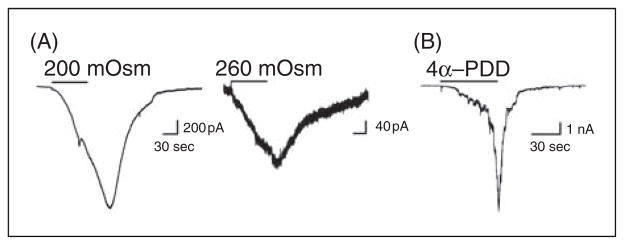
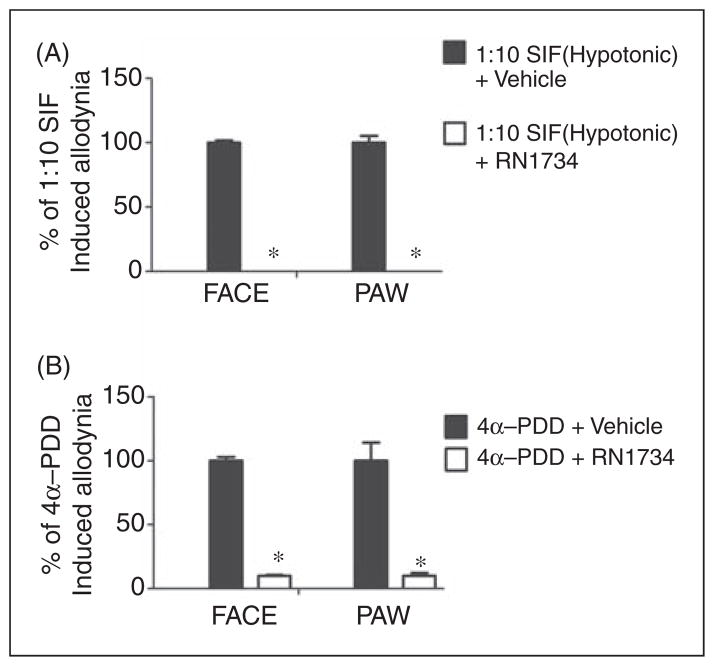
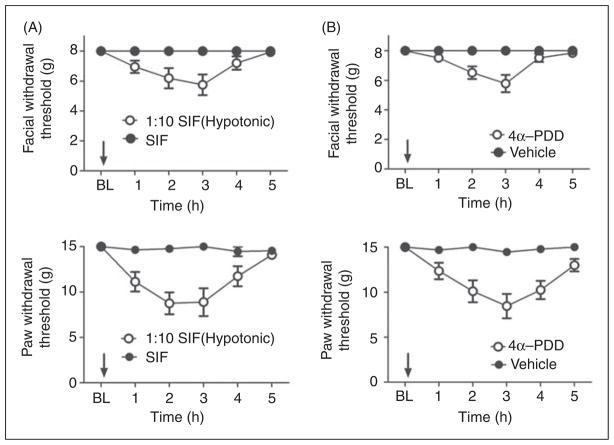
These studies found that 56% and 49% of identified dural afferents generate currents in response to hypotonic solutions and 4α-PDD, respectively. The response to these stimuli indicates that dural afferents express TRPV4. Activation of meningeal TPRV4 using hypotonic solution or 4α-PDD in vivo resulted in both facial and hind paw allodynia that was blocked by the TRPV4 antagonist RN1734.
These data indicate that activation of TRPV4 within the meninges produces afferent nociceptive signaling from the head that may contribute to migraine headache.
尽管三叉神经系统中的传入伤害感受器的激活被认为是一个关键事件,但导致偏头痛疼痛的机制仍不清楚。先前的研究表明,硬脑膜传入伤害感受器对渗透和机械刺激敏感。基于对这些刺激的敏感性,我们假设硬脑膜传入纤维表达渗透/机械敏感通道瞬时受体电位香草素 4(TRPV4)。
这些研究使用逆行标记从硬脑膜的三叉神经神经元的体外膜片钳电生理学来检查 TRPV4 的功能表达。此外,我们使用大鼠头痛模型来测量硬脑膜刺激后面部/后爪的痛觉过敏,以确定脑膜 TRPV4 的激活是否产生与偏头痛一致的反应。
这些研究发现,56%和 49%的鉴定出的硬脑膜传入纤维分别对低渗溶液和 4α-PDD 产生电流反应。对这些刺激的反应表明硬脑膜传入纤维表达 TRPV4。在体内使用低渗溶液或 4α-PDD 激活脑膜 TRPV4 会导致面部和后爪痛觉过敏,而 TRPV4 拮抗剂 RN1734 可阻断这种过敏反应。
这些数据表明,脑膜内 TRPV4 的激活会产生来自头部的伤害性传入信号,这可能导致偏头痛头痛。