Department of Biochemistry, University of Washington, Seattle, WA 98195, USA.
J Mol Biol. 2012 Jan 20;415(3):615-25. doi: 10.1016/j.jmb.2011.10.043. Epub 2011 Nov 3.
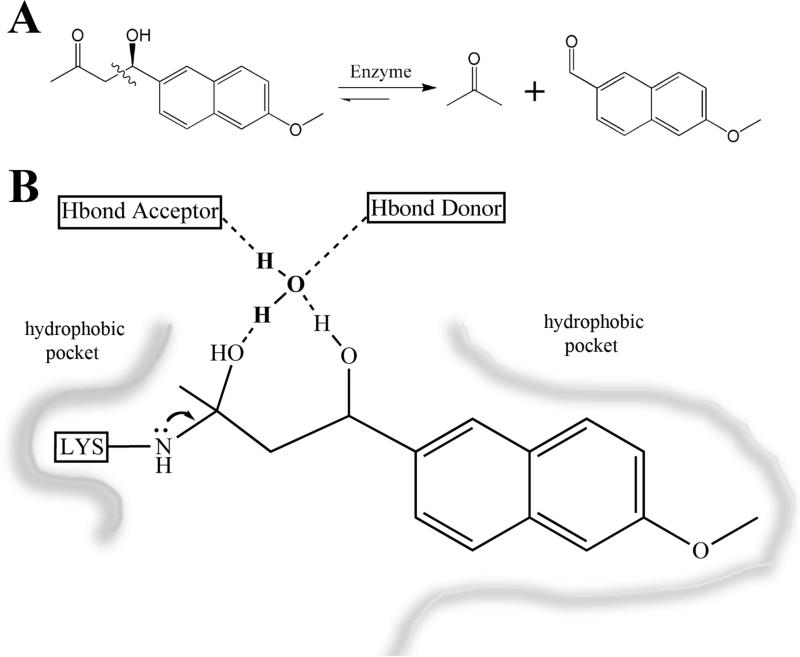
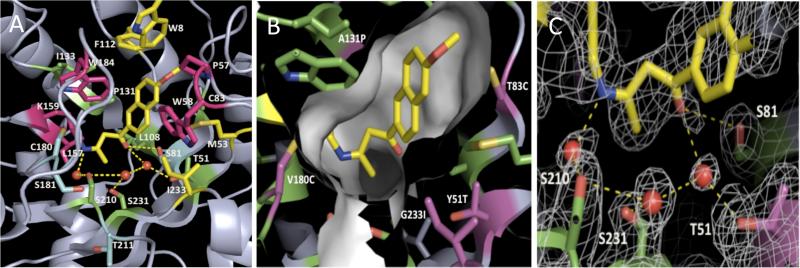
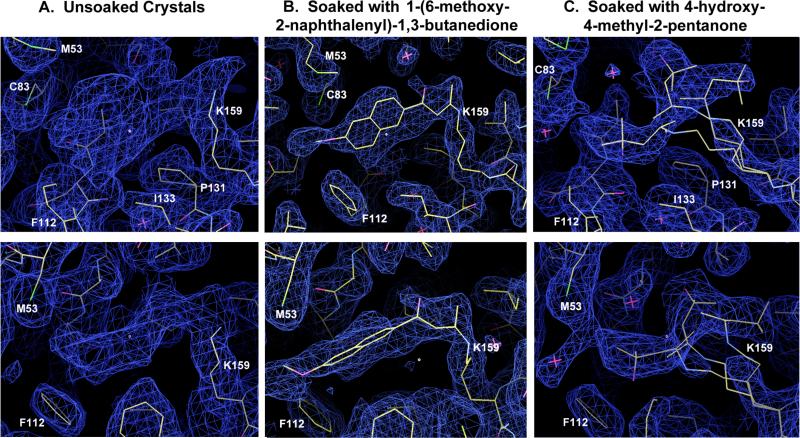
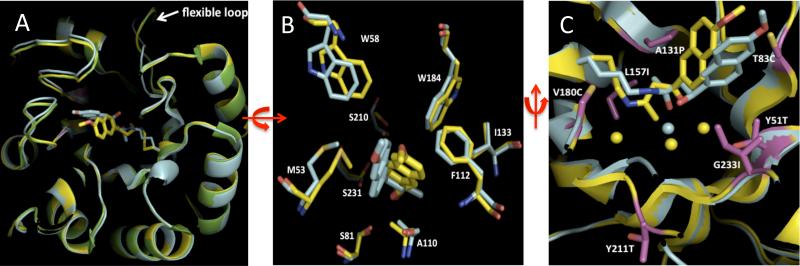
We report the cocrystal structures of a computationally designed and experimentally optimized retro-aldol enzyme with covalently bound substrate analogs. The structure with a covalently bound mechanism-based inhibitor is similar to, but not identical with, the design model, with an RMSD of 1.4 Å over active-site residues and equivalent substrate atoms. As in the design model, the binding pocket orients the substrate through hydrophobic interactions with the naphthyl moiety such that the oxygen atoms analogous to the carbinolamine and β-hydroxyl oxygens are positioned near a network of bound waters. However, there are differences between the design model and the structure: the orientation of the naphthyl group and the conformation of the catalytic lysine are slightly different; the bound water network appears to be more extensive; and the bound substrate analog exhibits more conformational heterogeneity than typical native enzyme-inhibitor complexes. Alanine scanning of the active-site residues shows that both the catalytic lysine and the residues around the binding pocket for the substrate naphthyl group make critical contributions to catalysis. Mutating the set of water-coordinating residues also significantly reduces catalytic activity. The crystal structure of the enzyme with a smaller substrate analog that lacks naphthyl ring shows the catalytic lysine to be more flexible than in the naphthyl-substrate complex; increased preorganization of the active site would likely improve catalysis. The covalently bound complex structures and mutagenesis data highlight the strengths and weaknesses of the de novo enzyme design strategy.
我们报告了一种经过计算设计和实验优化的 retro-aldol 酶与共价结合的底物类似物的共晶结构。与设计模型相比,具有共价结合的基于机制抑制剂的结构相似,但不完全相同,活性位点残基和等效的底物原子的 RMSD 为 1.4Å。与设计模型一样,结合口袋通过与萘基部分的疏水相互作用来定向底物,使得类似于碳亚胺和β-羟基氧的氧原子靠近结合水的网络。然而,设计模型和结构之间存在差异:萘基基团的取向和催化赖氨酸的构象略有不同;结合水网络似乎更加广泛;与典型的天然酶抑制剂复合物相比,结合的底物类似物表现出更多的构象异质性。活性位点残基的丙氨酸扫描表明,催化赖氨酸和结合口袋中萘基基团的周围残基对催化都有重要贡献。突变一组水配位残基也会显著降低催化活性。缺乏萘基环的较小底物类似物的酶的晶体结构表明,催化赖氨酸比在萘基-底物复合物中更灵活;增加活性位点的预组织可能会改善催化。共价结合的复合物结构和突变数据突出了从头设计酶策略的优缺点。