School of Environmental Science and Engineering, Tianjin University, Tianjin, China.
PLoS One. 2011;6(11):e27140. doi: 10.1371/journal.pone.0027140. Epub 2011 Nov 16.
To test whether the incidence of common colds among college students in China is associated with ventilation rates and crowdedness in dormitories.
In Phase I of the study, a cross-sectional study, 3712 students living in 1569 dorm rooms in 13 buildings responded to a questionnaire about incidence and duration of common colds in the previous 12 months. In Phase II, air temperature, relative humidity and CO(2) concentration were measured for 24 hours in 238 dorm rooms in 13 buildings, during both summer and winter. Out-to indoor air flow rates at night were calculated based on measured CO(2) concentrations.
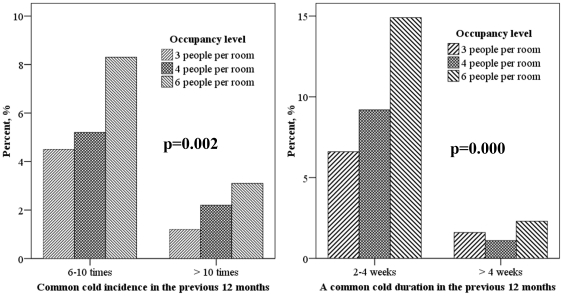
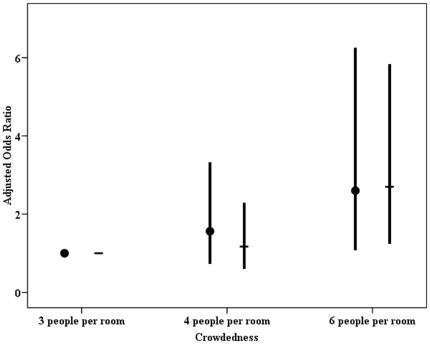
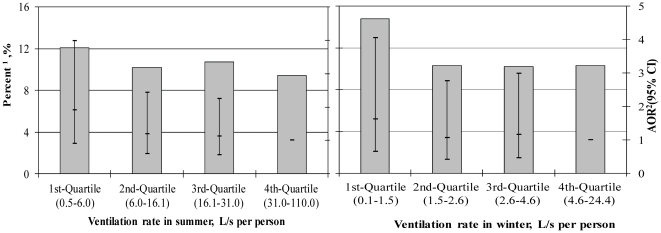
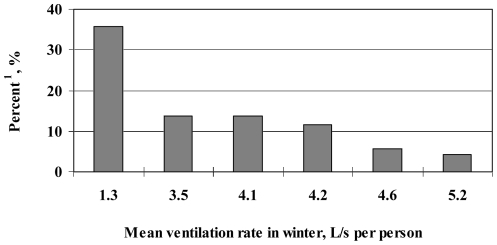
In Phase I, 10% of college students reported an incidence of more than 6 common colds in the previous 12 months, and 15% reported that each infection usually lasted for more than 2 weeks. Students in 6-person dorm rooms were about 2 times as likely to have an incidence of common colds ≥6 times per year and a duration ≥2 weeks, compared to students in 3-person rooms. In Phase II, 90% of the measured dorm rooms had an out-to indoor air flow rate less than the Chinese standard of 8.3 L/s per person during the heating season. There was a dose-response relationship between out-to indoor air flow rate per person in dorm rooms and the proportion of occupants with annual common cold infections ≥6 times. A mean ventilation rate of 5 L/(s•person) in dorm buildings was associated with 5% of self reported common cold ≥6 times, compared to 35% at 1 L/(s•person).
Crowded dormitories with low out-to indoor airflow rates are associated with more respiratory infections among college students.
检测中国大学生普通感冒的发病率是否与宿舍通风率和拥挤程度有关。
在研究的第一阶段,采用横断面研究,对 13 栋楼的 1569 间宿舍的 3712 名学生进行了问卷调查,调查内容为过去 12 个月内普通感冒的发病次数和持续时间。在第二阶段,在夏季和冬季,对 13 栋楼的 238 间宿舍进行了 24 小时的空气温度、相对湿度和 CO2 浓度测量,根据测量的 CO2 浓度计算夜间的室外到室内空气流量率。
在第一阶段,10%的大学生报告过去 12 个月内普通感冒发病率超过 6 次,15%的大学生报告每次感染通常持续超过 2 周。与 3 人间宿舍的学生相比,6 人间宿舍的学生每年普通感冒发病率≥6 次和每次持续时间≥2 周的可能性约为前者的 2 倍。在第二阶段,90%的测量宿舍在供暖季节的室外到室内空气流量率低于中国标准的 8.3 L/s 人。宿舍内每人的室外到室内空气流量率与每年普通感冒感染≥6 次的人数比例之间存在剂量反应关系。宿舍内的平均通风率为 5 L/(s·人)时,报告普通感冒≥6 次的比例为 5%,而通风率为 1 L/(s·人)时,这一比例为 35%。
通风率低且拥挤的宿舍与大学生呼吸道感染的增多有关。