Department of Virology, Erasmus Medical Centre, Rotterdam, The Netherlands.
Adv Exp Med Biol. 2011;719:59-66. doi: 10.1007/978-1-4614-0204-6_6.
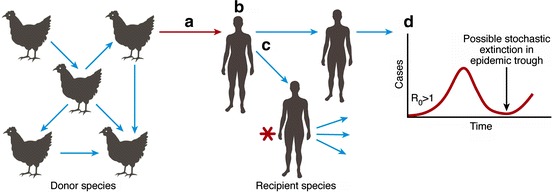
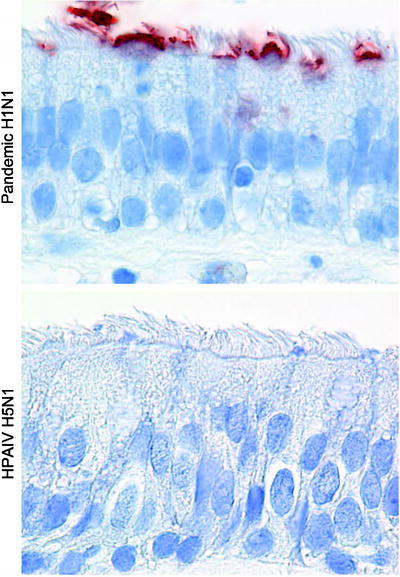
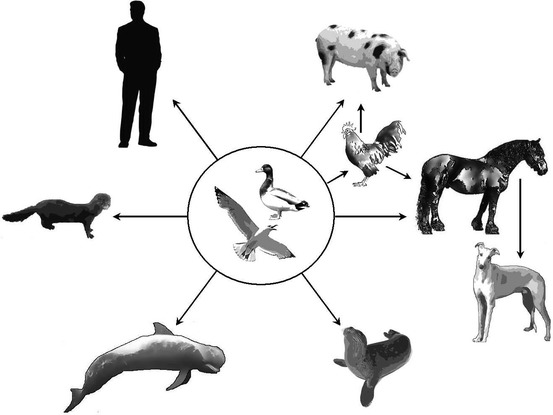
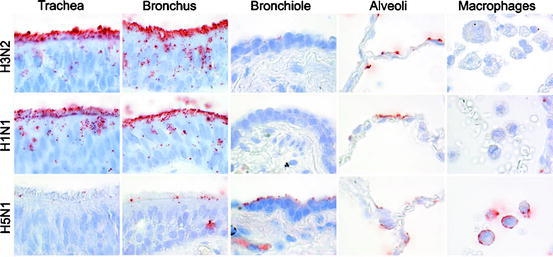
Emerging infections have an enormous impact on human health, food supply, economics, and the environment. Animals, and wild animals in particular, are considered to be the source of more than 70% of all emerging infections in humans. Two zoonotic influenza viruses that successfully spread from animals to humans are highly pathogenic avian influenza (HPAI) H5N1 virus, originating from poultry, and pandemic H1N1 influenza (pH1N1) virus, thought to originate from domestic swine. In this review, we discuss our research on the host species barrier for these viruses, concentrating on three questions: how does HPAI H5N1 virus transmit from birds to humans; what are the within-host dynamics of HPAI H5N1 virus and pH1N1 virus in humans and other mammals; and what determines transmission of influenza viruses among humans. To contain and eradicate zoonotic influenza viruses requires not only strategic virus surveillance of both animal and human populations, but also a better understanding of the hurdles that such a virus needs to jump over in order to cross the species barrier and cause a human pandemic. Advances in these two areas will allow us to better predict the risk of emergence of zoonotic influenza viruses in the human population.
新发传染病对人类健康、食品供应、经济和环境都有巨大影响。动物,尤其是野生动物,被认为是人类 70%以上新发传染病的源头。两种成功从动物传播到人类的人畜共患流感病毒是高致病性禽流感(HPAI)H5N1 病毒,源自家禽,以及大流行性 H1N1 流感(pH1N1)病毒,据认为源自家猪。在这篇综述中,我们讨论了我们对这些病毒宿主种间屏障的研究,重点讨论了三个问题:HPAI H5N1 病毒如何从鸟类传播到人类;HPAI H5N1 病毒和 pH1N1 病毒在人类和其他哺乳动物中的体内动力学如何;以及什么决定了流感病毒在人与人之间的传播。为了控制和消灭人畜共患流感病毒,不仅需要对动物和人群进行战略性病毒监测,还需要更好地了解这种病毒需要克服哪些障碍才能跨越种间屏障并引发人类大流行。这两个领域的进展将使我们能够更好地预测人畜共患流感病毒在人类中的出现风险。