Ecker Stephanie M, Hines Joshua C, Pfahler Scott M, Glaser Bert M
The National Retina Institute, Ocular Proteomics Laboratory, Towson, MD, USA.
Mol Vis. 2011;17:2856-63. Epub 2011 Nov 9.
Recent studies have illuminated the vitreous proteome as a potentially important diagnostic tool that will predict disease progression and response to treatment, in eyes with retinal disease. Studies to date have demonstrated correlations of protein levels between vitreous and aqueous humor. Because these results are un-expected and analysis was only done on a few endpoints, the present study further analyzes the relationship between aqueous and vitreous by probing a wide array of proteins in patients with posterior segment diseases.
Anterior chamber aqueous fluid was obtained using a limbal approach with a 30 gauge needle. Immediately following, the vitreous sample was obtained via a pars plana approach. A 25 gauge needle with a 1 ml syringe was directed into the mid-vitreous cavity and vitreous fluid was gently aspirated. Aqueous and vitreous samples were then analyzed using the quantitative native protein analysis method called reverse phase protein microarray technology (RPPM).
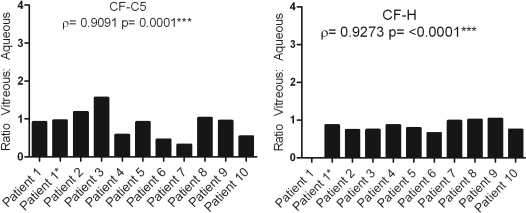
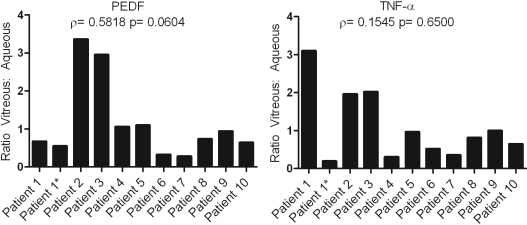
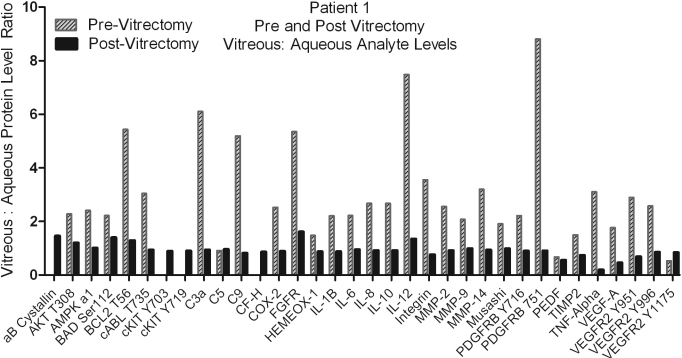
The entire sample population (n=11) was probed against 34 proteins, revealing 8 proteins that significantly correlate, 3 proteins that trend to correlation but fell short of significance and 23 proteins that have no correlation between the vitreous and aqueous humor.
Proteins in the aqueous cannot be assumed to correlate with their counterparts in the vitreous.
最近的研究表明,玻璃体蛋白质组作为一种潜在的重要诊断工具,可预测视网膜疾病患者的疾病进展和治疗反应。迄今为止的研究已经证明了玻璃体和房水中蛋白质水平的相关性。由于这些结果出乎意料,且仅对少数终点进行了分析,因此本研究通过检测后段疾病患者体内的多种蛋白质,进一步分析房水和玻璃体之间的关系。
采用30号针头经角膜缘入路获取前房房水。随后,立即通过睫状体平坦部入路获取玻璃体样本。将一根连接1毫升注射器的25号针头插入玻璃体腔中部,轻轻抽吸玻璃体液。然后使用称为反相蛋白质微阵列技术(RPPM)的定量天然蛋白质分析方法对房水和玻璃体样本进行分析。
对整个样本群体(n = 11)检测了34种蛋白质,发现8种蛋白质存在显著相关性,3种蛋白质有相关性趋势但未达到显著水平,23种蛋白质在玻璃体和房水之间无相关性。
不能认为房水中的蛋白质与其在玻璃体中的对应物存在相关性。