Laboratory for Computational Biology & Biophysics, Department of Biological Engineering, Massachusetts Institute of Technology, Cambridge, MA 02139, USA.
Nucleic Acids Res. 2012 Apr;40(7):2862-8. doi: 10.1093/nar/gkr1173. Epub 2011 Dec 10.
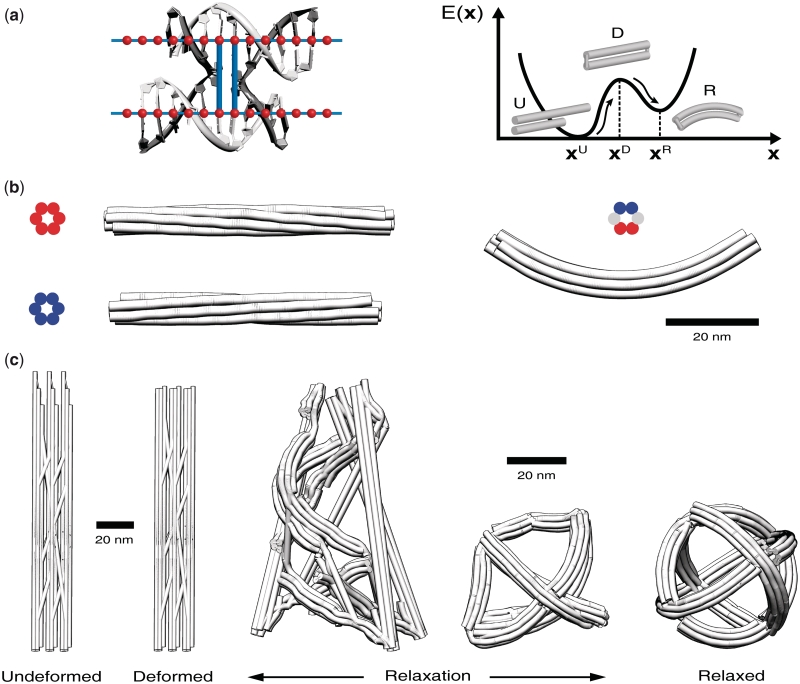
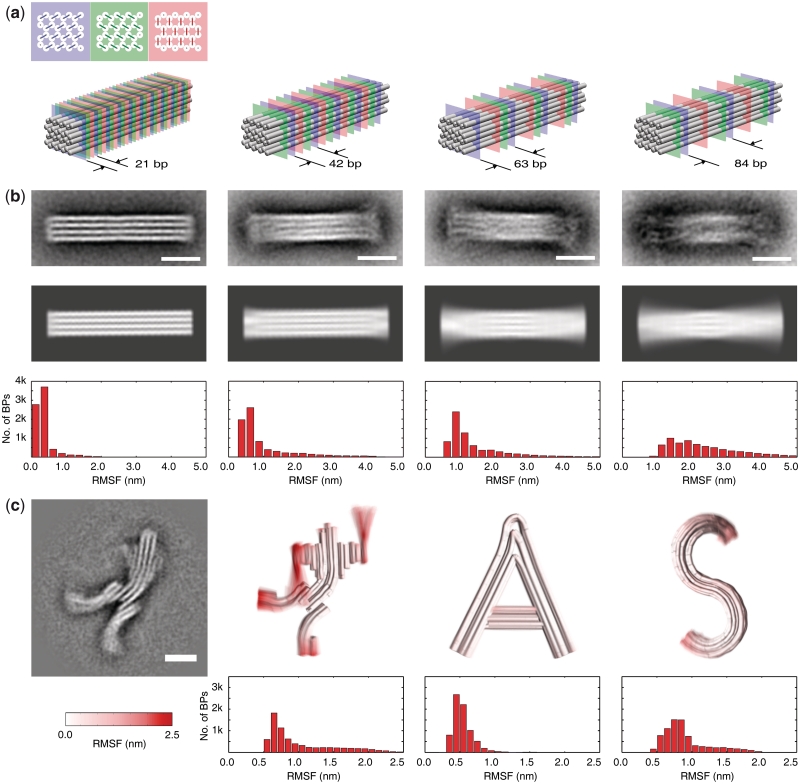
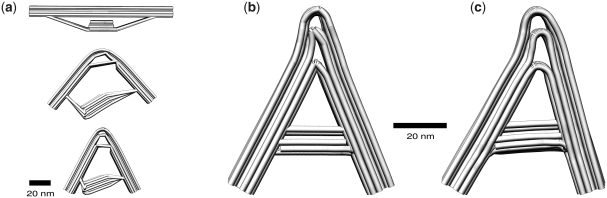
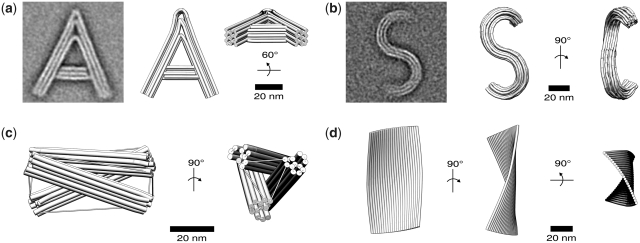
DNA nanotechnology enables the programmed synthesis of intricate nanometer-scale structures for diverse applications in materials and biological science. Precise control over the 3D solution shape and mechanical flexibility of target designs is important to achieve desired functionality. Because experimental validation of designed nanostructures is time-consuming and cost-intensive, predictive physical models of nanostructure shape and flexibility have the capacity to enhance dramatically the design process. Here, we significantly extend and experimentally validate a computational modeling framework for DNA origami previously presented as CanDo [Castro,C.E., Kilchherr,F., Kim,D.-N., Shiao,E.L., Wauer,T., Wortmann,P., Bathe,M., Dietz,H. (2011) A primer to scaffolded DNA origami. Nat. Meth., 8, 221-229.]. 3D solution shape and flexibility are predicted from basepair connectivity maps now accounting for nicks in the DNA double helix, entropic elasticity of single-stranded DNA, and distant crossovers required to model wireframe structures, in addition to previous modeling (Castro,C.E., et al.) that accounted only for the canonical twist, bend and stretch stiffness of double-helical DNA domains. Systematic experimental validation of nanostructure flexibility mediated by internal crossover density probed using a 32-helix DNA bundle demonstrates for the first time that our model not only predicts the 3D solution shape of complex DNA nanostructures but also their mechanical flexibility. Thus, our model represents an important advance in the quantitative understanding of DNA-based nanostructure shape and flexibility, and we anticipate that this model will increase significantly the number and variety of synthetic nanostructures designed using nucleic acids.
DNA 纳米技术使人们能够程序化地合成复杂的纳米级结构,从而在材料和生物科学领域得到广泛应用。对目标设计的 3D 溶液形状和机械灵活性进行精确控制对于实现所需的功能非常重要。由于设计的纳米结构的实验验证既耗时又昂贵,因此对纳米结构形状和灵活性的预测物理模型具有极大提高设计过程的能力。在这里,我们大大扩展并通过实验验证了以前作为 CanDo 提出的 DNA 折纸术的计算建模框架[Castro,C.E.,Kilchherr,F.,Kim,D.-N.,Shiao,E.L.,Wauer,T.,Wortmann,P.,Bathe,M.,Dietz,H.(2011)支架 DNA 折纸术入门。Nat. Meth.,8,221-229。]。现在,3D 溶液形状和灵活性是根据碱基对连接图来预测的,这些连接图现在考虑了 DNA 双螺旋的缺口、单链 DNA 的熵弹性以及建模线框结构所需的远程交叉,除了以前的建模(Castro,C.E.,等人)仅考虑了双螺旋 DNA 域的典型扭曲、弯曲和拉伸刚度。通过使用 32 螺旋 DNA 束探测内部交叉密度来对纳米结构柔韧性进行系统的实验验证,首次证明我们的模型不仅可以预测复杂 DNA 纳米结构的 3D 溶液形状,还可以预测其机械灵活性。因此,我们的模型代表了对基于 DNA 的纳米结构形状和灵活性的定量理解的重要进展,我们预计该模型将大大增加使用核酸设计的合成纳米结构的数量和种类。