Tabatabaie Vafa, Atzmon Gil, Rajpathak Swapnil N, Freeman Ruth, Barzilai Nir, Crandall Jill
Institute for Aging Research, Division of Endocrinology, Albert Einstein College of Medicine, Bronx, NY 10461, USA.
Aging (Albany NY). 2011 Dec;3(12):1202-5. doi: 10.18632/aging.100415.
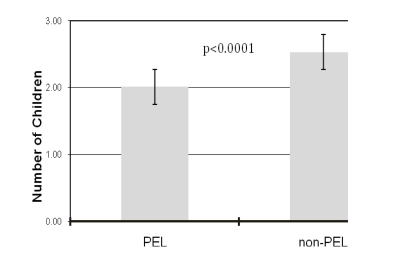
A number of leading theories of aging, namely The Antagonistic Pleiotropy Theory (Williams, 1957), The Disposable Soma Theory (Kirkwood, 1977) and most recently The Reproductive-Cell Cycle Theory (Bowen and Atwood, 2004, 2010) suggest a tradeoff between longevity and reproduction. While there has been an abundance of data linking longevity with reduced fertility in lower life forms, human data have been conflicting. We assessed this tradeoff in a cohort of genetically and socially homogenous Ashkenazi Jewish centenarians (average age ~100 years). As compared with an Ashkenazi cohort without exceptional longevity, our centenarians had fewer children (2.01 vs 2.53, p<0.0001), were older at first childbirth (28.0 vs 25.6, p<0.0001), and at last childbirth (32.4 vs 30.3, p<0.0001). The smaller number of children was observed for male and female centenarians alike. The lower number of children in both genders together with the pattern of delayed reproductive maturity is suggestive of constitutional factors that might enhance human life span at the expense of reduced reproductive ability.
一些主流的衰老理论,即拮抗基因多效性理论(威廉姆斯,1957年)、废弃体细胞理论(柯克伍德,1977年)以及最近的生殖细胞周期理论(鲍恩和阿特伍德,2004年、2010年)都表明,在寿命和繁殖之间存在一种权衡。虽然已有大量数据表明,在低等生物中寿命与生育力降低有关,但关于人类的数据却相互矛盾。我们在一组基因和社会背景均一的阿什肯纳兹犹太百岁老人(平均年龄约100岁)中评估了这种权衡。与没有特别长寿情况的阿什肯纳兹人群相比,我们的百岁老人子女较少(2.01个对2.53个,p<0.0001),首次生育年龄较大(28.0岁对25.6岁,p<0.0001),末次生育年龄也较大(32.4岁对30.3岁,p<0.0001)。男性和女性百岁老人的子女数量都较少。两性子女数量较少以及生殖成熟延迟的模式表明,可能存在一些体质因素,它们以降低生殖能力为代价来延长人类寿命。