Jonnal Ravi S, Kocaoglu Omer P, Wang Qiang, Lee Sangyeol, Miller Donald T
Program in Vision Science, Indiana University, 800 East Atwater Avenue, Bloomington, IN 47405, USA.
Biomed Opt Express. 2012 Jan 1;3(1):104-24. doi: 10.1364/BOE.3.000104. Epub 2011 Dec 13.
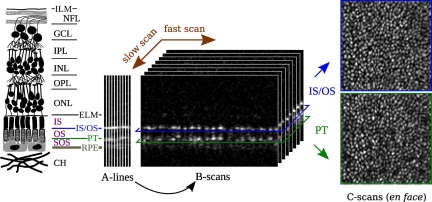
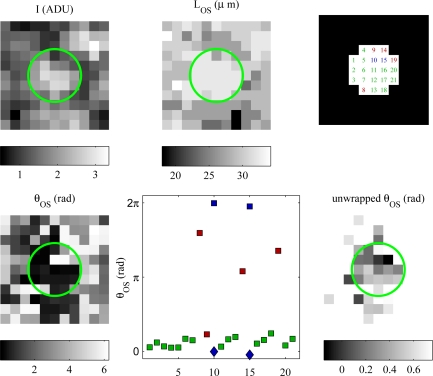
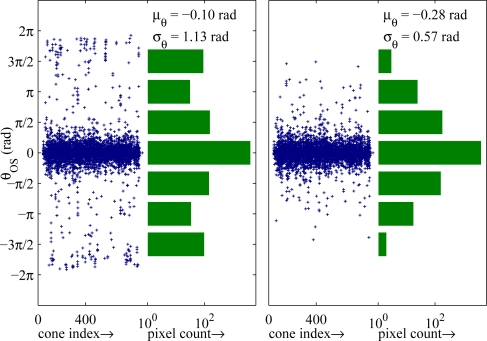
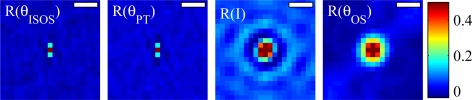
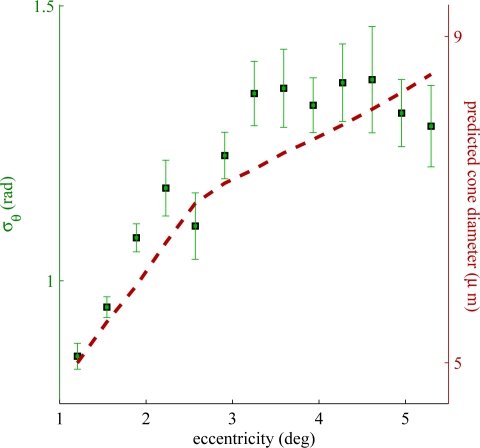
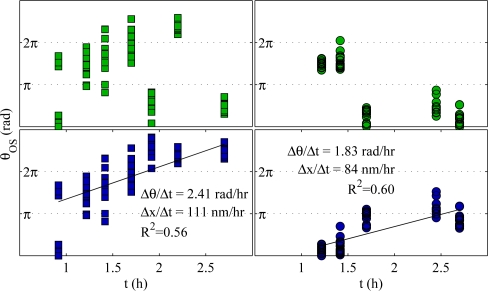
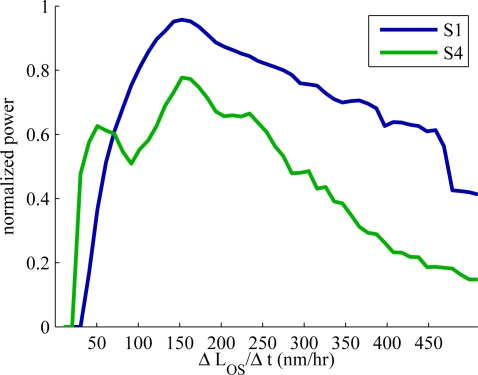
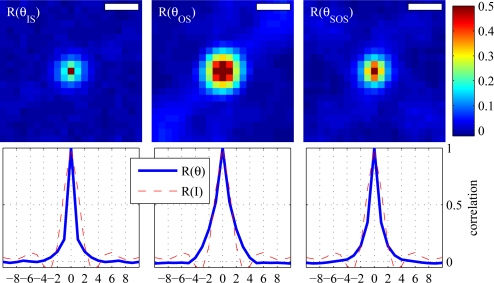
The cone photoreceptor's outer segment (OS) experiences changes in optical path length, both in response to visible stimuli and as a matter of its daily course of renewal and shedding. These changes are of interest, to quantify function in healthy cells and assess dysfunction in diseased ones. While optical coherence tomography (OCT), combined with adaptive optics (AO), has permitted unprecedented three-dimensional resolution in the living retina, it has not generally been able to measure these OS dynamics, whose scale is smaller than OCT's axial resolution of a few microns. A possible solution is to take advantage of the phase information encoded in the OCT signal. Phase-sensitive implementations of spectral-domain optical coherence tomography (SD-OCT) have been demonstrated, capable of resolving sample axial displacements much smaller than the imaging wavelength, but these have been limited to ex vivo samples. In this paper we present a novel technique for retrieving phase information from OCT volumes of the outer retina. The key component of our technique is quantification of phase differences within the retina. We provide a quantitative analysis of such phase information and show that-when combined with appropriate methods for filtering and unwrapping-it can improve the sensitivity to OS length change by more than an order of magnitude, down to 45 nm, slightly thicker than a single OS disc. We further show that phase sensitivity drops off with retinal eccentricity, and that the best location for phase imaging is close to the fovea. We apply the technique to the measurement of sub-resolution changes in the OS over matters of hours. Using custom software for registration and tracking, these microscopic changes are monitored in hundreds of cones over time. In two subjects, the OS was found to have average elongation rates of 150 nm/hr, values which agree with our previous findings.
视锥光感受器的外段(OS)在响应可见刺激以及日常更新和脱落过程中,其光程长度都会发生变化。这些变化对于量化健康细胞的功能以及评估患病细胞的功能障碍具有重要意义。虽然光学相干断层扫描(OCT)结合自适应光学(AO)技术在活体视网膜中实现了前所未有的三维分辨率,但通常无法测量这些OS动态变化,因为其尺度小于OCT几微米的轴向分辨率。一种可能的解决方案是利用OCT信号中编码的相位信息。光谱域光学相干断层扫描(SD - OCT)的相敏实现方式已得到证实,能够分辨比成像波长小得多的样本轴向位移,但这些仅限于离体样本。在本文中,我们提出了一种从视网膜外层的OCT体积中检索相位信息的新技术。我们技术的关键组成部分是对视网膜内相位差的量化。我们对这种相位信息进行了定量分析,并表明当与适当的滤波和解缠方法相结合时,它可以将对OS长度变化的灵敏度提高一个数量级以上,低至45纳米,略厚于单个OS盘。我们进一步表明,相位灵敏度随视网膜偏心率下降,并且相位成像的最佳位置靠近中央凹。我们将该技术应用于测量数小时内OS的亚分辨率变化。使用定制的配准和跟踪软件,随着时间的推移对数百个视锥细胞中的这些微观变化进行监测。在两名受试者中,发现OS的平均伸长率为150纳米/小时,这一数值与我们之前的研究结果一致。