Department of Radiology and BRIC, University of North Carolina at Chapel Hill, NC 27599, USA.
Neuroimage. 2012 Apr 2;60(2):1106-16. doi: 10.1016/j.neuroimage.2012.01.055. Epub 2012 Jan 14.
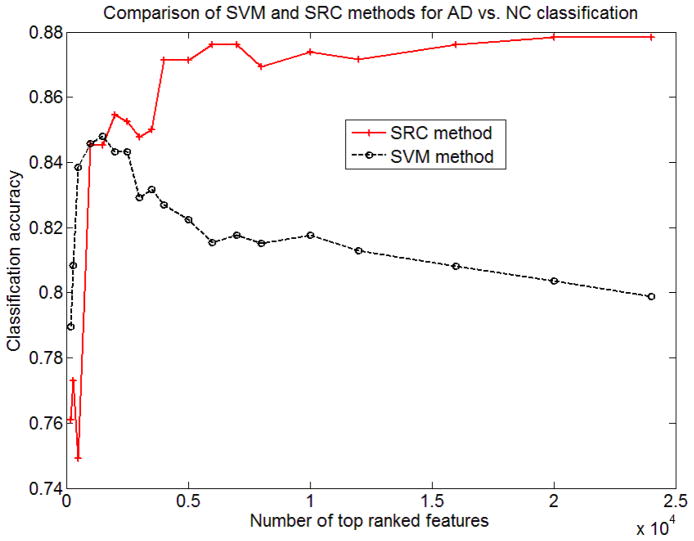
The high-dimensional pattern classification methods, e.g., support vector machines (SVM), have been widely investigated for analysis of structural and functional brain images (such as magnetic resonance imaging (MRI)) to assist the diagnosis of Alzheimer's disease (AD) including its prodromal stage, i.e., mild cognitive impairment (MCI). Most existing classification methods extract features from neuroimaging data and then construct a single classifier to perform classification. However, due to noise and small sample size of neuroimaging data, it is challenging to train only a global classifier that can be robust enough to achieve good classification performance. In this paper, instead of building a single global classifier, we propose a local patch-based subspace ensemble method which builds multiple individual classifiers based on different subsets of local patches and then combines them for more accurate and robust classification. Specifically, to capture the local spatial consistency, each brain image is partitioned into a number of local patches and a subset of patches is randomly selected from the patch pool to build a weak classifier. Here, the sparse representation-based classifier (SRC) method, which has shown to be effective for classification of image data (e.g., face), is used to construct each weak classifier. Then, multiple weak classifiers are combined to make the final decision. We evaluate our method on 652 subjects (including 198 AD patients, 225 MCI and 229 normal controls) from Alzheimer's Disease Neuroimaging Initiative (ADNI) database using MR images. The experimental results show that our method achieves an accuracy of 90.8% and an area under the ROC curve (AUC) of 94.86% for AD classification and an accuracy of 87.85% and an AUC of 92.90% for MCI classification, respectively, demonstrating a very promising performance of our method compared with the state-of-the-art methods for AD/MCI classification using MR images.
高维模式分类方法,例如支持向量机(SVM),已被广泛应用于分析结构和功能脑图像(如磁共振成像(MRI)),以辅助阿尔茨海默病(AD)的诊断,包括其前驱期,即轻度认知障碍(MCI)。大多数现有的分类方法从神经影像学数据中提取特征,然后构建单个分类器来进行分类。然而,由于神经影像学数据的噪声和小样本量,训练一个能够稳健地实现良好分类性能的全局分类器具有挑战性。在本文中,我们提出了一种基于局部补丁的子空间集成方法,而不是构建单个全局分类器,该方法基于不同的局部补丁子集构建多个单独的分类器,然后将它们组合起来进行更准确和稳健的分类。具体来说,为了捕获局部空间一致性,将每个脑图像划分为多个局部补丁,并从补丁池中随机选择一个补丁子集来构建弱分类器。这里,使用基于稀疏表示的分类器(SRC)方法来构建每个弱分类器,该方法已被证明对图像数据(例如人脸)的分类有效。然后,将多个弱分类器组合起来做出最终决策。我们使用来自阿尔茨海默病神经影像学倡议(ADNI)数据库的 652 名受试者(包括 198 名 AD 患者、225 名 MCI 和 229 名正常对照)的 MR 图像来评估我们的方法。实验结果表明,我们的方法在 AD 分类中达到了 90.8%的准确率和 94.86%的 ROC 曲线下面积(AUC),在 MCI 分类中达到了 87.85%的准确率和 92.90%的 AUC,与使用 MR 图像进行 AD/MCI 分类的最新方法相比,表现出非常有前景的性能。