Traffic and Environmental Psychology Group, Neuropsychology, University of Groningen, Groningen, The Netherlands.
PLoS One. 2012;7(1):e29857. doi: 10.1371/journal.pone.0029857. Epub 2012 Jan 18.
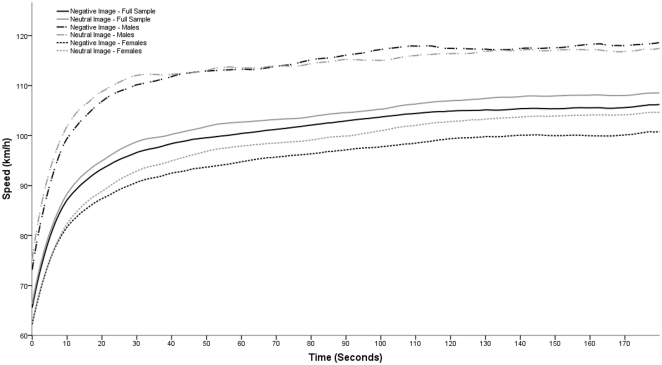
Many theories of driver behaviour suggest that unconscious or implicit emotions play a functional role in the shaping and control of behaviour. This has not been experimentally tested however. Therefore, in this study the effects of emotive masked images on driver behaviour were examined. While driving a simulator, participants were repeatedly exposed to negative or neutral emotionally laden target images that were sandwich masked by emotionally neutral images. These images were encountered across two different trials each of which consisted of 3-4 minutes of driving on a rural road. The results indicate an effect of the negative target images primarily in reducing the extent of familiarisation occurring between the first and second experimental drives. This is evident in a reduced decrease in heart rate and a reduced increase in high band heart rate variability and actual travelling speed from the first to second drives if the negative target image was presented in the second drive. In addition to these findings there was no clear effect of the target image on subjective ratings of effort or feelings of risk. There was however an effect of gender, with the majority of the effects found in the study being limited to the larger female dataset. These findings suggest that unconscious or implicit emotional stimuli may well influence driver behaviour without explicit awareness.
许多驾驶员行为理论表明,无意识或内隐情绪在行为的形成和控制中起着功能作用。然而,这尚未经过实验验证。因此,在这项研究中,考察了情感掩蔽图像对驾驶员行为的影响。在驾驶模拟器时,参与者反复暴露于被情感中性图像掩蔽的负性或中性情绪负荷目标图像下。这些图像在两个不同的试验中出现,每个试验都包含在乡村道路上驾驶 3-4 分钟。结果表明,负性目标图像的影响主要在于减少第一和第二实验驾驶之间发生的熟悉度。这在心率的降低幅度减小,以及从第一到第二驾驶时高波段心率变异性和实际行驶速度的增加幅度减小方面表现明显,如果在第二驾驶中呈现了负性目标图像。除了这些发现外,目标图像对努力感或风险感的主观评价没有明显影响。但是,存在性别效应,研究中发现的大多数效应仅限于较大的女性数据集。这些发现表明,无意识或内隐的情绪刺激可能会影响驾驶员行为,而无需明确的意识。