Department of Chemistry and International Institute for Nanotechnology, Northwestern University, 2145 Sheridan Road, Evanston, Illinois 60208-3113, USA.
Anal Chem. 2012 Feb 21;84(4):2062-6. doi: 10.1021/ac202648w. Epub 2012 Jan 30.
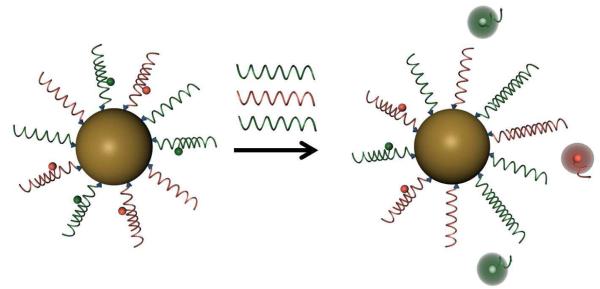
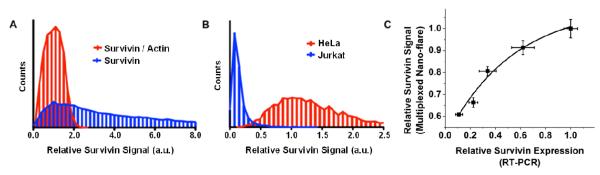
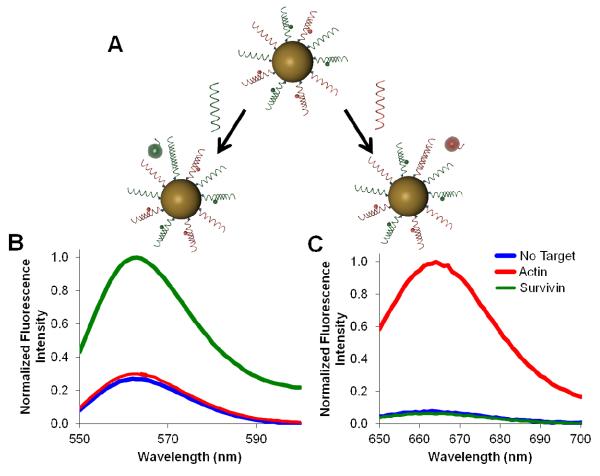
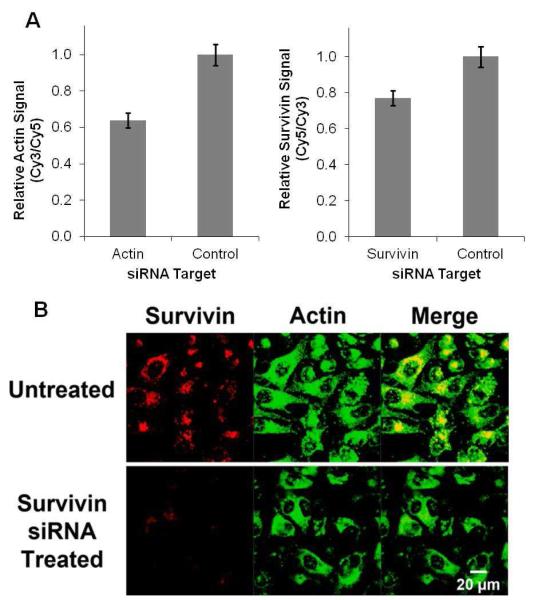
We report the development of the multiplexed nanoflare, a nanoparticle agent that is capable of simultaneously detecting two distinct mRNA targets inside a living cell. These probes are spherical nucleic acid (SNA) gold nanoparticle (Au NP) conjugates consisting of densely packed and highly oriented oligonucleotide sequences, many of which are hybridized to a reporter with a distinct fluorophore label and each complementary to its corresponding mRNA target. When multiplexed nanoflares are exposed to their targets, they provide a sequence specific signal in both extra- and intracellular environments. Importantly, one of the targets can be used as an internal control, improving detection by accounting for cell-to-cell variations in nanoparticle uptake and background. Compared to single-component nanoflares, these structures allow one to determine more precisely relative mRNA levels in individual cells, improving cell sorting and quantification.
我们报告了多重纳荧光团的发展,这是一种纳米颗粒试剂,能够在活细胞内同时检测两个不同的 mRNA 靶标。这些探针是由密集堆积和高度定向的寡核苷酸序列组成的球形核酸 (SNA) 金纳米颗粒 (AuNP) 缀合物,其中许多与具有独特荧光标记的报告分子杂交,并且每个探针都与其相应的 mRNA 靶标互补。当多重纳荧光团暴露于它们的靶标时,它们在细胞内外环境中提供了一种序列特异性信号。重要的是,其中一个靶标可用作内参,通过考虑到纳米颗粒摄取和背景的细胞间变化,提高了检测的准确性。与单组分纳荧光团相比,这些结构允许更精确地确定单个细胞中相对 mRNA 水平,从而改善细胞分选和定量。