London School of Hygiene and Tropical Medicine, London, United Kingdom.
PLoS One. 2012;7(2):e31409. doi: 10.1371/journal.pone.0031409. Epub 2012 Feb 20.
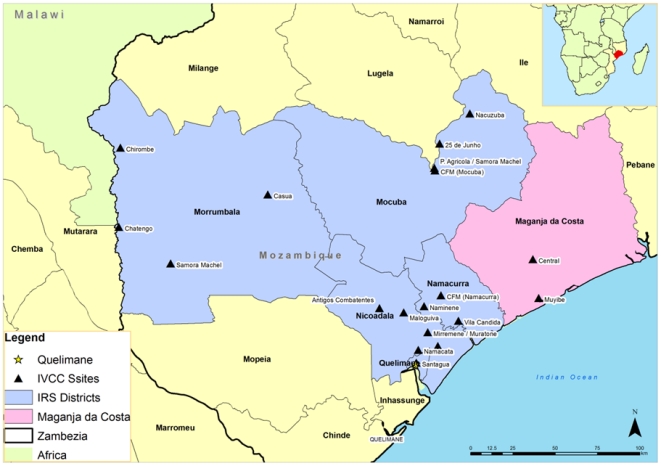
African countries are scaling up malaria interventions, especially insecticide treated nets (ITN) and indoor residual spraying (IRS), for which ambitious coverage targets have been set. In spite of these efforts infection prevalence remains high in many parts of the continent. This study investigated risk factors for malaria infection in children using three malaria indicator surveys from Zambezia province, Mozambique. The impact of IRS and ITNs, the effects of keeping farm animals and of the construction material of roofs of houses and other potential risk factors associated with malaria infection in children were assessed.
Cross-sectional community-based surveys were conducted in October of 2006, 2007 and 2008. A total of 8338 children (ages 1-15 years) from 2748 households were included in the study. All children were screened for malaria by rapid diagnostic tests. Caregiver interviews were used to assess household demographic and wealth characteristics and ITN and IRS coverage. Associations between malaria infection, vector control interventions and potential risk factors were assessed.
Overall, the prevalence of malaria infection was 47.8% (95%CI: 38.7%-57.1%) in children 1-15 years of age, less than a quarter of children (23.1%, 95%CI: 19.1%-27.6%) were sleeping under ITN and almost two thirds were living in IRS treated houses (coverage 65.4%, 95%CI: 51.5%-77.0%). Protective factors that were independently associated with malaria infection were: sleeping in an IRS house without sleeping under ITN (Odds Ratio (OR)= 0.6; 95%CI: 0.4-0.9); additional protection due to sleeping under ITN in an IRS treated house (OR = 0.5; 95%CI: 0.3-0.7) versus sleeping in an unsprayed house without a ITN; and parental education (primary/secondary: OR = 0.6; 95%CI: 0.5-0.7) versus parents with no education. Increased risk of infection was associated with: current fever (OR = 1.2; 95%CI: 1.0-1.5) versus no fever; pig keeping (OR = 3.2; 95%CI: 2.1-4.9) versus not keeping pigs; living in houses with a grass roof (OR = 1.7; 95%CI: 1.3-2.4) versus other roofing materials and bigger household size (8-15 people: OR = 1.6; 95%CI: 1.3-2.1) versus small households (1-4 persons).
Malaria infection among children under 15 years of age in Zambezia remained high but conventional malaria vector control methods, in particular IRS, provided effective means of protection. Household ownership of farm animals, particularly pigs, and living in houses with a grass roof were independently associated with increased risk of infection, even after allowing for household wealth. To reduce the burden of malaria, national control programs need to ensure high coverage of effective IRS and promote the use of ITNs, particularly in households with elevated risks of infection, such as those keeping farm animals, and those with grass roofs.
非洲国家正在扩大疟疾干预措施,特别是杀虫剂处理过的蚊帐(ITN)和室内残留喷洒(IRS),为此设定了雄心勃勃的覆盖目标。尽管做出了这些努力,该大陆许多地区的感染率仍然很高。本研究利用莫桑比克赞比西亚省的三项疟疾指标调查,研究了儿童疟疾感染的风险因素。评估了 IRS 和 ITN 的影响、饲养农场动物的影响以及与儿童疟疾感染相关的其他潜在风险因素,如房屋屋顶的建筑材料。
2006 年 10 月、2007 年和 2008 年进行了基于社区的横断面调查。共有 8338 名(年龄 1-15 岁)来自 2748 户家庭的儿童参加了这项研究。所有儿童均通过快速诊断测试筛查疟疾。通过访谈了解家庭人口统计学和财富特征以及 ITN 和 IRS 的覆盖情况。评估了疟疾感染、蚊虫控制干预措施和潜在风险因素之间的关联。
总的来说,1-15 岁儿童疟疾感染的患病率为 47.8%(95%CI:38.7%-57.1%),不到四分之一的儿童(23.1%,95%CI:19.1%-27.6%)睡在 ITN 下,近三分之二的儿童生活在 IRS 处理过的房屋中(覆盖率为 65.4%,95%CI:51.5%-77.0%)。与疟疾感染独立相关的保护因素有:睡在未喷洒 ITN 的 IRS 房内(比值比(OR)=0.6;95%CI:0.4-0.9);睡在 IRS 处理过的房屋内且使用 ITN(OR=0.5;95%CI:0.3-0.7)比睡在未喷洒 ITN 的房屋内更有保护作用;父母教育(小学/中学:OR=0.6;95%CI:0.5-0.7)比父母没有教育。感染风险增加的因素有:当前发热(OR=1.2;95%CI:1.0-1.5)比无发热;养猪(OR=3.2;95%CI:2.1-4.9)比不养猪;住在草屋顶的房屋(OR=1.7;95%CI:1.3-2.4)比其他屋顶材料和更大的家庭规模(8-15 人:OR=1.6;95%CI:1.3-2.1)比小家庭(1-4 人)。
赞比西亚省 15 岁以下儿童的疟疾感染仍然很高,但传统的疟疾媒介控制方法,特别是 IRS,提供了有效的保护手段。家庭拥有农场动物,特别是猪,以及居住在草屋顶房屋,与感染风险增加独立相关,即使考虑到家庭财富也是如此。为了减轻疟疾负担,国家控制规划需要确保 IRS 的高覆盖率并促进 ITN 的使用,特别是在那些感染风险较高的家庭,如饲养农场动物的家庭和草屋顶房屋的家庭。
