Department of Fish and Wildlife Conservation, Virginia Tech, Blacksburg, Virginia, United States of America.
PLoS One. 2012;7(3):e32842. doi: 10.1371/journal.pone.0032842. Epub 2012 Mar 8.
Brucellosis is a zoonotic disease of global importance infecting humans, domestic animals, and wildlife. Little is known about the epidemiology and persistence of brucellosis in wildlife in Southern Africa, particularly in Botswana.
Archived wildlife samples from Botswana (1995-2000) were screened with the Rose Bengal Test (RBT) and fluorescence polarization assay (FPA) and included the African buffalo (247), bushbuck (1), eland (5), elephant (25), gemsbok (1), giraffe (9), hartebeest (12), impala (171), kudu (27), red lechwe (10), reedbuck (1), rhino (2), springbok (5), steenbok (2), warthog (24), waterbuck (1), wildebeest (33), honey badger (1), lion (43), and zebra (21). Human case data were extracted from government annual health reports (1974-2006).
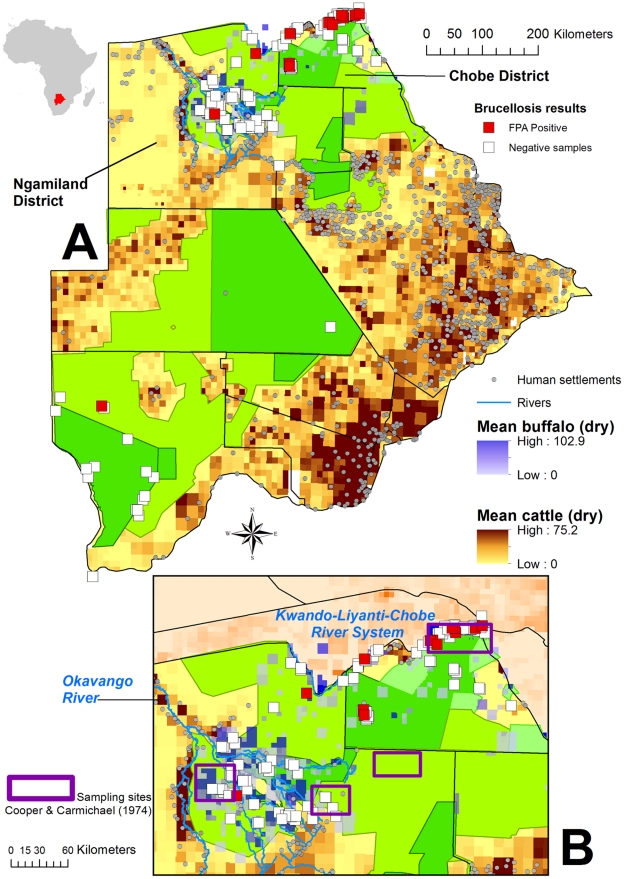
Only buffalo (6%, 95% CI 3.04%-8.96%) and giraffe (11%, 95% CI 0-38.43%) were confirmed seropositive on both tests. Seropositive buffalo were widely distributed across the buffalo range where cattle density was low. Human infections were reported in low numbers with most infections (46%) occurring in children (<14 years old) and no cases were reported among people working in the agricultural sector.
Low seroprevalence of brucellosis in Botswana buffalo in a previous study in 1974 and again in this survey suggests an endemic status of the disease in this species. Buffalo, a preferred source of bush meat, is utilized both legally and illegally in Botswana. Household meat processing practices can provide widespread pathogen exposure risk to family members and the community, identifying an important source of zoonotic pathogen transmission potential. Although brucellosis may be controlled in livestock populations, public health officials need to be alert to the possibility of human infections arising from the use of bush meat. This study illustrates the need for a unified approach in infectious disease research that includes consideration of both domestic and wildlife sources of infection in determining public health risks from zoonotic disease invasions.
布鲁氏菌病是一种具有全球重要性的人畜共患病,感染人类、家畜和野生动物。对于南部非洲野生动物中布鲁氏菌病的流行病学和持续性,特别是在博茨瓦纳,人们知之甚少。
利用虎红平板凝集试验(RBT)和荧光偏振试验(FPA)对博茨瓦纳(1995-2000 年)的存档野生动物样本进行筛查,包括非洲野牛(247 只)、狷羚(1 只)、大羚羊(5 只)、大象(25 只)、大羚羊(1 只)、长颈鹿(9 只)、黑斑羚(12 只)、大角斑羚(171 只)、马羚(27 只)、红鹿(10 只)、弯角大羚羊(1 只)、跳羚(5 只)、南非剑羚(5 只)、岩羚(2 只)、疣猪(24 只)、水羚(1 只)、角马(33 只)、蜜獾(1 只)、狮子(43 只)和斑马(21 只)。从政府年度健康报告(1974-2006 年)中提取人类病例数据。
只有水牛(6%,95%置信区间 3.04%-8.96%)和长颈鹿(11%,95%置信区间 0-38.43%)在两种检测方法上均呈血清阳性。血清阳性水牛广泛分布在牛密度较低的水牛分布区内。人类感染的报告数量较少,大多数感染(46%)发生在儿童(<14 岁)中,没有报告在农业部门工作的人感染。
1974 年的一项先前研究和本调查再次表明,博茨瓦纳水牛的布鲁氏菌病血清阳性率较低,这表明该疾病在该物种中呈地方性流行。水牛是丛林肉的首选来源,在博茨瓦纳既合法又非法地被利用。家庭肉类加工实践可能会使家庭成员和社区面临广泛的病原体暴露风险,这是人畜共患病病原体传播潜力的一个重要来源。尽管布鲁氏菌病可能在牲畜种群中得到控制,但公共卫生官员需要警惕因食用丛林肉而导致人类感染的可能性。本研究说明了在传染病研究中需要采取统一的方法,包括考虑国内和野生动物来源的感染,以确定人畜共患病入侵对公共卫生的风险。