Department of Epidemiology, Johns Hopkins Bloomberg School of Public Health, Baltimore, Maryland, USA.
Diabetes Care. 2012 May;35(5):1031-7. doi: 10.2337/dc11-2248. Epub 2012 Mar 19.
Diabetes and hypertension often co-occur and share risk factors. Hypertension is known to predict diabetes. However, hyperglycemia also may be independently associated with future development of hypertension. We investigated glycated hemoglobin (HbA(1c)) as a predictor of incident hypertension.
We conducted a prospective analysis of 9,603 middle-aged participants in the Atherosclerosis Risk in Communities Study without hypertension at baseline. Using Cox proportional hazards models, we estimated the association between HbA(1c) at baseline and incident hypertension by two definitions 1) self-reported hypertension during a maximum of 18 years of follow-up and 2) measured blood pressure or hypertension medication use at clinic visits for a maximum of 9 years of follow-up.
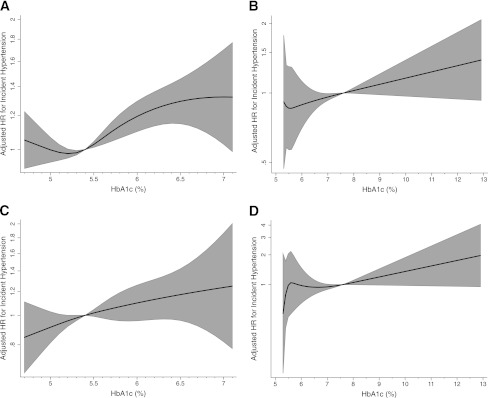
We observed 4,800 self-reported and 1,670 visit-based hypertension cases among those without diagnosed diabetes at baseline. Among those with diagnosed diabetes at baseline, we observed 377 self-reported and 119 visit-based hypertension cases. Higher baseline HbA(1c) was associated with an increased risk of hypertension in subjects with and without diabetes. Compared with nondiabetic adults with HbA(1c) <5.7%, HbA(1c) in the prediabetic range (5.7-6.4%) was independently associated with incident self-reported hypertension (hazard ratio 1.14 [95% CI 1.06-1.23]) and visit-detected hypertension (1.17 [1.03-1.33]).
We observed that individuals with elevated HbA(1c), even without a prior diabetes diagnosis, are at increased risk of hypertension. HbA(1c) is a known predictor of incident heart disease and stroke. Our results suggest that the association of HbA(1c) with cardiovascular risk may be partially mediated by the development of hypertension.
糖尿病和高血压常同时发生,并具有共同的危险因素。高血压是预测糖尿病的指标。然而,高血糖也可能与未来高血压的发生独立相关。我们研究了糖化血红蛋白(HbA1c)作为预测高血压发生的指标。
我们对基线时无高血压的社区动脉粥样硬化风险研究(Atherosclerosis Risk in Communities Study)中的 9603 名中年参与者进行了前瞻性分析。我们使用 Cox 比例风险模型,根据以下两种定义来估计基线时 HbA1c 与高血压发生之间的关联:1)在最大 18 年的随访期间报告高血压;2)在最大 9 年的随访期间,通过就诊时的血压或高血压药物使用情况来测量。
在基线时无诊断为糖尿病的人群中,我们观察到 4800 例自我报告的高血压病例和 1670 例就诊时确诊的高血压病例。在基线时已诊断为糖尿病的人群中,我们观察到 377 例自我报告的高血压病例和 119 例就诊时确诊的高血压病例。较高的基线 HbA1c 与患有和不患有糖尿病的人群高血压风险增加相关。与 HbA1c<5.7%的非糖尿病成年人相比,HbA1c 在糖尿病前期范围(5.7%-6.4%)与自我报告的高血压(危险比 1.14[95%CI 1.06-1.23])和就诊时发现的高血压(1.17[1.03-1.33])的发生独立相关。
我们发现,即使没有先前的糖尿病诊断,HbA1c 升高的个体患高血压的风险也会增加。HbA1c 是预测新发心脏病和中风的指标。我们的结果表明,HbA1c 与心血管风险的关联可能部分是通过高血压的发展来介导的。