Fromm-Dornieden Carolin, von der Heyde Silvia, Lytovchenko Oleksandr, Salinas-Riester Gabriela, Brenig Bertram, Beissbarth Tim, Baumgartner Bernhard G
Institute of Veterinary Medicine, University of Göttingen, Göttingen, Germany.
BMC Mol Biol. 2012 Mar 21;13:9. doi: 10.1186/1471-2199-13-9.
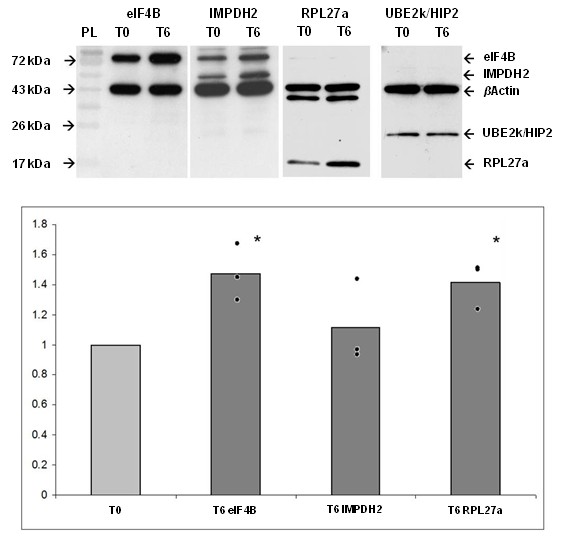
Control of translation allows for rapid adaptation of the cell to stimuli, rather than the slower transcriptional control. We presume that translational control is an essential process in the control of adipogenesis, especially in the first hours after hormonal stimulation. 3T3-L1 preadipocytes were cultured to confluency and adipogenesis was induced by standard protocols using a hormonal cocktail. Cells were harvested before and 6 hours after hormonal induction. mRNAs attached to ribosomes (polysomal mRNAs) were separated from unbound mRNAs by velocity sedimentation. Pools of polysomal and unbound mRNA fractions were analyzed by microarray analysis. Changes in relative abundance in unbound and polysomal mRNA pools were calculated to detect putative changes in translational activity. Changes of expression levels of selected genes were verified by qPCR and Western blotting.
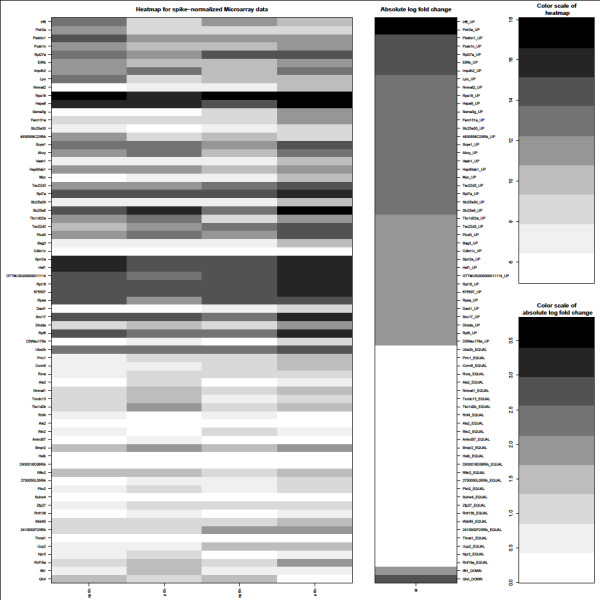
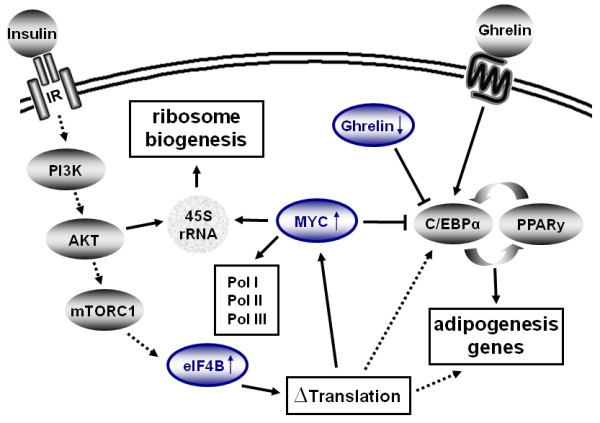
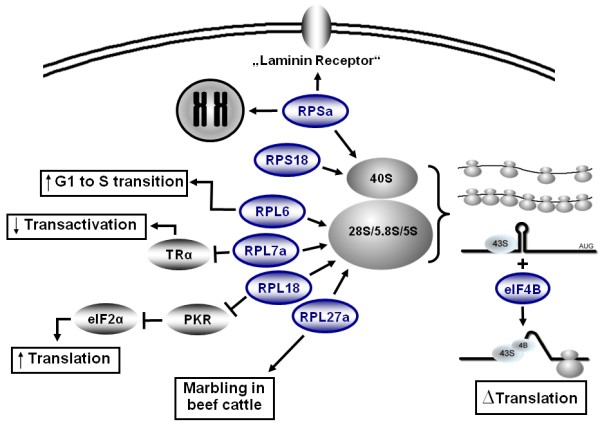
We identified 43 genes that shifted towards the polysomal fraction (up-regulated) and 2 genes that shifted towards free mRNA fraction (down-regulated). Interestingly, we found Ghrelin to be down-regulated. Up-regulated genes comprise factors that are nucleic acid binding (eIF4B, HSF1, IRF6, MYC, POLR2a, RPL18, RPL27a, RPL6, RPL7a, RPS18, RPSa, TSC22d3), form part of ribosomes (RPL18, RPL27a, RPL6, RPL7a, RPS18, RPSa), act on the regulation of translation (eIF4B) or transcription (HSF1, IRF6, MYC, TSC22d3). Others act as chaperones (BAG3, HSPA8, HSP90ab1) or in other metabolic or signals transducing processes.
We conclude that a moderate reorganisation of the functionality of the ribosomal machinery and translational activity are very important steps for growth and gene expression control in the initial phase of adipogenesis.
翻译控制能够使细胞快速适应刺激,而非较慢的转录控制。我们推测翻译控制是脂肪生成控制中的一个重要过程,尤其是在激素刺激后的最初几个小时。将3T3-L1前脂肪细胞培养至汇合状态,并使用激素混合物通过标准方案诱导脂肪生成。在激素诱导前和诱导后6小时收获细胞。通过速度沉降将附着在核糖体上的mRNA(多聚核糖体mRNA)与未结合的mRNA分离。通过微阵列分析对多聚核糖体和未结合mRNA组分池进行分析。计算未结合和多聚核糖体mRNA池相对丰度的变化,以检测翻译活性的假定变化。通过qPCR和蛋白质印迹法验证所选基因表达水平的变化。
我们鉴定出43个向多聚核糖体组分转移(上调)的基因和2个向游离mRNA组分转移(下调)的基因。有趣的是,我们发现胃饥饿素被下调。上调的基因包括核酸结合因子(eIF4B、HSF1、IRF6、MYC、POLR2a、RPL18、RPL27a、RPL6、RPL7a、RPS18、RPSa、TSC22d3)、核糖体组成部分(RPL18、RPL27a、RPL6、RPL7a、RPS18、RPSa)、作用于翻译调控(eIF4B)或转录调控(HSF1、IRF6、MYC、TSC22d3)的因子。其他基因充当伴侣蛋白(BAG3、HSPA8、HSP90ab1)或参与其他代谢或信号转导过程。
我们得出结论,核糖体机制功能的适度重组和翻译活性是脂肪生成初始阶段生长和基因表达控制的非常重要的步骤。