Department of Mechanical Engineering, Inha University, 253 Yonghyun-dong, Nam-Ku, Incheon, 402-751, Korea.
Sensors (Basel). 2009;9(8):6046-57. doi: 10.3390/s90806046. Epub 2009 Jul 29.
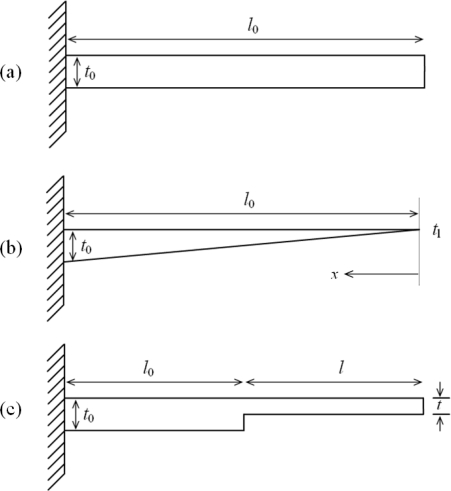
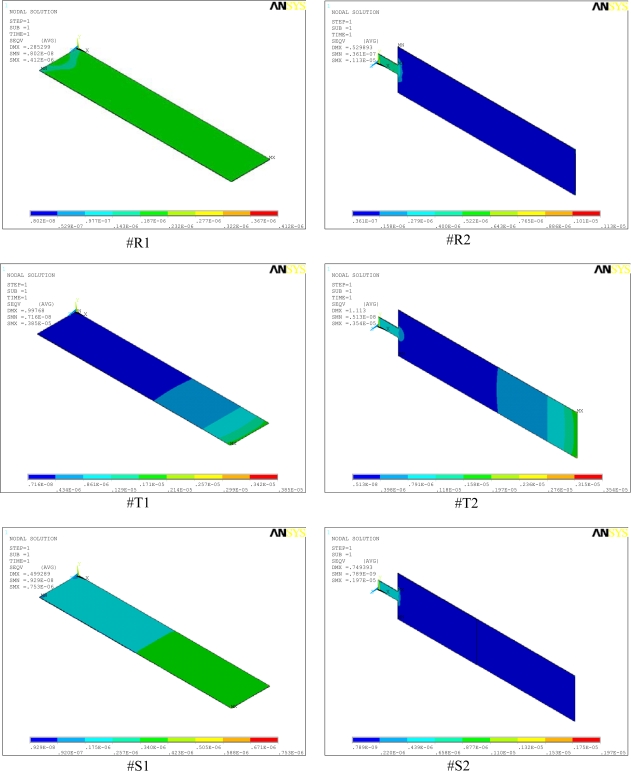
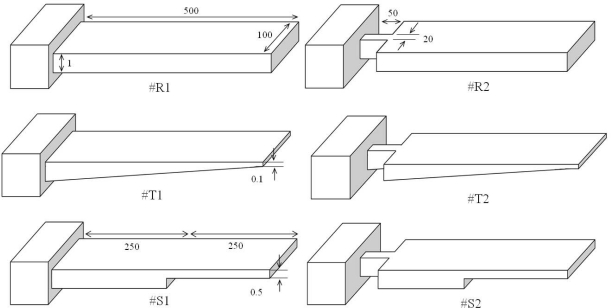
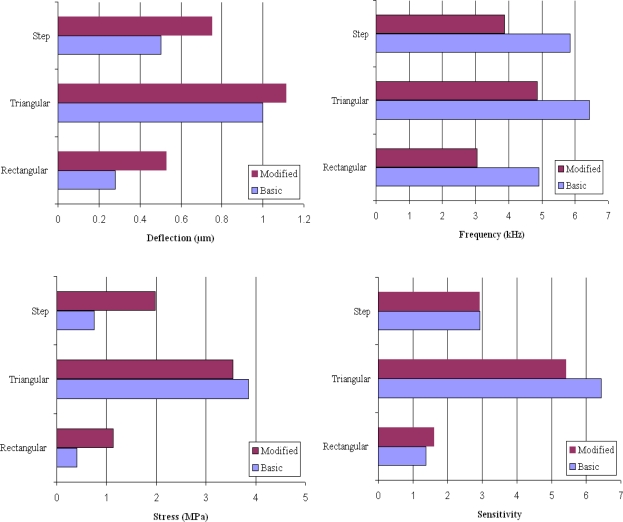
This study presents the deflection, resonant frequency and stress results of rectangular, triangular, and step profile microcantilevers subject to surface stress. These cantilevers can be used as the sensing element in microcantilever biosensors. To increase the overall sensitivity of microcantilever biosensors, both the deflection and the resonant frequency of the cantilever should be increased. The effect of the cantilever profile change and the cantilever cross-section shape change is first investigated separately and then together. A finite element code ANSYS Multiphysics is used and solid finite elements cantilever models are solved. A surface stress of 0.05 N/m was applied to the top surface of the cantilevers. The cantilevers are made of silicon with elastic modulus 130 GPa and Poisson's ratio 0.28. To show the conformity of this study, the numerical results are compared against their analytical ones. Results show that triangular and step cantilevers have better deflection and frequency characteristics than rectangular ones.
本研究提出了受表面应力影响的矩形、三角形和阶梯型微悬臂梁的挠度、共振频率和应力结果。这些微悬臂梁可用作微悬臂梁生物传感器的传感元件。为了提高微悬臂梁生物传感器的整体灵敏度,应该增加微悬臂梁的挠度和共振频率。首先分别研究了微悬臂梁轮廓变化和微悬臂梁横截面形状变化的影响,然后一起研究了它们的影响。使用有限元代码 ANSYS Multiphysics 并求解了实体有限元微悬臂梁模型。在微悬臂梁的顶表面施加了 0.05 N/m 的表面应力。微悬臂梁由弹性模量为 130 GPa、泊松比为 0.28 的硅制成。为了展示本研究的一致性,将数值结果与分析结果进行了比较。结果表明,与矩形微悬臂梁相比,三角形和阶梯型微悬臂梁具有更好的挠度和频率特性。