Department of Mechanical Engineering, National Chung Hsing University, Taichung, 402 Taiwan; E-Mail:
Sensors (Basel). 2009;9(8):6219-31. doi: 10.3390/s90806219. Epub 2009 Aug 6.
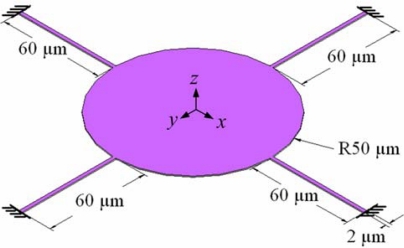
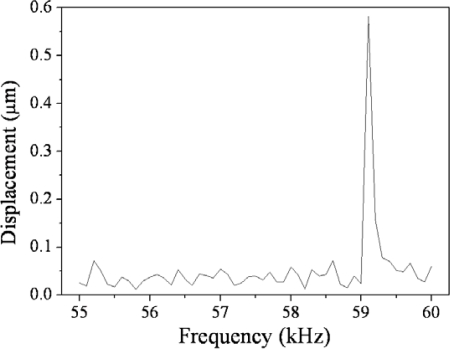
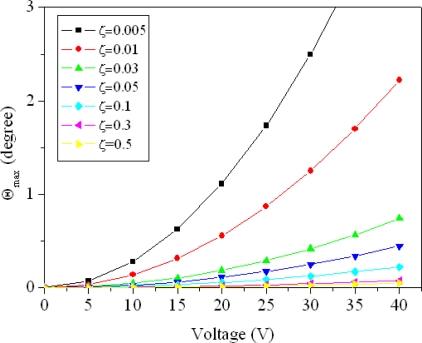
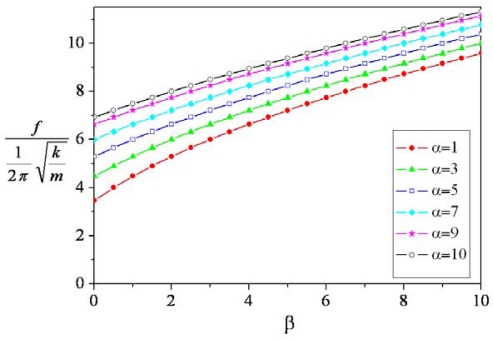
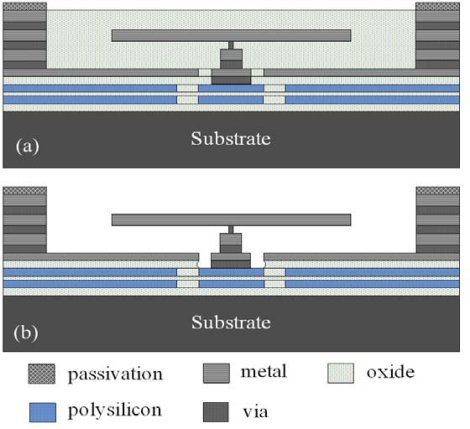
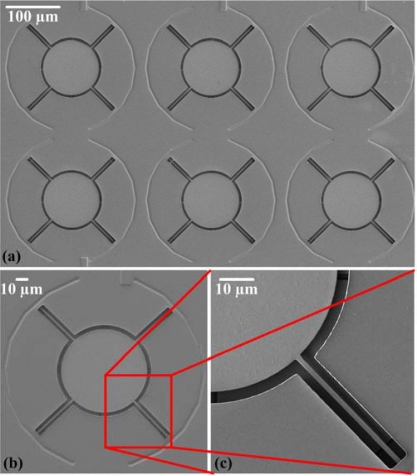
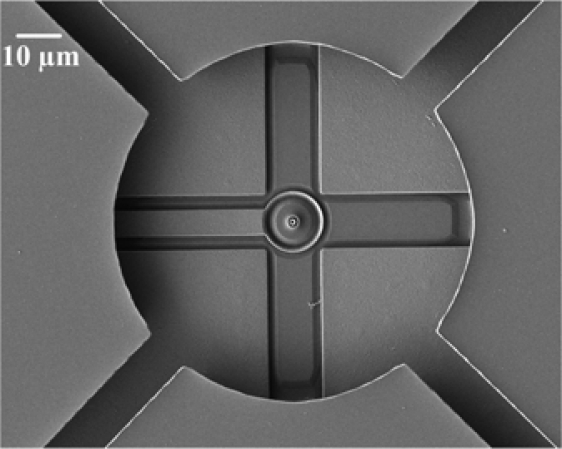
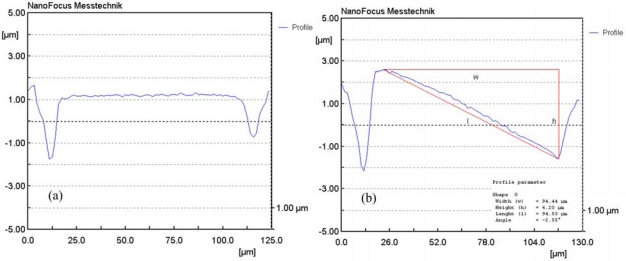
In this study we used the commercial 0.35 μm CMOS (complementary metal oxide semiconductor) process and simple maskless post-processing to fabricate an array of micromirrors exhibiting high natural frequency. The micromirrors were manufactured from aluminum; the sacrificial layer was silicon dioxide. Because we fabricated the micromirror arrays using the standard CMOS process, they have the potential to be integrated with circuitry on a chip. For post-processing we used an etchant to remove the sacrificial layer and thereby suspend the micromirrors. The micromirror array contained a circular membrane and four fixed beams set symmetrically around and below the circular mirror; these four fan-shaped electrodes controlled the tilting of the micromirror. A MEMS (microelectromechanical system) motion analysis system and a confocal 3D-surface topography were used to characterize the properties and configuration of the micromirror array. Each micromirror could be rotated in four independent directions. Experimentally, we found that the micromirror had a tilting angle of about 2.55° when applying a driving voltage of 40 V. The natural frequency of the micromirrors was 59.1 kHz.
在这项研究中,我们使用商业 0.35 μm CMOS(互补金属氧化物半导体)工艺和简单的无掩模后处理来制造具有高自然频率的微镜阵列。微镜由铝制成;牺牲层为二氧化硅。由于我们使用标准的 CMOS 工艺制造微镜阵列,它们有可能与芯片上的电路集成。在后处理中,我们使用蚀刻剂去除牺牲层,从而使微镜悬浮。微镜阵列包含一个圆形膜和四个固定梁,它们对称地设置在圆形镜的周围和下方;这四个扇形电极控制微镜的倾斜。使用 MEMS(微机电系统)运动分析系统和共焦 3D 表面形貌来表征微镜阵列的特性和结构。每个微镜可以在四个独立的方向上旋转。实验中,我们发现当施加 40 V 的驱动电压时,微镜的倾斜角度约为 2.55°。微镜的自然频率为 59.1 kHz。