Colegio de Postgraduados, Montecillo, Edo. de México, Mexico.
Theor Appl Genet. 2012 Aug;125(4):759-71. doi: 10.1007/s00122-012-1868-9. Epub 2012 May 8.
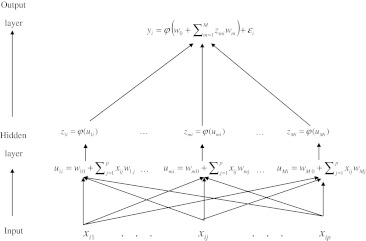
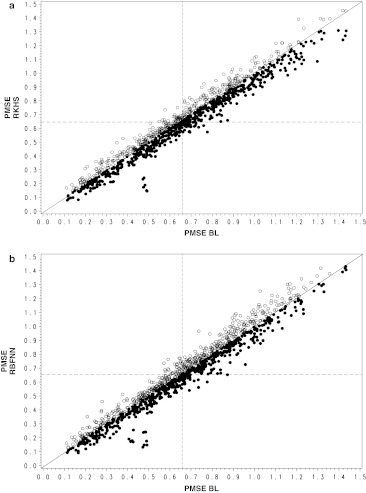
The availability of high density panels of molecular markers has prompted the adoption of genomic selection (GS) methods in animal and plant breeding. In GS, parametric, semi-parametric and non-parametric regressions models are used for predicting quantitative traits. This article shows how to use neural networks with radial basis functions (RBFs) for prediction with dense molecular markers. We illustrate the use of the linear Bayesian LASSO regression model and of two non-linear regression models, reproducing kernel Hilbert spaces (RKHS) regression and radial basis function neural networks (RBFNN) on simulated data and real maize lines genotyped with 55,000 markers and evaluated for several trait-environment combinations. The empirical results of this study indicated that the three models showed similar overall prediction accuracy, with a slight and consistent superiority of RKHS and RBFNN over the additive Bayesian LASSO model. Results from the simulated data indicate that RKHS and RBFNN models captured epistatic effects; however, adding non-signal (redundant) predictors (interaction between markers) can adversely affect the predictive accuracy of the non-linear regression models.
高密度分子标记面板的可用性促使人们在动植物育种中采用基因组选择(GS)方法。在 GS 中,参数、半参数和非参数回归模型用于预测数量性状。本文展示了如何使用具有径向基函数(RBF)的神经网络进行密集分子标记的预测。我们在模拟数据和用 55000 个标记进行基因型分析并针对几个性状-环境组合进行评估的真实玉米品系上,说明了线性贝叶斯 LASSO 回归模型以及两种非线性回归模型(再生核希尔伯特空间(RKHS)回归和径向基函数神经网络(RBFNN))的使用。这项研究的实证结果表明,这三个模型的整体预测准确性相似,RKHS 和 RBFNN 模型略微且一致地优于加性贝叶斯 LASSO 模型。模拟数据的结果表明,RKHS 和 RBFNN 模型捕获了上位效应;然而,添加非信号(冗余)预测因子(标记之间的相互作用)可能会对非线性回归模型的预测准确性产生不利影响。