Entwicklungs- und Molekularbiologie der Pflanzen, Heinrich-Heine-Universität Düsseldorf, Germany.
Front Plant Sci. 2012 Feb 28;3:38. doi: 10.3389/fpls.2012.00038. eCollection 2012.
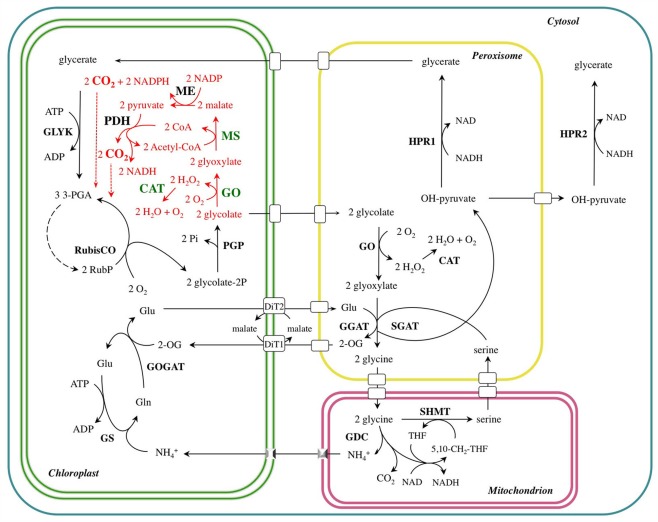
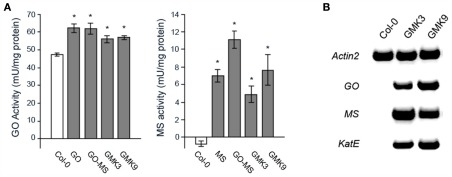
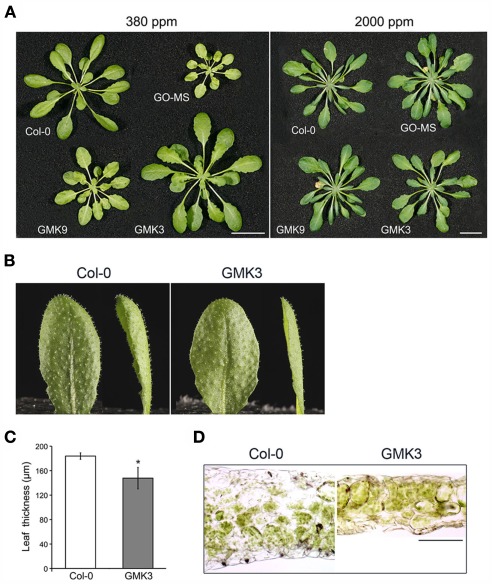
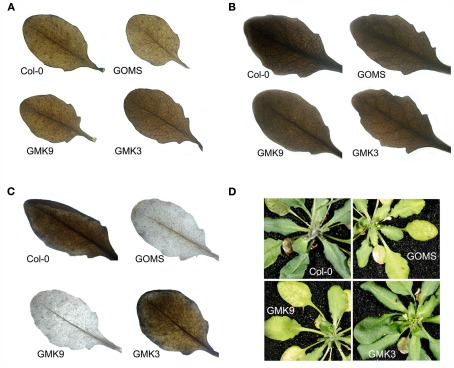
The photorespiratory pathway helps illuminated C(3)-plants under conditions of limited CO(2) availability by effectively exporting reducing equivalents in form of glycolate out of the chloroplast and regenerating glycerate-3-P as substrate for RubisCO. On the other hand, this pathway is considered as probably futile because previously assimilated CO(2) is released in mitochondria. Consequently, a lot of effort has been made to reduce this CO(2) loss either by reducing fluxes via engineering RubisCO or circumventing mitochondrial CO(2) release by the introduction of new enzyme activities. Here we present an approach following the latter route, introducing a complete glycolate catabolic cycle in chloroplasts of Arabidopsis thaliana comprising glycolate oxidase (GO), malate synthase (MS), and catalase (CAT). Results from plants bearing both GO and MS activities have already been reported (Fahnenstich et al., 2008). This previous work showed that the H(2)O(2) produced by GO had strongly negative effects. These effects can be prevented by introducing a plastidial catalase activity, as reported here. Transgenic lines bearing all three transgenic enzyme activities were identified and some with higher CAT activity showed higher dry weight, higher photosynthetic rates, and changes in glycine/serine ratio compared to the wild type. This indicates that the fine-tuning of transgenic enzyme activities in the chloroplasts seems crucial and strongly suggests that the approach is valid and that it is possible to improve the growth of A. thaliana by introducing a synthetic glycolate oxidative cycle into chloroplasts.
光呼吸途径通过将叶绿体内的还原当量以甘氨酸的形式有效地输出,并将甘油酸-3-P 再生为 RubisCO 的底物,从而帮助 CO2 供应有限的 C3 植物在光照条件下生存。另一方面,由于先前同化的 CO2 在粒体中释放,因此该途径被认为可能是无效的。因此,人们已经做出了很多努力来减少这种 CO2 损失,要么通过工程 RubisCO 来减少通量,要么通过引入新的酶活性来绕过粒体 CO2 的释放。在这里,我们采用了后一种方法,在拟南芥的叶绿体中引入了完整的甘氨酸分解代谢循环,其中包括甘氨酸氧化酶(GO)、苹果酸合酶(MS)和过氧化氢酶(CAT)。已经报道了具有 GO 和 MS 活性的植物的结果(Fahnenstich 等人,2008 年)。以前的工作表明,GO 产生的 H2O2 具有强烈的负面影响。正如这里所报道的,通过引入质体过氧化氢酶活性可以防止这种影响。已经鉴定出携带所有三种转基因酶活性的转基因系,并且一些具有更高 CAT 活性的系显示出更高的干重、更高的光合速率和甘氨酸/丝氨酸比的变化,与野生型相比。这表明在叶绿体中精细调节转基因酶活性似乎至关重要,并强烈表明该方法是有效的,并且通过将合成的甘氨酸氧化循环引入叶绿体可以提高拟南芥的生长。