School of Sport and Exercise Sciences, University of Birmingham, Edgbaston, Birmingham, B15 2TT, UK.
BMC Public Health. 2012 Jun 11;12:423. doi: 10.1186/1471-2458-12-423.
Accumulation of lifestyle physical activity is a current aim of health promotion, with increased stair climbing one public health target. While the workplace provides an opportunity for regular stair climbing, evidence for effectiveness of point-of-choice interventions is equivocal. This paper reports a new approach to worksite interventions, aimed at changing attitudes and, hence, behaviour.
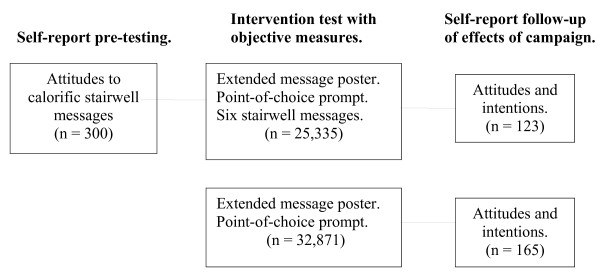
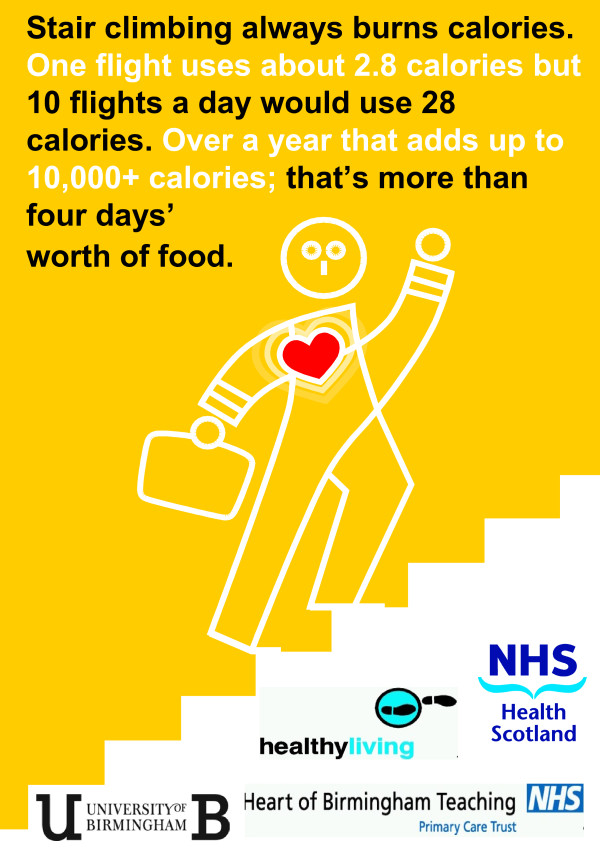
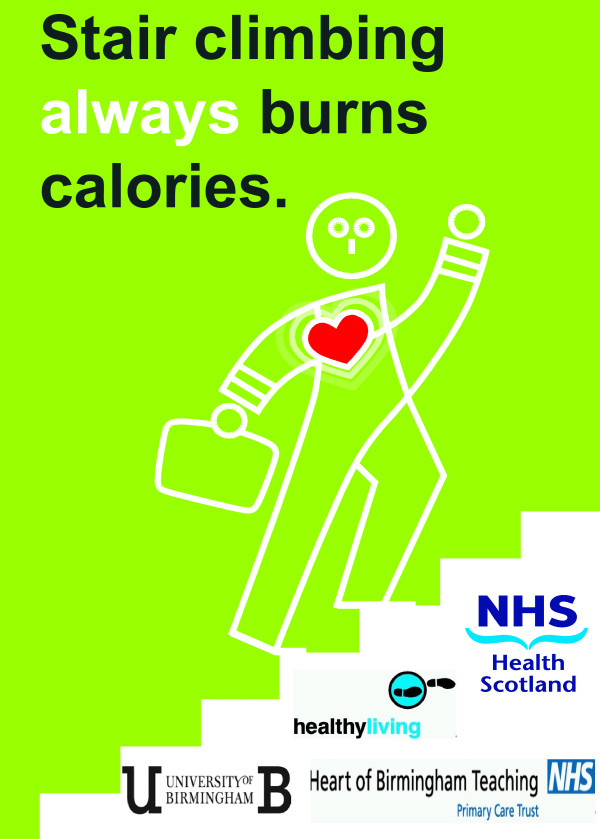
Pre-testing of calorific expenditure messages used structured interviews with members of the public (n = 300). Effects of multi-component campaigns on stair climbing were tested with quasi-experimental, interrupted time-series designs. In one worksite, a main campaign poster outlining the amount of calorific expenditure obtainable from stair climbing and a conventional point-of-choice prompt were used (Poster alone site). In a second worksite, additional messages in the stairwell about calorific expenditure reinforced the main campaign (Poster + Stairwell messages site). The outcome variables were automated observations of stair and lift ascent (28,854) and descent (29,352) at baseline and for three weeks after the intervention was installed. Post-intervention questionnaires for employees at the worksites assessed responses to the campaign (n = 253). Analyses employed Analysis of Variance with follow-up Bonferroni t-tests (message pre-testing), logistic regression of stair ascent and descent (campaign testing), and Bonferroni t-tests and multiple regression (follow-up questionnaire).
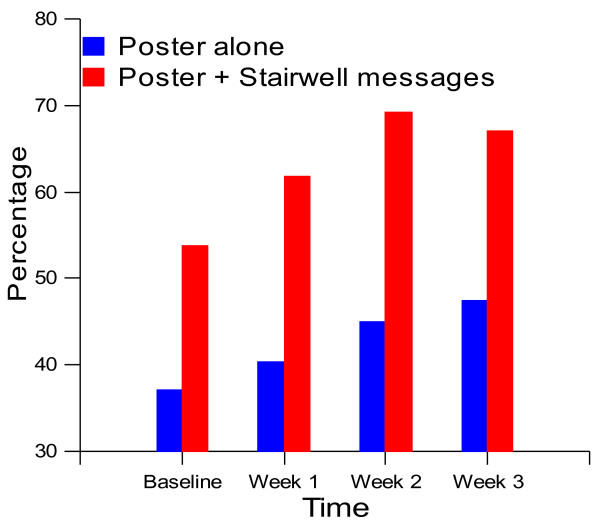
Pre-testing of messages based on calorific expenditure suggested they could motivate stair climbing if believed. The new campaign increased stair climbing, with greater effects at the Poster + Stairwell messages site (OR = 1.52, 95% CI = 1.40-1.66) than Posters alone (OR = 1.24, 95% CI = 1.15-1.34). Follow-up revealed higher agreement with two statements about calorific outcomes of stair climbing in the site where they were installed in the stairwell, suggesting more positive attitudes resulted from the intervention. Future intentions for stair use were predicted by motivation by the campaign and beliefs that stair climbing would help weight control.
Multi-component campaigns that target attitudes and intentions may substantially increase stair climbing at work.
积累生活方式体力活动是当前促进健康的目标,增加爬楼梯是一个公共卫生目标。虽然工作场所提供了定期爬楼梯的机会,但选择干预措施的有效性证据尚无定论。本文报告了一种新的工作场所干预方法,旨在改变态度,从而改变行为。
使用公众(n=300)的结构化访谈对热量消耗信息进行预测试。使用准实验、中断时间序列设计测试多组分运动对爬楼梯的影响。在一个工作场所,使用了一个主要的宣传海报,概述了从爬楼梯中获得的热量消耗,以及一个传统的选择点提示(单独海报工作场所)。在第二个工作场所,楼梯间的额外信息强化了主要运动(海报+楼梯间信息工作场所)。主要结果变量是基线和干预措施安装后三周内自动观察到的楼梯和电梯上升(28854)和下降(29352)。对工作场所的员工进行干预后问卷调查,评估对运动的反应(n=253)。分析采用方差分析,后续 Bonferroni t 检验(信息预测试),逻辑回归爬楼梯上升和下降(运动测试),以及 Bonferroni t 检验和多元回归(随访问卷调查)。
基于热量消耗的信息预测试表明,如果人们相信,它们可以激励爬楼梯。新的运动增加了爬楼梯的次数,在海报+楼梯间信息工作场所的效果更大(OR=1.52,95%置信区间=1.40-1.66),而单独海报(OR=1.24,95%置信区间=1.15-1.34)。后续调查显示,在安装在楼梯间的地点,人们对两条关于爬楼梯热量消耗结果的声明的认同度更高,这表明干预措施产生了更积极的态度。未来使用楼梯的意图由运动的动机和认为爬楼梯有助于控制体重的信念来预测。
针对态度和意图的多组分运动可能会大大增加工作场所的爬楼梯次数。