Social Medicine and Global Health, Department of Clinical Sciences, Malmö, Lund University, Lund, Sweden.
Reprod Health. 2012 Aug 6;9:10. doi: 10.1186/1742-4755-9-10.
The fight against maternal deaths has gained attention as the target date for Millennium Development Goal 5 approaches. Induced-abortion is one of the leading causes of maternal deaths in developing countries which hamper this effort. In Ghana, alcohol consumption and unwanted pregnancies are on the ascendancy. We examined the association between alcohol consumption and maternal mortality from induced-abortion. We further analyzed the factors that lie behind the alcohol consumption patterns in the study population.
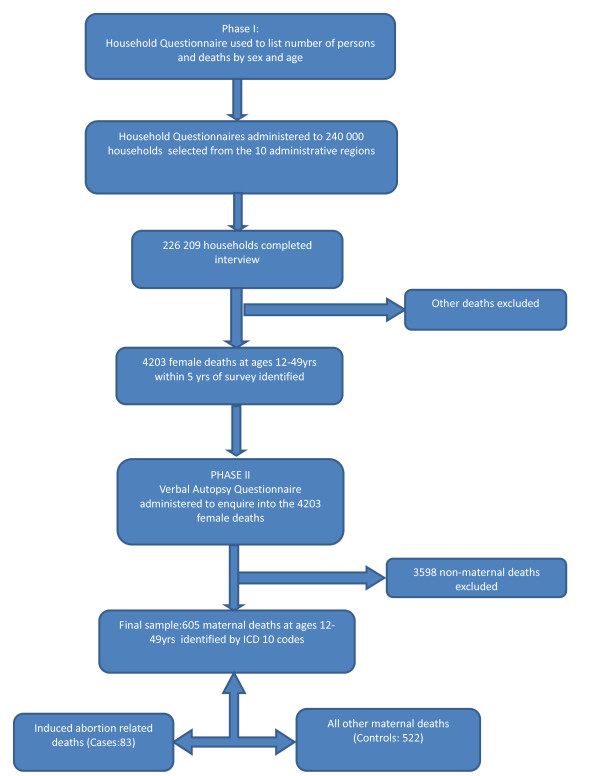
The data we used was extracted from the Ghana Maternal Health Survey 2007. This was a national survey conducted across the 10 administrative regions of Ghana. The survey identified 4203 female deaths through verbal autopsy, among which 605 were maternal deaths in the 12 to 49 year-old age group. Analysis was done using Statistical software IBM SPSS Statistics 20. A case control study design was used. Cross-tabulations and logistic regression models were used to investigate associations between the different variables.
Alcohol consumption was significantly associated with abortion-related maternal deaths. Women who had ever consumed alcohol (OR (adjusted) 2.6, 95% CI 1.38-4.87), frequent consumers (OR (adjusted) 2.6, 95% CI 0.89-7.40) and occasional consumers (OR (adjusted) 2.7, 95% CI 1.29-5.46) were about three times as likely to die from abortion-related causes compared to those who abstained from alcohol. Maternal age, marital status and educational level were found to have a confounding effect on the observed association.
Policy actions directed toward reducing abortion-related deaths should consider alcohol consumption, especially among younger women. Policy makers in Ghana should consider increasing the legal age for alcohol consumption. We suggest that information on the health risks posed by alcohol and abortion be disseminated to communities in the informal sector where vulnerable groups can best be reached.
随着千年发展目标 5 的截止日期临近,人们对降低孕产妇死亡率的关注度日益提高。在发展中国家,人工流产是导致孕产妇死亡的主要原因之一,这对降低孕产妇死亡率的努力造成了阻碍。在加纳,饮酒和意外怀孕的人数呈上升趋势。我们研究了饮酒与因人工流产导致的孕产妇死亡之间的关联,并进一步分析了研究人群中饮酒模式背后的因素。
我们使用的数据来自 2007 年加纳母婴健康调查。这是一项在加纳 10 个行政区进行的全国性调查。该调查通过口头尸检确定了 4203 名女性死亡,其中 605 名是 12 至 49 岁年龄组的孕产妇死亡。使用 IBM SPSS Statistics 20 统计软件进行分析。采用病例对照研究设计。交叉表和逻辑回归模型用于调查不同变量之间的关联。
饮酒与与流产相关的孕产妇死亡显著相关。曾经饮酒的女性(调整后的比值比(OR)为 2.6,95%置信区间为 1.38-4.87)、频繁饮酒者(调整后的 OR 为 2.6,95%置信区间为 0.89-7.40)和偶尔饮酒者(调整后的 OR 为 2.7,95%置信区间为 1.29-5.46)与不饮酒的女性相比,死于与流产相关原因的可能性是其三倍。孕产妇年龄、婚姻状况和教育水平对观察到的关联存在混杂影响。
旨在降低与流产相关的孕产妇死亡的政策行动应考虑饮酒问题,特别是针对年轻女性。加纳的政策制定者应考虑提高饮酒的法定年龄。我们建议向非正式部门的弱势群体传播有关酒精和流产带来的健康风险的信息。