Institute of Sport, Physical Education and Health Sciences, University of Edinburgh, United Kingdom.
Sports Health. 2011 May;3(3):303-9. doi: 10.1177/1941738111403872.
Aquatic plyometric programs are becoming increasingly popular because they provide a less stressful alternative to land-based programs. Buoyancy reduces the impact forces experienced in water.
To quantify the landing kinetics during a range of typical lower limb plyometric exercises performed on land and in water.
Crossover design.
Eighteen male participants performed ankle hops, tuck jumps, a countermovement jump, a single-leg vertical jump, and a drop jump from 30 cm in a biomechanics laboratory and in a swimming pool. Land and underwater force plates (Kistler) were used to obtain peak impact force, impulse, rate of force development, and time to reach peak force for the landing phase of each jump.
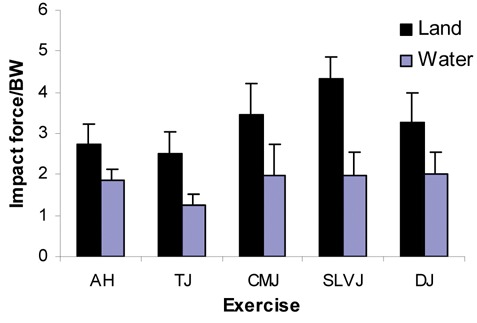
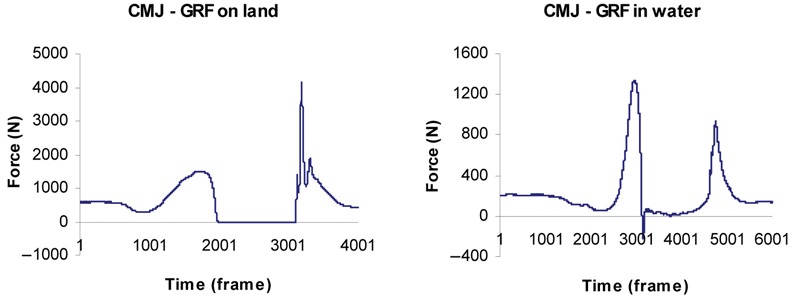
Significant reductions were observed in peak impact forces (33%-54%), impulse (19%-54%), and rate of force development (33%-62%) in water compared with land for the majority of exercises in this study (P < 0.05).
The level of force reduction varies with landing technique, water depth, and participant height and body composition.
This information can be used to reintroduce athletes to the demands of plyometric exercises after injury.
水上增强式训练计划越来越受欢迎,因为它们提供了一种比基于陆地的训练计划更具吸引力的选择。浮力可以减少在水中运动时所承受的冲击力。
量化在陆地上和水中进行的一系列典型下肢增强式训练中,落地时的动力学变化。
交叉设计。
18 名男性参与者在生物力学实验室和游泳池中,分别进行了踝关节跳、塔克跳、反向跳、单腿垂直跳和 30cm 跳下的跳落实验。陆地和水下力量板(Kistler)用于获得每次跳跃落地阶段的峰值冲击力、冲量、力发展速率和达到峰值力的时间。
与陆地相比,本研究中的大多数练习(P < 0.05)在水中时,峰值冲击力(33%-54%)、冲量(19%-54%)和力发展速率(33%-62%)均显著降低。
力的减少程度因着陆技术、水深以及参与者的身高和身体成分而异。
这些信息可以用于在运动员受伤后重新引入增强式训练。