Institut für Pharmakologie und Toxikologie, Universität Würzburg, Würzburg, Germany.
PLoS One. 2012;7(9):e46397. doi: 10.1371/journal.pone.0046397. Epub 2012 Sep 27.
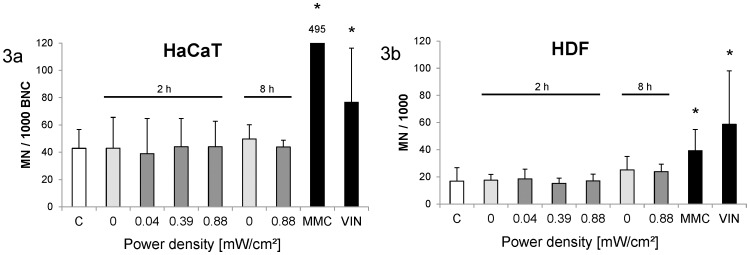
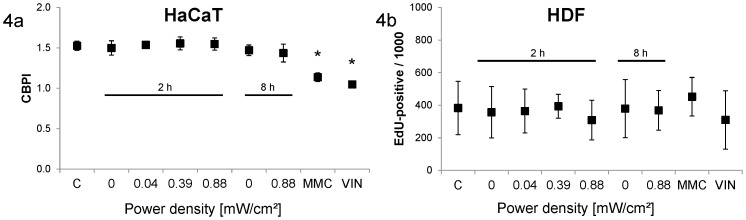
Terahertz electromagnetic fields are non-ionizing electromagnetic fields in the frequency range from 0.1 to 10 THz. Potential applications of these electromagnetic fields include the whole body scanners, which currently apply millimeter waves just below the terahertz range, but future scanners will use higher frequencies in the terahertz range. These and other applications will bring along human exposure to these fields. Up to now, only a limited number of investigations on biological effects of terahertz electromagnetic fields have been performed. Therefore, research is strongly needed to enable reliable risk assessment.Cells were exposed for 2 h, 8 h, and 24 h with different power intensities ranging from 0.04 mW/cm(2) to 2 mW/cm(2), representing levels below, at, and above current safety limits. Genomic damage on the chromosomal level was measured as micronucleus formation. DNA strand breaks and alkali-labile sites were quantified with the comet assay. No DNA strand breaks or alkali-labile sites were observed as a consequence of exposure to terahertz electromagnetic fields in the comet assay. The fields did not cause chromosomal damage in the form of micronucleus induction.
太赫兹电磁场是频率在 0.1 到 10 太赫兹之间的非电离电磁场。这些电磁场的潜在应用包括全身扫描仪,目前这些扫描仪应用的是太赫兹以下的毫米波,但未来的扫描仪将使用太赫兹范围内的更高频率。这些和其他应用将带来人类对这些场的暴露。到目前为止,只有少数关于太赫兹电磁场生物效应的研究。因此,需要进行强有力的研究,以进行可靠的风险评估。细胞暴露于不同的功率强度下 2 小时、8 小时和 24 小时,范围从 0.04 mW/cm(2)到 2 mW/cm(2),代表低于、等于和高于当前安全限制的水平。染色体水平的基因组损伤以微核形成来衡量。彗星试验定量测量 DNA 链断裂和碱不稳定部位。彗星试验未观察到由于太赫兹电磁场暴露而导致的 DNA 链断裂或碱不稳定部位。这些场没有以微核诱导的形式造成染色体损伤。