Najafi Mohammad Hassan, Taheri Morteza, Mokhtari Majid Reza, Forouzanfar Ali, Farazi Fateme, Mirzaee Mona, Ebrahiminik Zahra, Mehrara Reza
Department of Periodontics, School of Dentistry, Mashad University of Medical Sciences, Mashad, Iran.
Dent Res J (Isfahan). 2012 May;9(3):305-8.
Chlorhexidine (CHX) as a gold standard chemical agent appears to be the most effective antimicrobial agent for reduction of both plaque and gingivitis. The aim of this study was to compare the efficacy of two concentrations of digluconate chlorhexidine (CHX) solutions (0.12% and 0.20%) on gingival indices and the level of dental staining during 14 days.
in this double-blind controlled clinical trial study 60 patients with moderate to severe gingivitis aged 17-56 years were randomly selected and divided to three groups: Group I (placebo) Group II (0.12% CHX), and Group III (0.2% CHX). Patients rinsed their mouthwashes twice a day after brushing. Before the examination and after 14 days plaque index, gingival index, bleeding index, and stain index were evaluated. The data were analyzed by "Mann-Whitney" test and P value was 0.05.
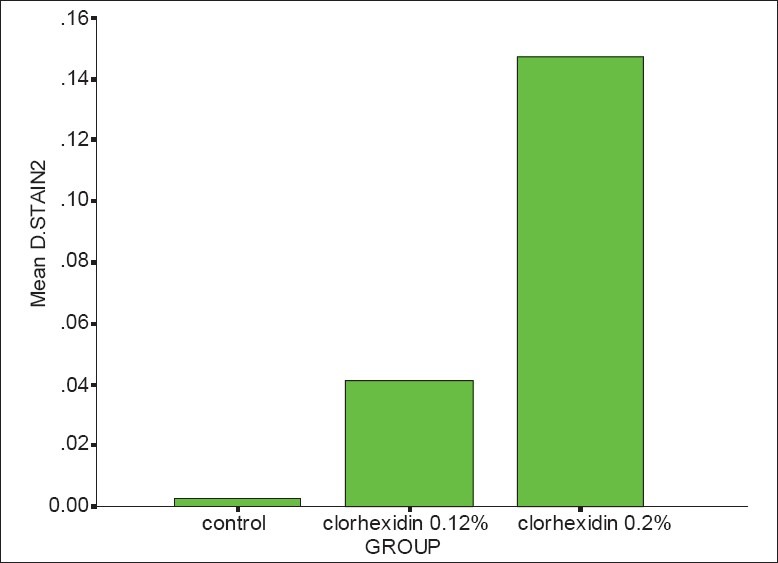
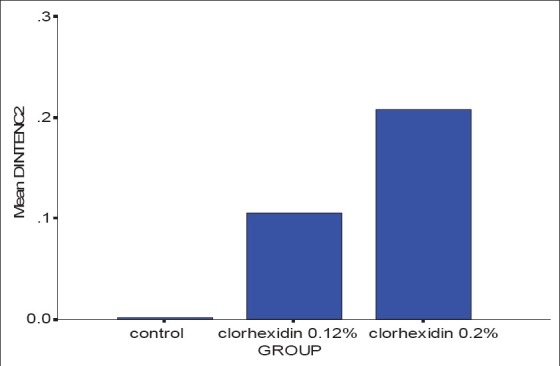
the results showed that plaque index and gingival index significantly reduced in Groups II and III in comparison with the placebo group (P < 0.0001). However, the two concentrations did not differ significantly from each other (P = 0.552). Same results were observed in term of gingival bleeding index with this different that 0.2% CHX was significantly more efficient than 0.12% CHX (P < 0.0001). CHX mouthrinse, both concentrations, significantly increased the dental staining level (intensity and area) in comparison with the placebo group. Remarkable difference also was seen between 2 CHX concentrations so that the 0.2% CHX caused much more staining on the teeth than 0.12% CHX.
based on the results of this study we can conclude that the lower concentrations of CHX should be prescribed, decreasing side effects, since higher concentrations do not seem to be more effective in controlling dental plaque and gingivitis.
洗必泰(CHX)作为金标准化学药剂,似乎是减少牙菌斑和牙龈炎最有效的抗菌剂。本研究的目的是比较两种浓度的葡萄糖酸洗必泰(CHX)溶液(0.12%和0.20%)在14天内对牙龈指数和牙齿染色程度的疗效。
在这项双盲对照临床试验研究中,随机选取60例年龄在17 - 56岁的中重度牙龈炎患者,分为三组:第一组(安慰剂组)、第二组(0.12% CHX组)和第三组(0.2% CHX组)。患者每天刷牙后使用漱口水漱口两次。在检查前和14天后评估菌斑指数、牙龈指数、出血指数和染色指数。数据采用“曼 - 惠特尼”检验进行分析,P值为0.05。
结果显示,与安慰剂组相比,第二组和第三组的菌斑指数和牙龈指数显著降低(P < 0.0001)。然而,两种浓度之间没有显著差异(P = 0.552)。牙龈出血指数方面也观察到相同结果,不同的是0.2% CHX比0.12% CHX显著更有效(P < 0.0001)。与安慰剂组相比,两种浓度的CHX漱口水均显著增加了牙齿染色程度(强度和面积)。两种CHX浓度之间也有显著差异,0.2% CHX导致的牙齿染色比0.12% CHX多得多。
基于本研究结果,我们可以得出结论,应开具较低浓度的CHX,以减少副作用,因为较高浓度在控制牙菌斑和牙龈炎方面似乎并不更有效。