Department of Epidemiology and Biostatistics, University of Georgia, Athens, Georgia, United States of America.
PLoS Negl Trop Dis. 2012;6(11):e1881. doi: 10.1371/journal.pntd.0001881. Epub 2012 Nov 8.
There is significant heterogeneity in reported sensitivities and specificities of diagnostic serological assays for Chagas disease, as might be expected from studies that vary widely according to setting, research design, antigens employed, and reference standard. The purpose of this study is to summarize the reported accuracy of serological assays and to identify sources of heterogeneity including quality of research design. To avoid associated spectrum bias, our analysis was limited to cohort studies.
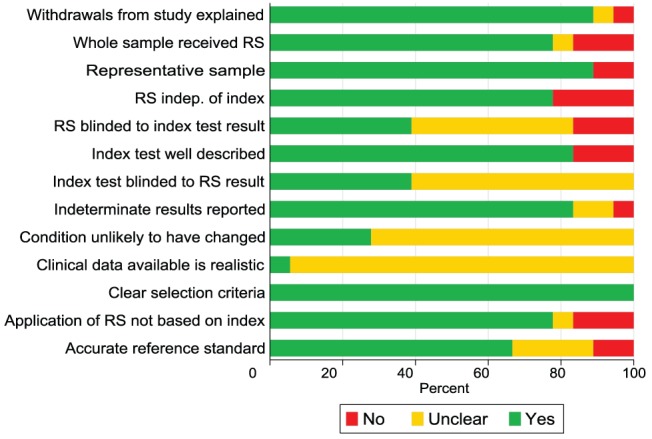
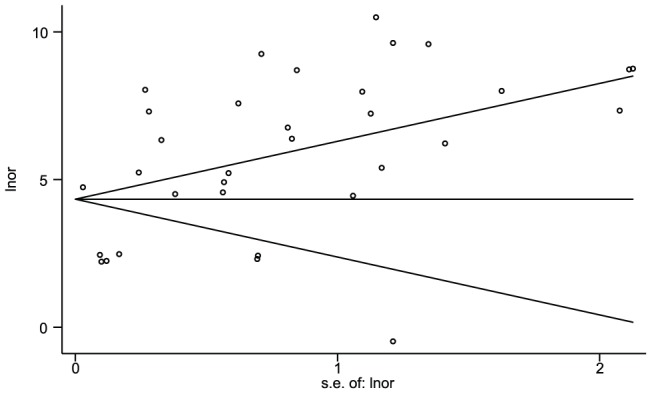
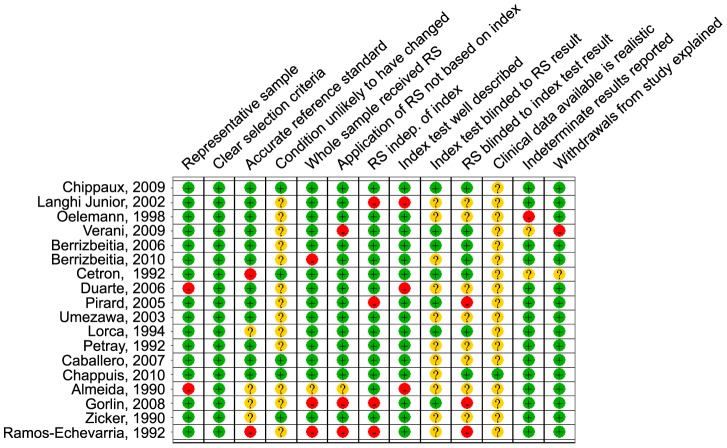
We completed a search of PubMed, a bibliographic review of potentially relevant articles, and a review of articles identified by a study author involved in this area of research. Studies were limited to prospective cohort studies of adults published since 1985. Measures of diagnostic accuracy were pooled using a Der Simonian Laird Random Effects Model. A subgroup analysis and meta regression were employed to identify sources of heterogeneity. The QUADAS tool was used to assess quality of included studies and Begg's funnel plot was used to assess publication bias.
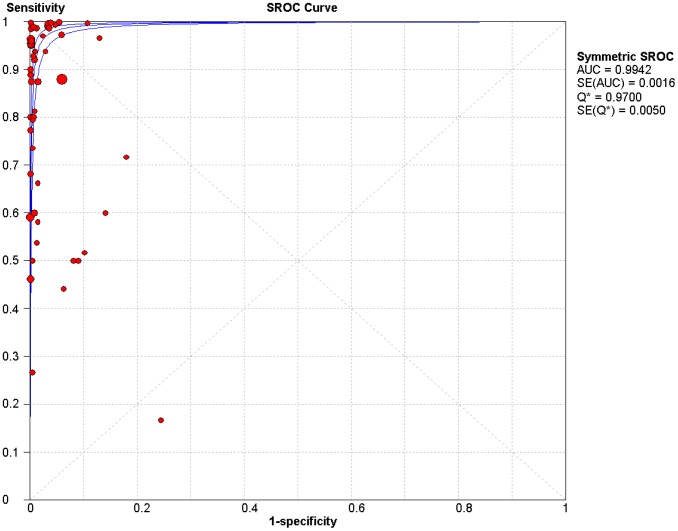
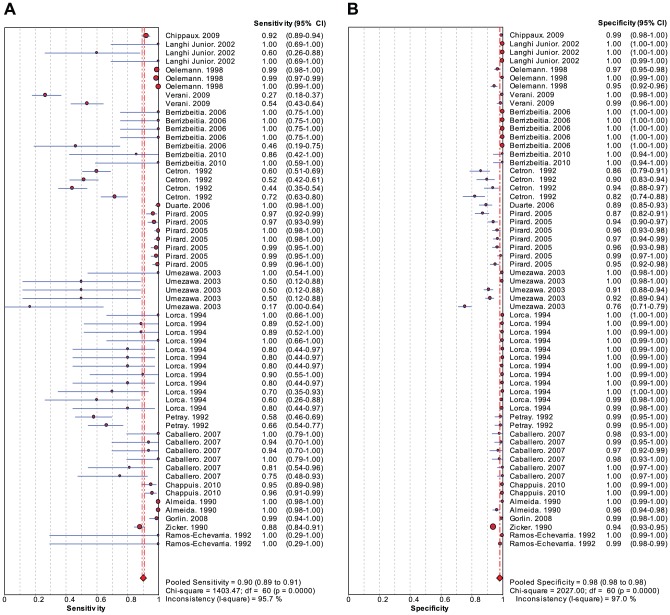
Eighteen studies and 61 assays were included in the final analysis. Significant heterogeneity was found in all pre-determined subgroups. Overall sensitivity was 90% (95% CI: 89%-91%) and overall specificity was 98% (95% CI: 98%-98%).
Sensitivity and specificity of serological assays for the diagnosis of Chagas disease appear less accurate than previously thought. Suggestions to improve the accuracy of reporting include the enrollment of patients in a prospective manner, double blinding, and providing an explicit method of addressing subjects that have an indeterminate diagnosis by either the reference standard or index test.
由于研究环境、研究设计、使用的抗原和参考标准差异很大,报道的用于诊断恰加斯病的诊断血清学检测的敏感性和特异性存在显著异质性,这是意料之中的。本研究的目的是总结血清学检测的报道准确性,并确定包括研究设计质量在内的异质性来源。为避免相关的光谱偏倚,我们的分析仅限于队列研究。
我们完成了对 PubMed 的检索、对可能相关文章的文献综述以及对该研究领域的一位作者确定的文章的综述。研究仅限于 1985 年以后发表的前瞻性成人队列研究。使用 DerSimonian 和 Laird 随机效应模型汇总诊断准确性测量值。进行亚组分析和荟萃回归以确定异质性的来源。使用 QUADAS 工具评估纳入研究的质量,使用 Begg 漏斗图评估发表偏倚。
最终分析纳入了 18 项研究和 61 项检测。在所有预先确定的亚组中均发现存在显著的异质性。总体敏感性为 90%(95%CI:89%-91%),总体特异性为 98%(95%CI:98%-98%)。
血清学检测用于诊断恰加斯病的敏感性和特异性似乎不如以前认为的那么准确。提高报告准确性的建议包括以前瞻性方式招募患者、双盲、并提供一种明确的方法来处理参考标准或指标检测对不确定诊断的患者。