Marković Slobodan
Laboratory of Experimental Psychology and Department of Psychology, University of Belgrade, Serbia; e-mail:
Iperception. 2012;3(1):1-17. doi: 10.1068/i0450aap. Epub 2012 Jan 12.
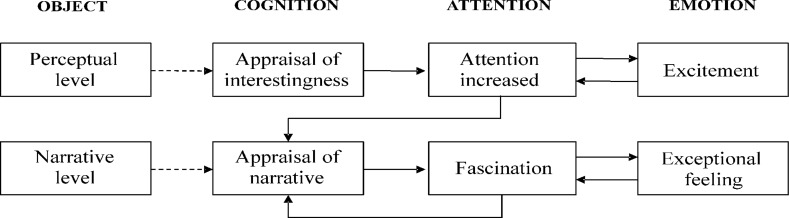
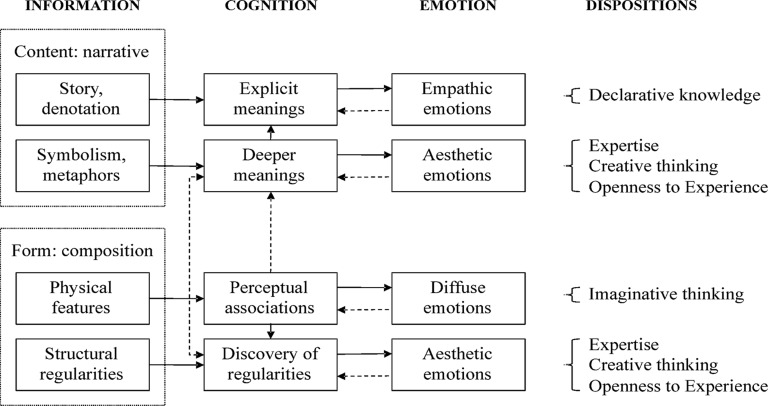
In this paper aesthetic experience is defined as an experience qualitatively different from everyday experience and similar to other exceptional states of mind. Three crucial characteristics of aesthetic experience are discussed: fascination with an aesthetic object (high arousal and attention), appraisal of the symbolic reality of an object (high cognitive engagement), and a strong feeling of unity with the object of aesthetic fascination and aesthetic appraisal. In a proposed model, two parallel levels of aesthetic information processing are proposed. On the first level two sub-levels of narrative are processed, story (theme) and symbolism (deeper meanings). The second level includes two sub-levels, perceptual associations (implicit meanings of object's physical features) and detection of compositional regularities. Two sub-levels are defined as crucial for aesthetic experience, appraisal of symbolism and compositional regularities. These sub-levels require some specific cognitive and personality dispositions, such as expertise, creative thinking, and openness to experience. Finally, feedback of emotional processing is included in our model: appraisals of everyday emotions are specified as a matter of narrative content (eg, empathy with characters), whereas the aesthetic emotion is defined as an affective evaluation in the process of symbolism appraisal or the detection of compositional regularities.
在本文中,审美体验被定义为一种在性质上不同于日常体验且类似于其他特殊心理状态的体验。文中讨论了审美体验的三个关键特征:对审美对象的着迷(高度唤起和关注)、对对象象征现实的评价(高度认知参与),以及与审美着迷对象和审美评价对象的强烈统一感。在一个提出的模型中,提出了两个并行的审美信息处理层次。在第一个层次上,处理叙事的两个子层次,故事(主题)和象征意义(深层含义)。第二个层次包括两个子层次,感知联想(对象物理特征的隐含意义)和构图规律的检测。两个子层次被定义为对审美体验、象征意义评价和构图规律至关重要。这些子层次需要一些特定的认知和个性倾向,如专业知识、创造性思维和对体验的开放性。最后,我们的模型中纳入了情绪处理的反馈:日常情绪的评价被指定为叙事内容的问题(例如,对角色的同理心),而审美情绪被定义为在象征意义评价过程或构图规律检测过程中的情感评价。