Department of Medicine and Clinical Science, Graduate School of Medical Sciences, Kyushu University, Fukuoka, Japan.
Diabetes Care. 2013 Mar;36(3):611-7. doi: 10.2337/dc12-0904. Epub 2012 Nov 12.
Few studies are currently available regarding the influence of sleep duration on glycemic control in diabetic patients. The objective of the current study was to examine the relationship between sleep duration, obesity, and the glycemic level in type 2 diabetic patients.
A total of 4,870 Japanese type 2 diabetic patients aged ≥20 years were divided into six groups according to their self-reported sleep duration: less than 4.5 h, 4.5-5.4 h, 5.5-6.4 h, 6.5-7.4 h, 7.5-8.4 h, and more than 8.5 h. The associations of sleep duration with obesity and the HbA(1c) levels were examined in a cross-sectional manner.
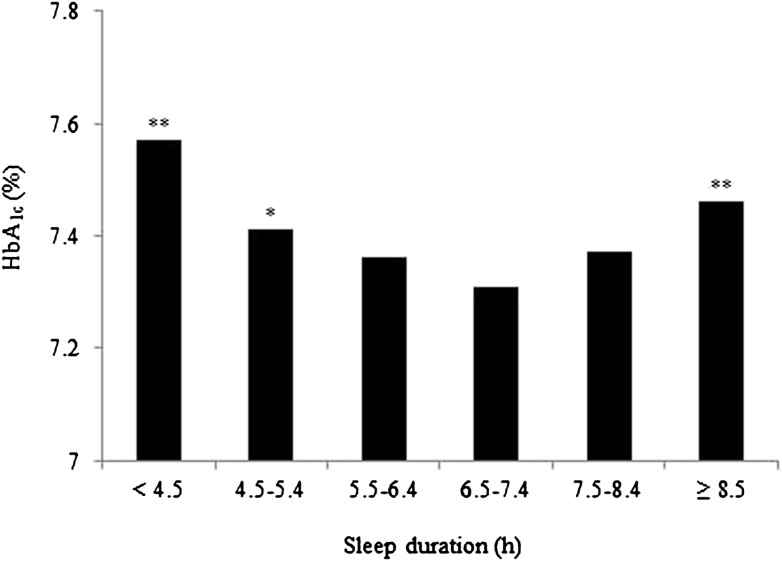
The HbA(1c) levels showed a quadratic association with sleep duration; namely, a shorter or longer sleep duration was associated with a higher level compared with a sleep duration of 6.5-7.4 h (P for quadratic trend <0.001). This association remained significant after adjusting for potential confounders, including the total energy intake and depressive symptoms. Furthermore, additional adjustments for obesity, which also showed a U-shaped relationship with sleep duration, did not attenuate the U-shaped sleep-HbA(1c) association. A significant interaction between sleep duration and age or the use of insulin was observed for the HbA(1c) levels.
Sleep duration was shown to have U-shaped associations with obesity and the HbA(1c) levels in type 2 diabetic patients, independent of potential confounders, and therefore may be an important modifiable factor for the clinical management of patients with type 2 diabetes.
目前关于睡眠时间对糖尿病患者血糖控制影响的研究较少。本研究旨在探讨 2 型糖尿病患者的睡眠时间、肥胖与血糖水平之间的关系。
共有 4870 名年龄≥20 岁的日本 2 型糖尿病患者,根据其自我报告的睡眠时间分为 6 组:<4.5 小时、4.5-5.4 小时、5.5-6.4 小时、6.5-7.4 小时、7.5-8.4 小时和>8.5 小时。采用横断面研究方法,分析睡眠时间与肥胖和糖化血红蛋白(HbA1c)水平的关系。
HbA1c 水平与睡眠时间呈二次曲线关系;与 6.5-7.4 小时睡眠时间相比,睡眠时间较短或较长与 HbA1c 水平较高相关(二次趋势 P<0.001)。在调整潜在混杂因素(包括总能量摄入和抑郁症状)后,这种相关性仍然显著。此外,进一步调整肥胖因素,肥胖与睡眠时间也呈 U 型关系,但不能减弱 U 型睡眠-HbA1c 关系。HbA1c 水平与睡眠时间之间观察到显著的交互作用,与年龄或胰岛素的使用有关。
睡眠时间与 2 型糖尿病患者的肥胖和 HbA1c 水平呈 U 型关系,独立于潜在的混杂因素,因此可能是 2 型糖尿病患者临床管理的一个重要可改变因素。