Graduate School of Information Science and Technology, Osaka University, 1-5 Yamadaoka, Suita, Osaka, Japan.
BMC Genomics. 2013 Jan 16;14:25. doi: 10.1186/1471-2164-14-25.
Both large deletions in genome and heat shock stress would lead to alterations in the gene expression profile; however, whether there is any potential linkage between these disturbances to the transcriptome have not been discovered. Here, the relationship between the genomic and environmental contributions to the transcriptome was analyzed by comparing the transcriptomes of the bacterium Escherichia coli (strain MG1655 and its extensive genomic deletion derivative, MDS42) grown in regular and transient heat shock conditions.
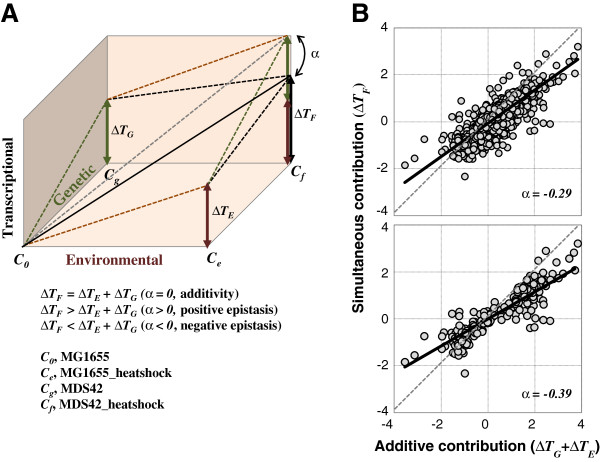
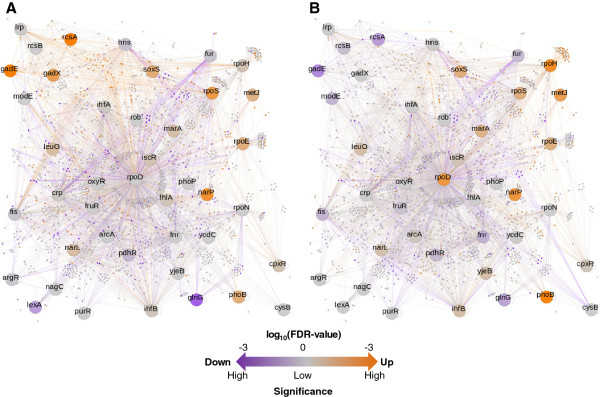
The transcriptome analysis showed the following: (i) there was a reorganization of the transcriptome in accordance with preferred chromosomal periodicity upon genomic or heat shock perturbation; (ii) there was a considerable overlap between the perturbed regulatory networks and the categories enriched for differentially expressed genes (DEGs) following genome reduction and heat shock; (iii) the genes sensitive to genome reduction tended to be located close to genomic scars, and some were also highly responsive to heat shock; and (iv) the genomic and environmental contributions to the transcriptome displayed not only a positive correlation but also a negatively compensated relationship (i.e., antagonistic epistasis).
The contributions of genome reduction and heat shock to the Escherichia coli transcriptome were evaluated at multiple levels. The observations of overlapping perturbed networks, directional similarity in transcriptional changes, positive correlation and epistatic nature linked the two contributions and suggest somehow a crosstalk guiding transcriptional reorganization in response to both genetic and environmental disturbances in bacterium E. coli.
基因组的大片段缺失和热休克应激都会导致基因表达谱的改变;然而,这些转录组的干扰之间是否存在任何潜在的联系尚未被发现。在这里,通过比较在常规和瞬时热休克条件下生长的细菌大肠杆菌(MG1655 菌株及其广泛的基因组缺失衍生物 MDS42)的转录组,分析了基因组和环境对转录组的贡献之间的关系。
转录组分析表明:(i)在基因组或热休克扰动时,转录组按照染色体的周期性进行了重新组织;(ii)在基因组减少和热休克后,受干扰的调控网络与差异表达基因(DEG)富集的类别之间存在相当大的重叠;(iii)对基因组减少敏感的基因往往位于基因组疤痕附近,有些基因对热休克也高度敏感;(iv)基因组和环境对转录组的贡献不仅呈正相关,而且呈负补偿关系(即拮抗上位性)。
在多个层面评估了基因组减少和热休克对大肠杆菌转录组的贡献。受干扰的网络重叠、转录变化的方向相似性、正相关和上位性表明,这两种贡献之间存在某种联系,并暗示了在细菌大肠杆菌中,遗传和环境干扰会产生一种相互作用,指导转录重组。