Department of Ecology and Evolutionary Biology, Yale University, 21 Sachem St, New Haven, CT, USA.
BMC Evol Biol. 2013 Feb 5;13:31. doi: 10.1186/1471-2148-13-31.
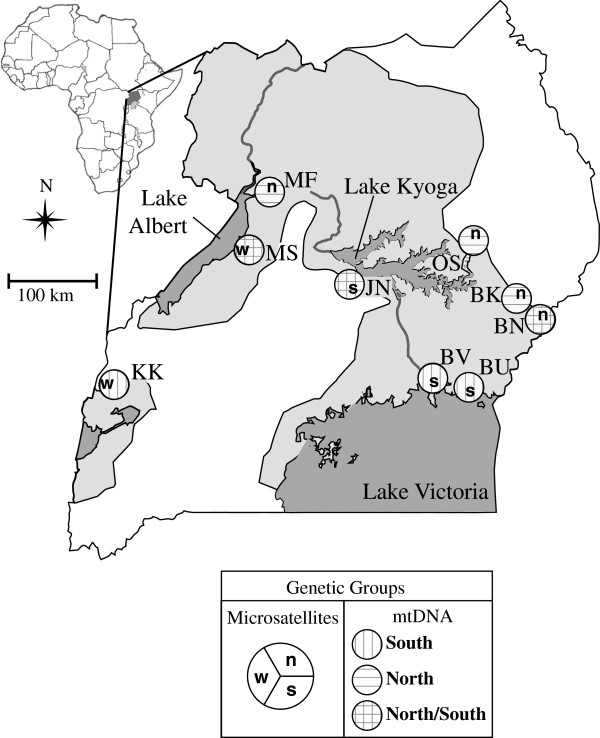
Wolbachia pipientis, a diverse group of α-proteobacteria, can alter arthropod host reproduction and confer a reproductive advantage to Wolbachia-infected females (cytoplasmic incompatibility (CI)). This advantage can alter host population genetics because Wolbachia-infected females produce more offspring with their own mitochondrial DNA (mtDNA) haplotypes than uninfected females. Thus, these host haplotypes become common or fixed (selective sweep). Although simulations suggest that for a CI-mediated sweep to occur, there must be a transient phase with repeated initial infections of multiple individual hosts by different Wolbachia strains, this has not been observed empirically. Wolbachia has been found in the tsetse fly, Glossina fuscipes fuscipes, but it is not limited to a single host haplotype, suggesting that CI did not impact its population structure. However, host population genetic differentiation could have been generated if multiple Wolbachia strains interacted in some populations. Here, we investigated Wolbachia genetic variation in G. f. fuscipes populations of known host genetic composition in Uganda. We tested for the presence of multiple Wolbachia strains using Multi-Locus Sequence Typing (MLST) and for an association between geographic region and host mtDNA haplotype using Wolbachia DNA sequence from a variable locus, groEL (heat shock protein 60).
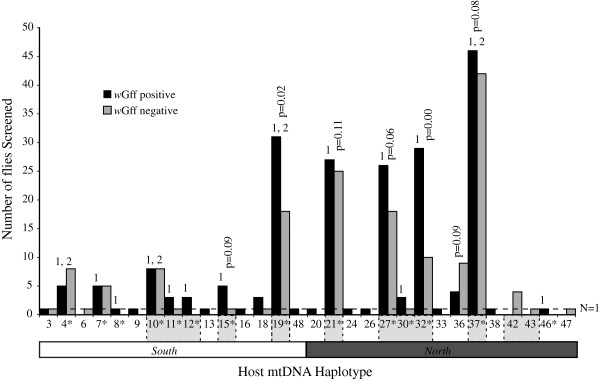
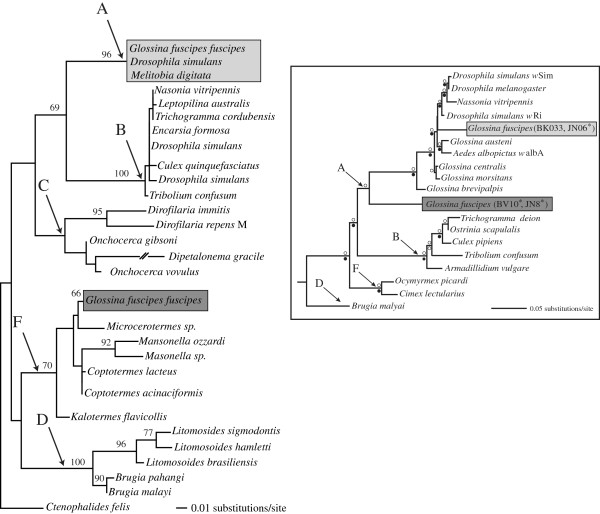
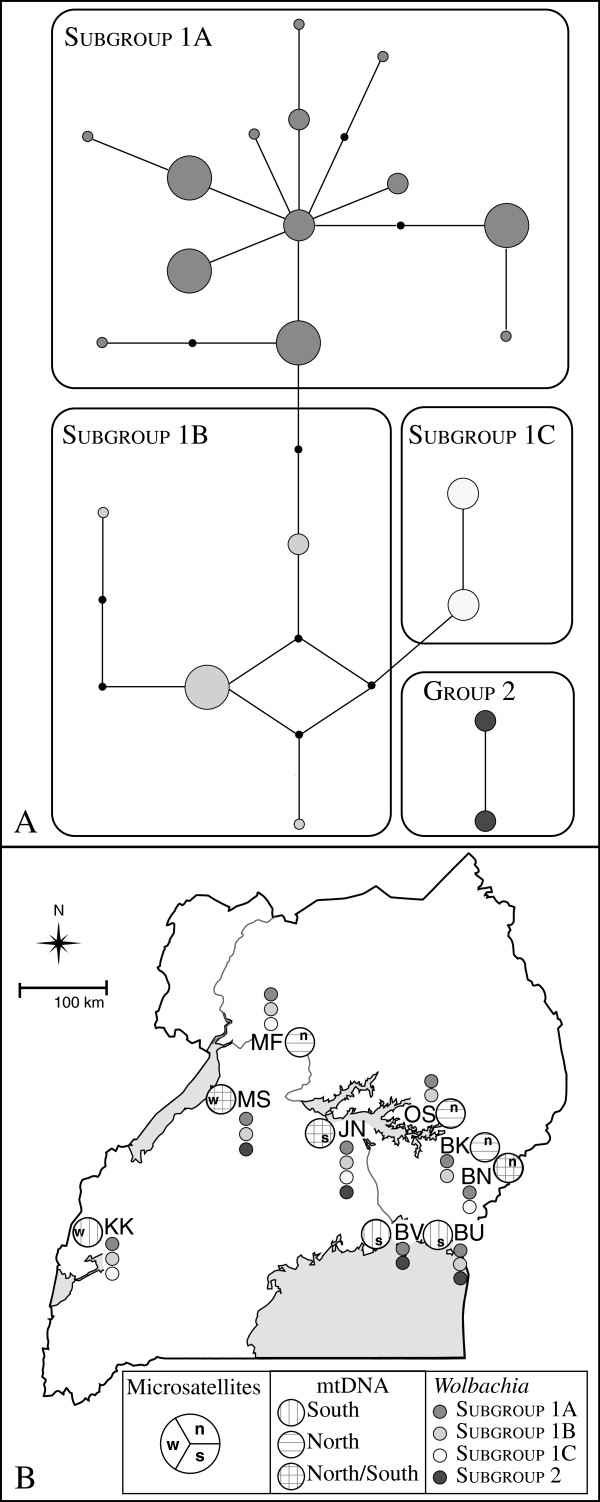
MLST demonstrated that some G. f. fuscipes carry Wolbachia strains from two lineages. GroEL revealed high levels of sequence diversity within and between individuals (Haplotype diversity = 0.945). We found Wolbachia associated with 26 host mtDNA haplotypes, an unprecedented result. We observed a geographical association of one Wolbachia lineage with southern host mtDNA haplotypes, but it was non-significant (p = 0.16). Though most Wolbachia-infected host haplotypes were those found in the contact region between host mtDNA groups, this association was non-significant (p = 0.17).
High Wolbachia sequence diversity and the association of Wolbachia with multiple host haplotypes suggest that different Wolbachia strains infected G. f. fuscipes multiple times independently. We suggest that these observations reflect a transient phase in Wolbachia evolution that is influenced by the long gestation and low reproductive output of tsetse. Although G. f. fuscipes is superinfected with Wolbachia, our data does not support that bidirectional CI has influenced host genetic diversity in Uganda.
沃尔巴克氏体(Wolbachia pipientis)是一组多样化的α-变形菌,可改变节肢动物宿主的繁殖,并赋予感染沃尔巴克氏体的雌性生殖优势(细胞质不相容性(CI))。这种优势可以改变宿主种群的遗传结构,因为感染沃尔巴克氏体的雌性会产生更多具有自身线粒体 DNA(mtDNA)单倍型的后代,而未感染的雌性则较少。因此,这些宿主单倍型变得常见或固定(选择性清除)。尽管模拟表明,为了发生由 CI 介导的清除,必须有一个短暂的阶段,多个个体宿主被不同的沃尔巴克氏体菌株重复初始感染,但这在经验上尚未观察到。沃尔巴克氏体已在采采蝇( Glossina fuscipes fuscipes )中发现,但它不限于单一的宿主单倍型,表明 CI 并未影响其种群结构。然而,如果在某些种群中多种沃尔巴克氏体菌株相互作用,宿主种群遗传分化可能已经产生。在这里,我们调查了乌干达已知宿主遗传组成的 G. f. fuscipes 种群中的沃尔巴克氏体遗传变异。我们使用多位点序列分型(MLST)检测多种沃尔巴克氏体菌株的存在,并使用可变基因座 groEL(热休克蛋白 60)的沃尔巴克氏体 DNA 序列检测地理区域与宿主 mtDNA 单倍型之间的关联。
MLST 表明,一些 G. f. fuscipes 携带来自两个谱系的沃尔巴克氏体菌株。GroEL 显示个体内和个体间的序列多样性很高(单倍型多样性=0.945)。我们发现沃尔巴克氏体与 26 种宿主 mtDNA 单倍型相关,这是一个前所未有的结果。我们观察到一个沃尔巴克氏体谱系与南部宿主 mtDNA 单倍型之间存在地理关联,但无统计学意义(p=0.16)。尽管大多数感染沃尔巴克氏体的宿主单倍型是在宿主 mtDNA 群体之间的接触区域发现的,但这种关联无统计学意义(p=0.17)。
高沃尔巴克氏体序列多样性和沃尔巴克氏体与多种宿主单倍型的关联表明,不同的沃尔巴克氏体菌株多次独立感染了 G. f. fuscipes。我们认为这些观察结果反映了沃尔巴克氏体进化的一个短暂阶段,受到采采蝇妊娠时间长和繁殖率低的影响。尽管 G. f. fuscipes 被沃尔巴克氏体超级感染,但我们的数据并不支持双向 CI 影响了乌干达的宿主遗传多样性。