Division of Chemical and Biomolecular Engineering, School of Chemical and Biomedical Engineering, Nanyang Technological University, 62 Nanyang Drive, Nanyang 637459, Singapore.
Biotechnol Biofuels. 2013 Feb 13;6(1):21. doi: 10.1186/1754-6834-6-21.
Hydrocarbon alkanes, components of major fossil fuels, are considered as next-generation biofuels because their biological production has recently been shown to be possible. However, high-yield alkane production requires robust host cells that are tolerant against alkanes, which exhibit cytotoxicity. In this study, we aimed to improve alkane tolerance in Saccharomyces cerevisiae, a key industrial microbial host, by harnessing heterologous transporters that potentially pump out alkanes.
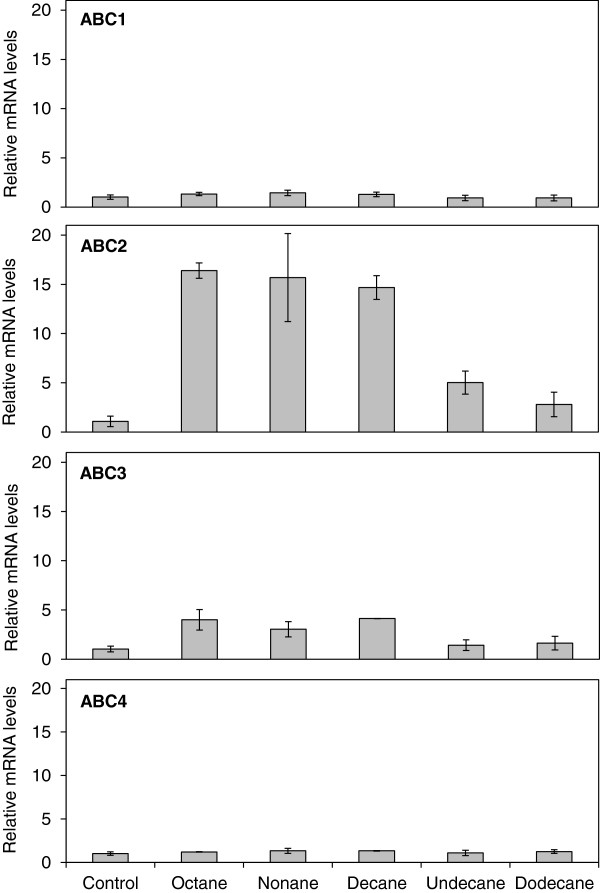
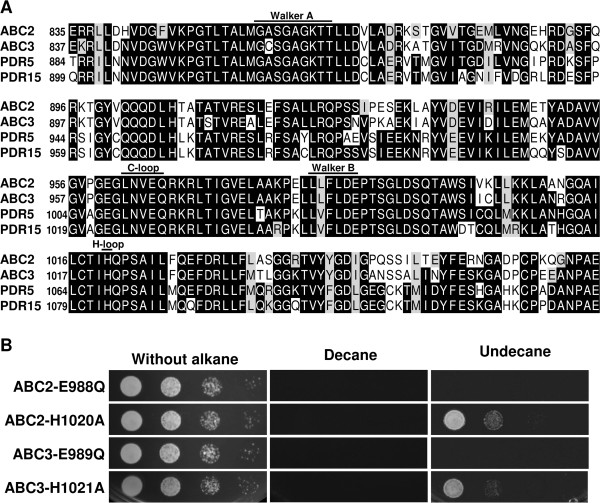
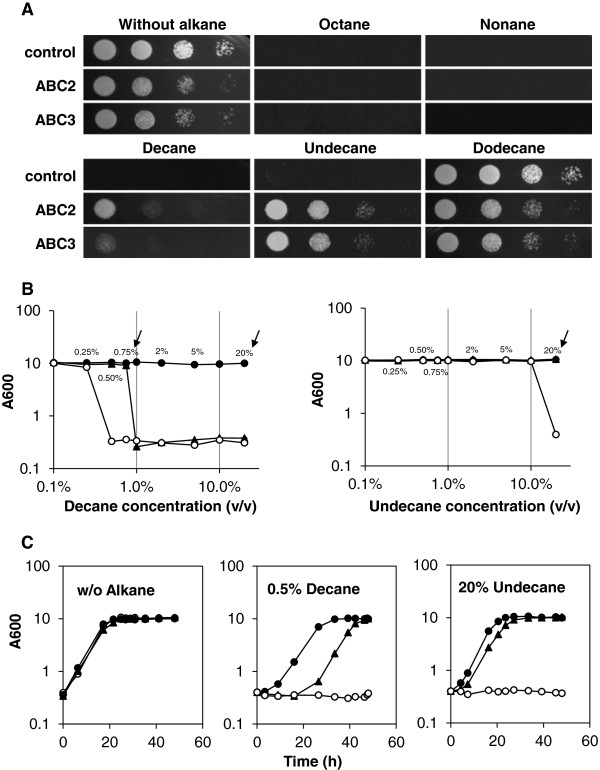
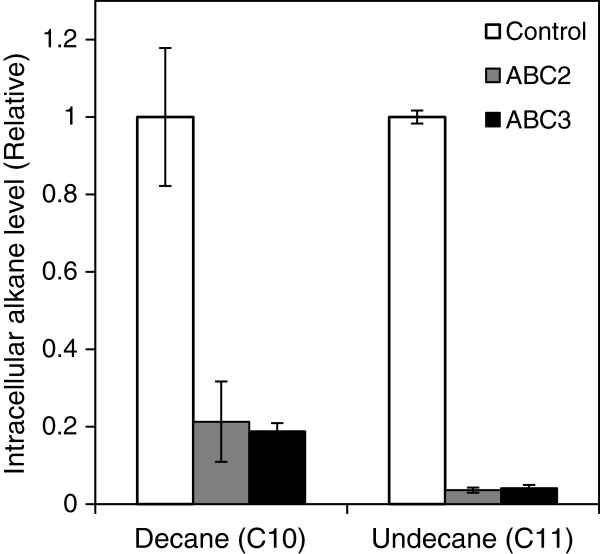
To this end, we attempted to exploit ABC transporters in Yarrowia lipolytica based on the observation that it utilizes alkanes as a carbon source. We confirmed the increased transcription of ABC2 and ABC3 transporters upon exposure to a range of alkanes in Y. lipolytica. We then showed that the heterologous expression of ABC2 and ABC3 transporters significantly increased tolerance against decane and undecane in S. cerevisiae through maintaining lower intracellular alkane level. In particular, ABC2 transporter increased the tolerance limit of S. cerevisiae about 80-fold against decane. Furthermore, through site-directed mutagenesis for glutamate (E988 for ABC2, and E989 for ABC3) and histidine (H1020 for ABC2, and H1021 for ABC3), we provided the evidence that glutamate was essential for the activity of ABC2 and ABC3 transporters, with ATP most likely to be hydrolyzed by a catalytic carboxylate mechanism.
Here, we demonstrated that transporter engineering through expression of heterologous efflux pumps led to significantly improved tolerance against alkane biofuels in S. cerevisiae. We believe that our results laid the groundwork for developing robust alkane-producing yeast cells through transporter engineering, which will greatly aid in next-generation alkane biofuel production and recovery.
碳氢化合物烷烃是主要化石燃料的组成部分,被认为是下一代生物燃料,因为最近已经证明它们可以生物合成。然而,高产烷烃的生产需要对烷烃具有抗性的健壮宿主细胞,而烷烃具有细胞毒性。在这项研究中,我们旨在通过利用可能将烷烃泵出的异源转运蛋白来提高酿酒酵母(一种关键的工业微生物宿主)对烷烃的耐受性。
为此,我们试图利用解脂耶氏酵母中的 ABC 转运蛋白,这是基于观察到它将烷烃用作碳源。我们证实了在解脂耶氏酵母中,当暴露于一系列烷烃时,ABC2 和 ABC3 转运蛋白的转录增加。然后,我们表明通过在酿酒酵母中异源表达 ABC2 和 ABC3 转运蛋白,可以通过维持较低的细胞内烷烃水平来显著提高对癸烷和十一烷的耐受性。特别是,ABC2 转运蛋白使酿酒酵母对癸烷的耐受性提高了约 80 倍。此外,通过对谷氨酸(ABC2 的 E988 和 ABC3 的 E989)和组氨酸(ABC2 的 H1020 和 ABC3 的 H1021)的定点突变,我们提供了证据,证明谷氨酸对 ABC2 和 ABC3 转运蛋白的活性是必不可少的,最有可能通过催化羧酸机制水解 ATP。
在这里,我们证明了通过表达异源外排泵进行转运蛋白工程,可以显著提高酿酒酵母对烷烃生物燃料的耐受性。我们相信,我们的研究结果为通过转运蛋白工程开发健壮的产烷酵母细胞奠定了基础,这将极大地促进下一代烷烃生物燃料的生产和回收。