Biomaterials & Tissue Engineering Division, Department of Endodontics, Prosthodontics and Operative Dentistry, University of Maryland School of Dentistry, Baltimore, MD 21201, USA.
J Dent. 2013 May;41(5):464-74. doi: 10.1016/j.jdent.2013.02.001. Epub 2013 Feb 8.
The objective of this study was to investigate the effects of dentine primer containing dual antibacterial agents, namely, 12-methacryloyloxydodecylpyridinium bromide (MDPB) and nanoparticles of silver (NAg), on dentine bond strength, dental plaque microcosm biofilm response, and fibroblast cytotoxicity for the first time.
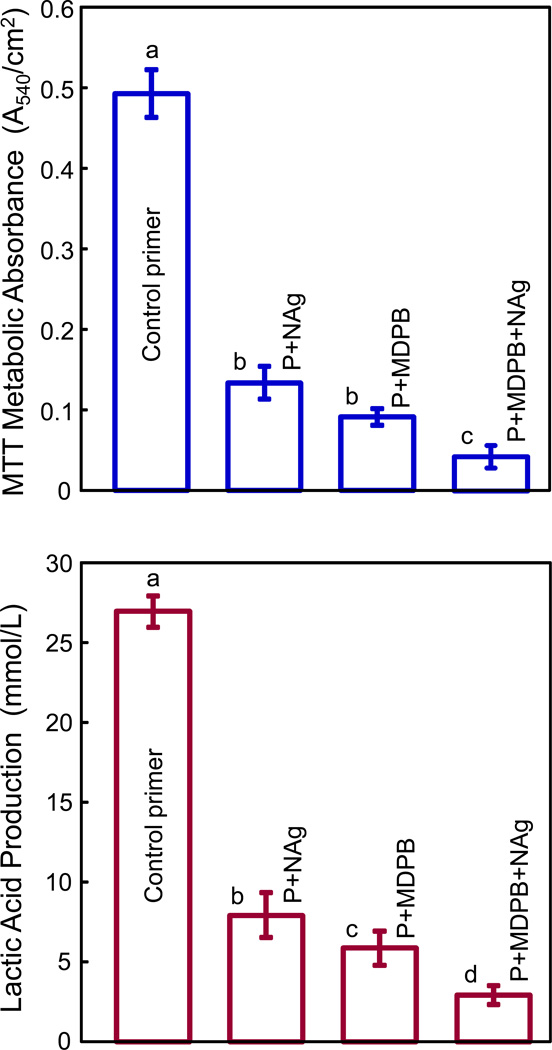
Scotchbond Multi-Purpose (SBMP) was used as the parent bonding agent. Four primers were tested: SBMP primer control (referred to as "P"), P+5% MDPB, P+0.05% NAg, and P+5% MDPB+0.05% NAg. Dentine shear bond strengths were measured using extracted human teeth. Biofilms from the mixed saliva of 10 donors were cultured to investigate metabolic activity, colony-forming units (CFU), and lactic acid production. Human fibroblast cytotoxicity of the four primers was tested in vitro.
Incorporating MDPB and NAg into primer did not reduce dentine bond strength compared to control (p>0.1). SEM revealed well-bonded adhesive-dentine interfaces with numerous resin tags. MDPB or NAg each greatly reduced biofilm viability and acid production, compared to control. Dual agents MDPB+NAg had a much stronger effect than either agent alone (p<0.05), increasing inhibition zone size and reducing metabolic activity, CFU and lactic acid by an order of magnitude, compared to control. There was no difference in cytotoxicity between commercial control and antibacterial primers (p>0.1).
The method of using dual agents MDPB+NAg in the primer yielded potent antibacterial properties. Hence, this method may be promising to combat residual bacteria in tooth cavity and invading bacteria at the margins. The dual agents MDPB+NAg may have wide applicability to other adhesives, composites, sealants and cements to inhibit biofilms and caries.
本研究旨在首次探讨含有双抗菌剂(12-甲丙烯氧十二烷基溴化吡啶鎓(MDPB)和纳米银(NAg))的牙本质底漆对牙本质粘结强度、牙菌斑微生态生物膜反应和成纤维细胞细胞毒性的影响。
使用 Scotchbond Multi-Purpose(SBMP)作为母体粘结剂。测试了四种底漆:SBMP 底漆对照(简称“P”)、P+5% MDPB、P+0.05% NAg 和 P+5% MDPB+0.05% NAg。使用从 10 位供体混合唾液中培养的生物膜来检测代谢活性、菌落形成单位(CFU)和乳酸生成。在体外测试了四种底漆对人成纤维细胞的细胞毒性。
与对照相比,将 MDPB 和 NAg 掺入底漆中并未降低牙本质粘结强度(p>0.1)。SEM 显示,具有大量树脂突的粘结剂-牙本质界面结合良好。与对照相比,MDPB 或 NAg 均能显著降低生物膜的活力和产酸。与单独使用任一试剂相比,双试剂 MDPB+NAg 的作用要强得多(p<0.05),与对照相比,抑菌圈的大小增加,代谢活性、CFU 和乳酸减少一个数量级。商业对照和抗菌底漆之间的细胞毒性没有差异(p>0.1)。
使用双试剂 MDPB+NAg 的底漆方法具有很强的抗菌性能。因此,这种方法可能有望对抗牙腔内残留的细菌和边缘入侵的细菌。双试剂 MDPB+NAg 可能广泛适用于其他黏合剂、复合材料、密封剂和水泥,以抑制生物膜和龋齿。