Institute of Evolutionary Biology (CSIC-Universitat Pompeu Fabra), CEXS-UPF-PRBB, Barcelona, Catalonia, Spain.
BMC Evol Biol. 2013 Feb 23;13:52. doi: 10.1186/1471-2148-13-52.
Visual perception is initiated in the photoreceptor cells of the retina via the phototransduction system. This system has shown marked evolution during mammalian divergence in such complex attributes as activation time and recovery time. We have performed a molecular evolutionary analysis of proteins involved in mammalian phototransduction in order to unravel how the action of natural selection has been distributed throughout the system to evolve such traits.
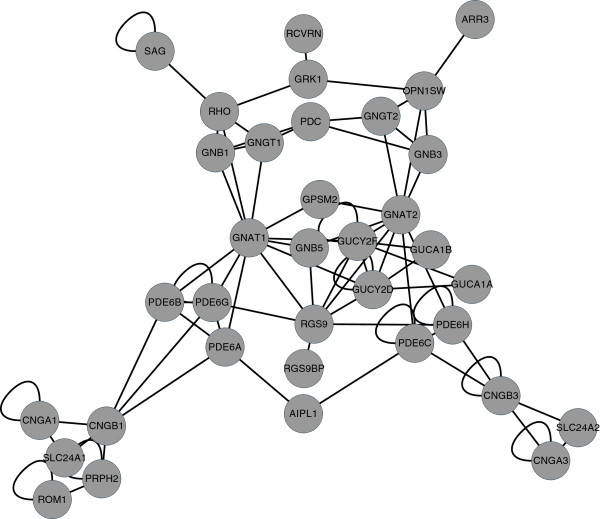
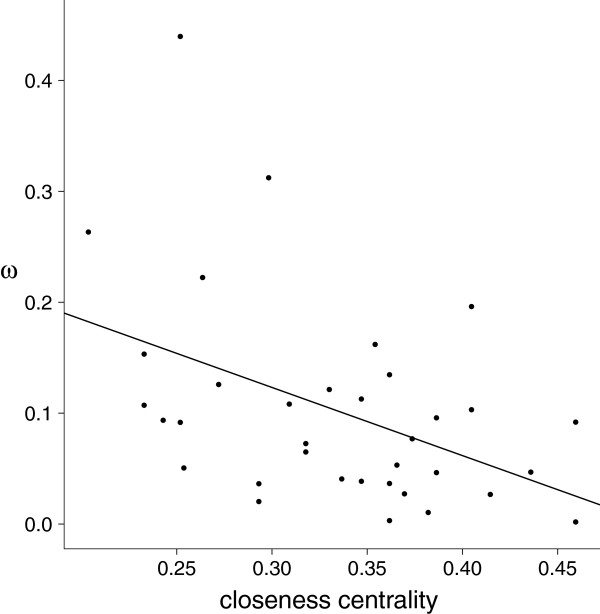
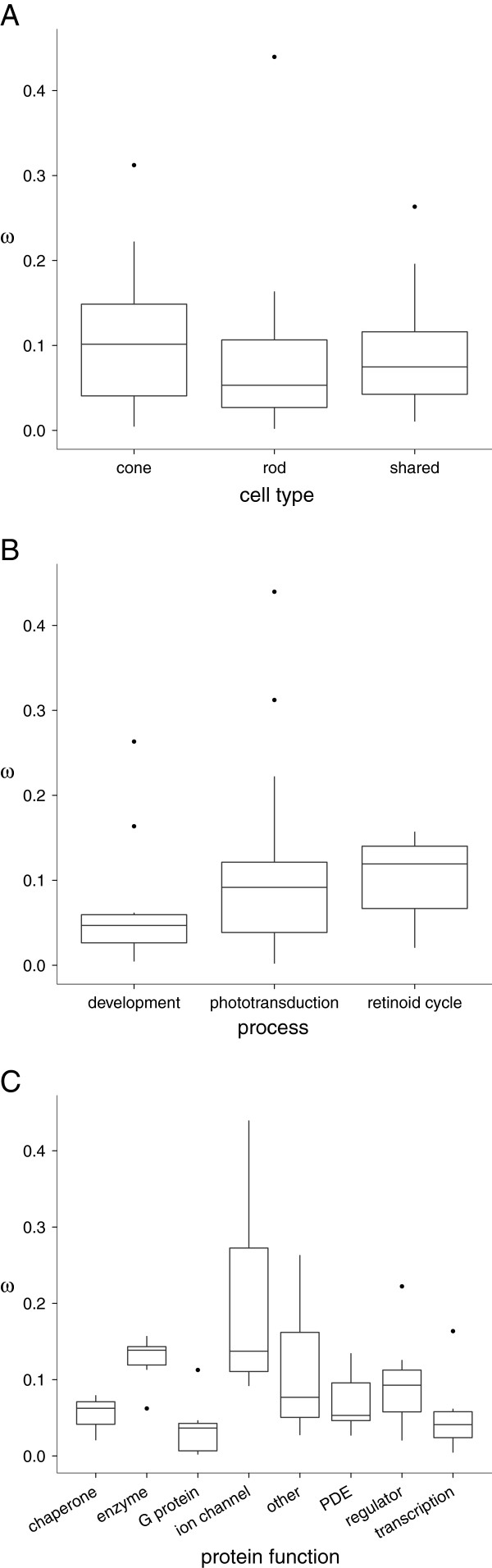
We found selective pressures to be non-randomly distributed according to both a simple protein classification scheme and a protein-interaction network representation of the signaling pathway. Proteins which are topologically central in the signaling pathway, such as the G proteins, as well as retinoid cycle chaperones and proteins involved in photoreceptor cell-type determination, were found to be more constrained in their evolution. Proteins peripheral to the pathway, such as ion channels and exchangers, as well as the retinoid cycle enzymes, have experienced a relaxation of selective pressures. Furthermore, signals of positive selection were detected in two genes: the short-wave (blue) opsin (OPN1SW) in hominids and the rod-specific Na+/ Ca2+, K+ ion exchanger (SLC24A1) in rodents.
The functions of the proteins involved in phototransduction and the topology of the interactions between them have imposed non-random constraints on their evolution. Thus, in shaping or conserving system-level phototransduction traits, natural selection has targeted the underlying proteins in a concerted manner.
视觉感知是通过光感受器细胞中的光转导系统在视网膜中启动的。在哺乳动物的分化过程中,这个系统在激活时间和恢复时间等复杂属性上表现出了明显的进化。我们对参与哺乳动物光转导的蛋白质进行了分子进化分析,以揭示自然选择的作用是如何分布在整个系统中,从而进化出这些特征的。
我们发现,选择压力的分布既不是随机的,也不是根据简单的蛋白质分类方案,而是根据信号通路的蛋白质相互作用网络表示。在信号通路中拓扑上处于中心位置的蛋白质,如 G 蛋白、视黄醛循环伴侣蛋白和参与光感受器细胞类型决定的蛋白质,其进化受到更多的限制。位于通路外围的蛋白质,如离子通道和交换器,以及视黄醛循环酶,其选择压力已经放松。此外,在两个基因中检测到了正选择的信号:灵长类动物中的短波(蓝色)视蛋白(OPN1SW)和啮齿动物中的 rod 特异性 Na+/Ca2+,K+ 离子交换器(SLC24A1)。
参与光转导的蛋白质的功能和它们之间相互作用的拓扑结构对它们的进化施加了非随机的限制。因此,在塑造或保护系统水平的光转导特征时,自然选择以协同的方式针对潜在的蛋白质。