Narasimhan Padmanesan, Wood James, Macintyre Chandini Raina, Mathai Dilip
School of Public Health and Community Medicine, The University of New South Wales, Kensington, Sydney, NSW 2052, Australia.
Pulm Med. 2013;2013:828939. doi: 10.1155/2013/828939. Epub 2013 Feb 12.
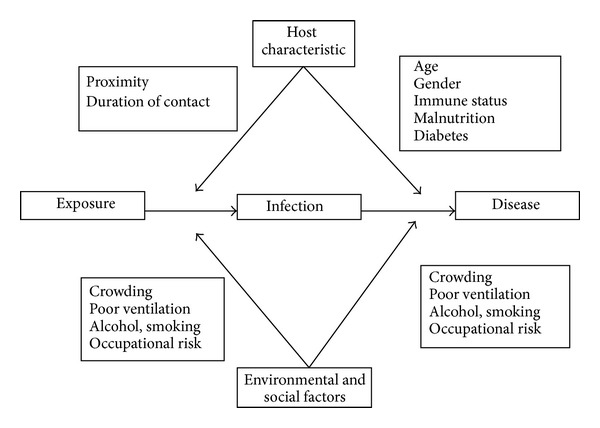
The risk of progression from exposure to the tuberculosis bacilli to the development of active disease is a two-stage process governed by both exogenous and endogenous risk factors. Exogenous factors play a key role in accentuating the progression from exposure to infection among which the bacillary load in the sputum and the proximity of an individual to an infectious TB case are key factors. Similarly endogenous factors lead in progression from infection to active TB disease. Along with well-established risk factors (such as human immunodeficiency virus (HIV), malnutrition, and young age), emerging variables such as diabetes, indoor air pollution, alcohol, use of immunosuppressive drugs, and tobacco smoke play a significant role at both the individual and population level. Socioeconomic and behavioral factors are also shown to increase the susceptibility to infection. Specific groups such as health care workers and indigenous population are also at an increased risk of TB infection and disease. This paper summarizes these factors along with health system issues such as the effects of delay in diagnosis of TB in the transmission of the bacilli.
从接触结核杆菌发展到活动性疾病的风险是一个两阶段过程,受外源性和内源性风险因素共同影响。外源性因素在加剧从接触到感染的进展过程中起关键作用,其中痰中的杆菌载量以及个体与传染性结核病病例的接近程度是关键因素。同样,内源性因素导致从感染发展到活动性结核病。除了已确定的风险因素(如人类免疫缺陷病毒(HIV)、营养不良和年轻)外,糖尿病、室内空气污染、酒精、使用免疫抑制药物和烟草烟雾等新出现的变量在个体和人群层面都起着重要作用。社会经济和行为因素也显示会增加感染易感性。医护人员和原住民等特定群体感染结核病和患病的风险也更高。本文总结了这些因素以及卫生系统问题,如结核病诊断延迟在杆菌传播中的影响。