Department of Functional Pharmacology, Institute of Molecular Pharmacology, Research Centre for Natural Sciences, Hungarian Academy of Science, Budapest, Hungary.
J Nanobiotechnology. 2013 Apr 4;11:9. doi: 10.1186/1477-3155-11-9.
The potential nanocarrier polyamidoamine (PAMAM) generation 5 (G5-NH(2)) dendrimer has been shown to evoke lasting neuronal depolarization and cell death in a concentration-dependent manner. In this study we explored the early progression of G5-NH(2) action in brain tissue on neuronal and astroglial cells.
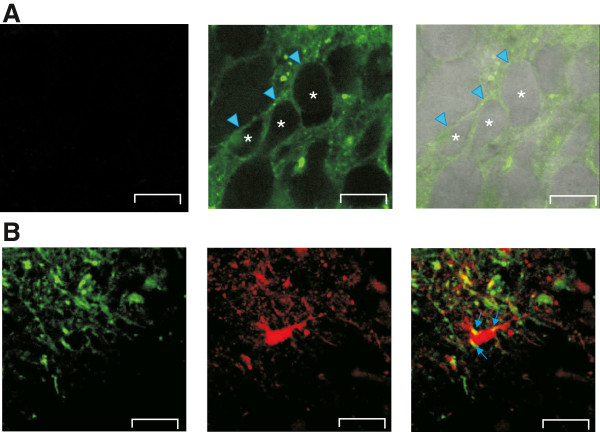
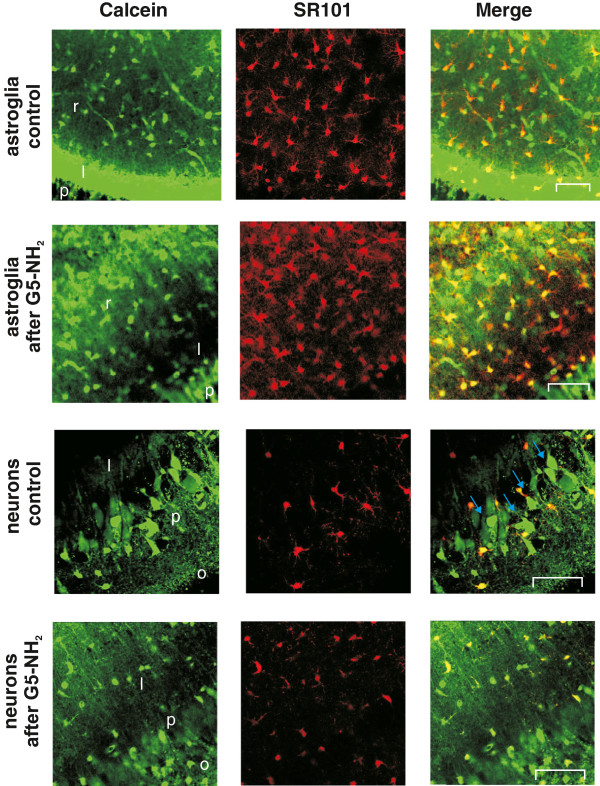
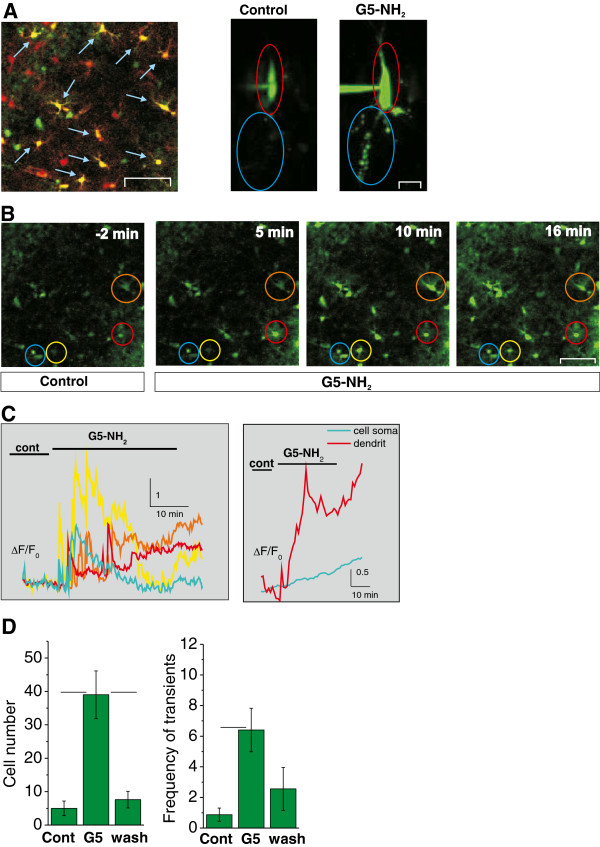
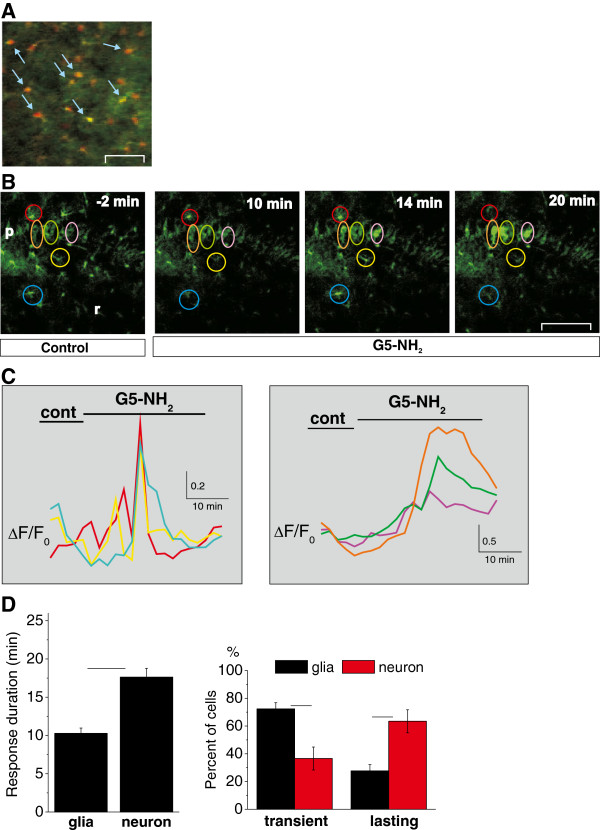
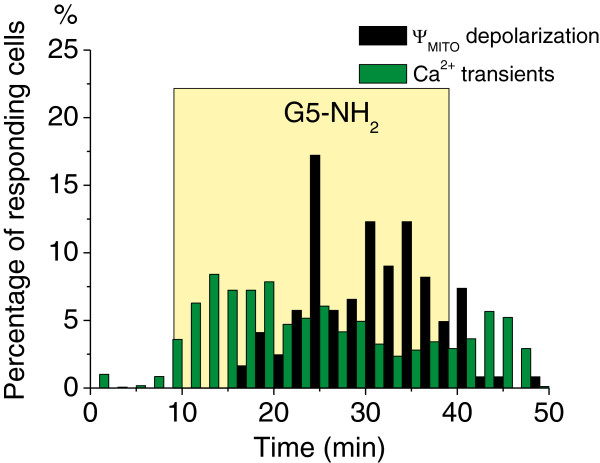
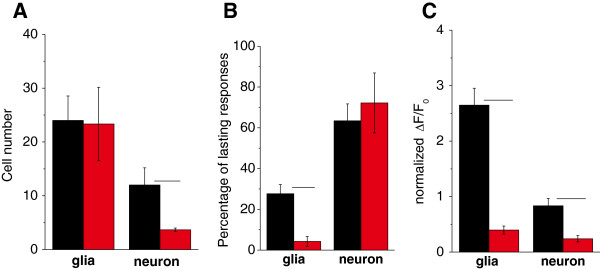
In order to describe early mechanisms of G5-NH(2) dendrimer action in brain tissue we assessed G5-NH(2) trafficking, free intracellular Ca(2+) and mitochondrial membrane potential (Ψ(MITO)) changes in the rat hippocampal slice by microfluorimetry. With the help of fluorescent dye conjugated G5-NH(2), we observed predominant appearance of the dendrimer in the plasma membrane of pyramidal neurons and glial cells within 30 min. Under this condition, G5-NH(2) evoked robust intracellular Ca(2+) enhancements and Ψ(MITO) depolarization both in pyramidal neurons and astroglial cells. Intracellular Ca(2+) enhancements clearly preceded Ψ(MITO) depolarization in astroglial cells. Comparing activation dynamics, neurons and glia showed prevalence of lasting and transient Ψ(MITO) depolarization, respectively. Transient as opposed to lasting Ψ(MITO) changes to short-term G5-NH(2) application suggested better survival of astroglia, as observed in the CA3 stratum radiatum area. We also showed that direct effect of G5-NH(2) on astroglial Ψ(MITO) was significantly enhanced by neuron-astroglia interaction, subsequent to G5-NH(2) evoked neuronal activation.
These findings indicate that the interaction of the PAMAM dendrimer with the plasma membrane leads to robust activation of neurons and astroglial cells, leading to mitochondrial depolarization. Distinguishable dynamics of mitochondrial depolarization in neurons and astroglia suggest that the enhanced mitochondrial depolarization followed by impaired oxidative metabolism of neurons may be the primary basis of neurotoxicity.
聚酰胺胺(PAMAM)树枝状大分子第五代(G5-NH2)已被证明能以浓度依赖的方式引起神经元持续去极化和细胞死亡。本研究旨在探索 G5-NH2 在脑组织中的作用早期进展对神经元和神经胶质细胞的影响。
为了描述 G5-NH2 树枝状大分子在脑组织中的早期作用机制,我们通过微荧光法评估了 G5-NH2 在大鼠海马切片中的转运、游离细胞内 Ca2+和线粒体膜电位(Ψ(MITO))的变化。借助荧光染料偶联的 G5-NH2,我们观察到在 30 分钟内,树枝状大分子主要出现在锥体神经元和神经胶质细胞的质膜中。在此条件下,G5-NH2 可引起锥体神经元和神经胶质细胞内 Ca2+明显增强和 Ψ(MITO)去极化。在神经胶质细胞中,细胞内 Ca2+增强明显先于 Ψ(MITO)去极化。与激活动力学相比,神经元和神经胶质细胞表现出持久和短暂 Ψ(MITO)去极化的优势。与短期 G5-NH2 应用相比,短暂 Ψ(MITO)变化表明神经胶质细胞的存活更好,如 CA3 辐射层区域观察到的那样。我们还表明,G5-NH2 对神经胶质细胞 Ψ(MITO)的直接作用在 G5-NH2 激活神经元后,通过神经元-神经胶质细胞相互作用显著增强。
这些发现表明 PAMAM 树枝状大分子与质膜的相互作用导致神经元和神经胶质细胞的强烈激活,导致线粒体去极化。神经元和神经胶质细胞中线粒体去极化的可区分动力学表明,随后神经元氧化代谢受损的线粒体去极化可能是神经毒性的主要基础。