College of Life Science, Jilin University, Changchun, China.
PLoS One. 2013 Apr 11;8(4):e60553. doi: 10.1371/journal.pone.0060553. Print 2013.
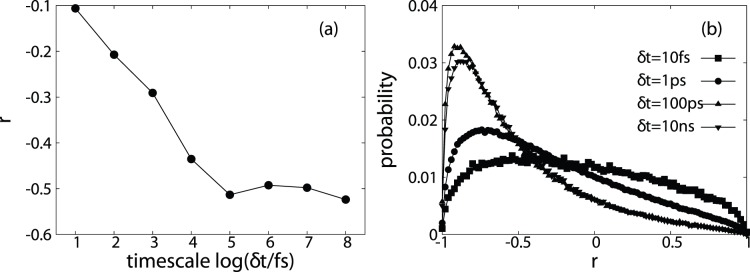
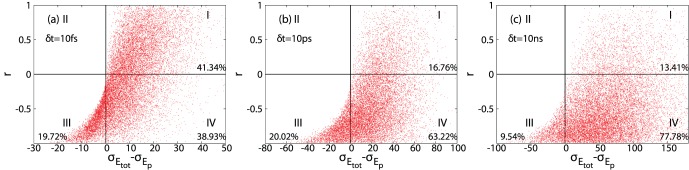
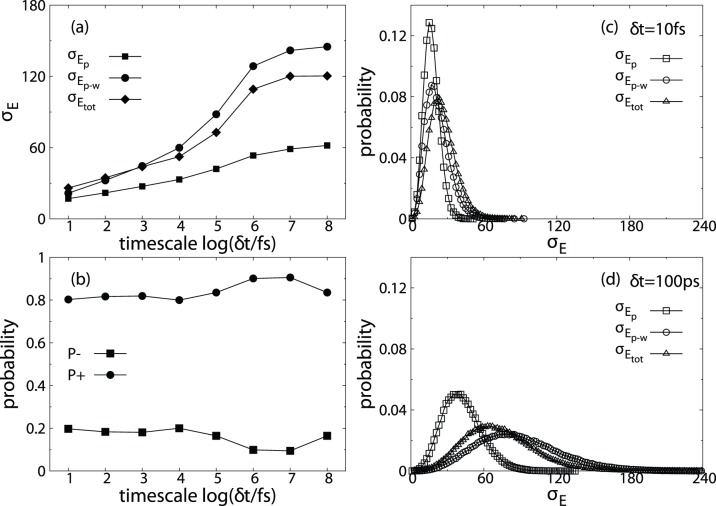
Proteins accomplish their physiological functions with remarkably organized dynamic transitions among a hierarchical network of conformational substates. Despite the essential contribution of water molecules in shaping functionally important protein dynamics, their exact role is still controversial. Water molecules were reported either as mediators that facilitate or as masters that slave protein dynamics. Since dynamic behaviour of a given protein is ultimately determined by the underlying energy landscape, we systematically analysed protein self energies and protein-water interaction energies obtained from extensive molecular dynamics simulation trajectories of barstar. We found that protein-water interaction energy plays the dominant role when compared with protein self energy, and these two energy terms on average have negative correlation that increases with increasingly longer time scales ranging from 10 femtoseconds to 100 nanoseconds. Water molecules effectively roughen potential energy surface of proteins in the majority part of observed conformational space and smooth in the remaining part. These findings support a scenario wherein water on average slave protein conformational dynamics but facilitate a fraction of transitions among different conformational substates, and reconcile the controversy on the facilitating and slaving roles of water molecules in protein conformational dynamics.
蛋白质通过在层次化构象亚稳态网络中进行显著有序的动态转变来实现其生理功能。尽管水分子在塑造具有重要功能的蛋白质动力学方面发挥了重要作用,但它们的确切作用仍存在争议。水分子既可以作为促进或控制蛋白质动力学的介体,也可以作为蛋白质动力学的奴隶。由于给定蛋白质的动态行为最终取决于其潜在的能量景观,因此我们系统地分析了来自 barstar 的广泛分子动力学模拟轨迹中获得的蛋白质自能和蛋白质-水相互作用能。我们发现,与蛋白质自能相比,蛋白质-水相互作用能起着主导作用,并且这两个能量项的平均值具有负相关关系,这种相关性随着时间尺度的增加而增加,时间尺度范围从 10 飞秒到 100 纳秒。水分子在观察到的构象空间的大部分区域有效地使蛋白质的势能表面变得粗糙,而在其余部分则使表面变得平滑。这些发现支持了这样一种情景,即水分子平均控制蛋白质构象动力学,但促进了不同构象亚稳态之间的一部分转变,调和了水分子在蛋白质构象动力学中促进和控制作用的争议。