• 文献检索
  • 文档翻译
  • 深度研究
  • 学术资讯
  • Suppr Zotero 插件Zotero 插件
  • 邀请有礼
  • 套餐&价格
  • 历史记录
应用&插件
Suppr Zotero 插件Zotero 插件浏览器插件Mac 客户端Windows 客户端微信小程序
定价
高级版会员购买积分包购买API积分包
服务
文献检索文档翻译深度研究API 文档MCP 服务
关于我们
关于 Suppr公司介绍联系我们用户协议隐私条款
关注我们

Suppr 超能文献

核心技术专利:CN118964589B侵权必究
粤ICP备2023148730 号-1Suppr @ 2026

文献检索

告别复杂PubMed语法,用中文像聊天一样搜索,搜遍4000万医学文献。AI智能推荐,让科研检索更轻松。

立即免费搜索

文件翻译

保留排版,准确专业,支持PDF/Word/PPT等文件格式,支持 12+语言互译。

免费翻译文档

深度研究

AI帮你快速写综述,25分钟生成高质量综述,智能提取关键信息,辅助科研写作。

立即免费体验

节食状态影响青少年饮食模式与身体成分之间的关联:一项横断面研究。

Dieting status influences associations between dietary patterns and body composition in adolescents: a cross-sectional study.

机构信息

Department of Human Nutrition, University of Otago, PO Box 56, Dunedin 9054, New Zealand.

出版信息

Nutr J. 2013 Apr 24;12:51. doi: 10.1186/1475-2891-12-51.

DOI:10.1186/1475-2891-12-51
PMID:23617772
原文链接:https://pmc.ncbi.nlm.nih.gov/articles/PMC3646700/
Abstract

BACKGROUND

Associations between food choice and body composition in previous studies of adolescents have been inconsistent. This may be due to the body composition measures used, or these associations may be affected by the dieting status of adolescents. The objective of this study was to investigate the association between dietary patterns and body composition in adolescents, and determine if these associations are moderated by dieting status.

METHODS

Information on food consumption and current dieting status was collected, using a web-based survey, in 681 adolescents (mean age 15.8 (SD 0.9) years) from schools in Otago, New Zealand. Non-dieters were defined as those reporting not being on a diet as they were "happy with their weight". Principal components analysis (PCA) was used to determine dietary patterns. Body mass index (BMI), waist circumference (WC), waist-to-height ratio (WHtR), fat mass index (FMI), and fat-free mass index (FFMI) were examined as outcomes. Generalized estimating equations were used to examine associations between dietary patterns and body composition.

RESULTS

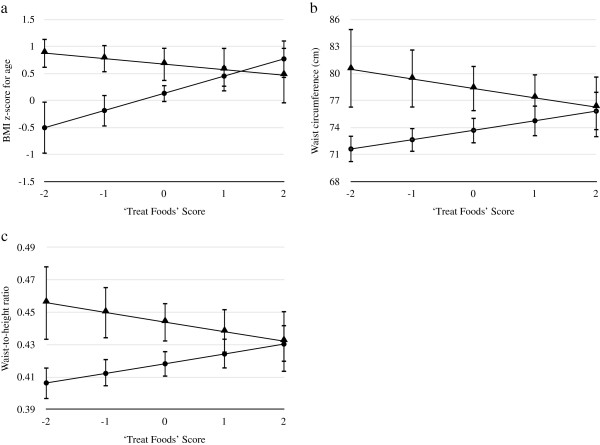
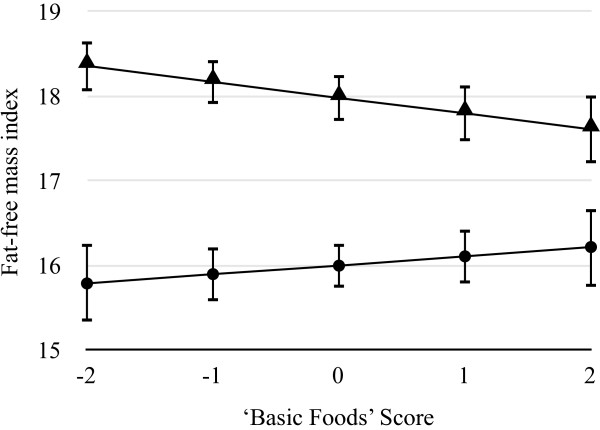
PCA produced three dietary patterns: 'Treat Foods', 'Fruits and Vegetables', and 'Basic Foods'. A standard deviation increase in 'Basic Foods' was associated with a 3.58% decrease in FMI (95%CI -6.14, -0.94) in the total sample. When separate sex analysis was undertaken significant negative associations were found in boys only, between the 'Basic Food' score and WC, WHtR, FMI, and FFMI, while the 'Fruits and Vegetables' pattern was negatively associated with FMI. Associations between 'Treat Foods' and BMI, WC, and WHtR in non-dieters were positive, while these associations were negative for all other participants.

CONCLUSIONS

Significant associations were found between dietary patterns and indices of both central and total adiposity, but not BMI. Therefore using only BMI measures may not be useful in this age group. Since our results were significant for boys and not girls, nutrition messages designed to prevent obesity may be particularly important for adolescent boys. As an interaction between dieting status and 'Treat Foods' existed, future studies should also explore the role of dieting when investigating food choice and body composition.

摘要

背景

以往青少年的食物选择与身体成分的研究结果并不一致。这可能是由于所使用的身体成分测量方法不同,或者这些关联可能受到青少年节食状态的影响。本研究的目的是调查青少年饮食模式与身体成分之间的关系,并确定这些关联是否受到节食状态的调节。

方法

在新西兰奥塔哥的学校,通过网络调查收集了 681 名青少年(平均年龄 15.8(0.9)岁)的食物消费和当前节食状态信息。非节食者被定义为那些报告自己“对体重满意”而不节食的人。采用主成分分析(PCA)确定饮食模式。将体重指数(BMI)、腰围(WC)、腰高比(WHtR)、脂肪质量指数(FMI)和去脂体重指数(FFMI)作为研究结果。采用广义估计方程检验饮食模式与身体成分之间的关系。

结果

PCA 产生了三种饮食模式:“款待食品”、“水果和蔬菜”和“基础食品”。在总样本中,“基础食品”的标准差增加与 FMI 降低 3.58%(95%CI -6.14,-0.94)相关。当进行单独的性别分析时,仅在男孩中发现“基础食品”得分与 WC、WHtR、FMI 和 FFMI 之间存在显著负相关,而“水果和蔬菜”模式与 FMI 呈负相关。非节食者中,“款待食品”与 BMI、WC 和 WHtR 之间存在正相关,而对于所有其他参与者,这些关联则为负相关。

结论

饮食模式与中心和总体肥胖的指标之间存在显著关联,但与 BMI 无关。因此,仅使用 BMI 测量可能对该年龄组不适用。由于我们的结果仅在男孩中显著,而在女孩中不显著,因此设计用于预防肥胖的营养信息可能对青少年男孩尤为重要。由于节食状态与“款待食品”之间存在交互作用,因此未来的研究还应在研究食物选择与身体成分时探讨节食的作用。
https://cdn.ncbi.nlm.nih.gov/pmc/blobs/be4f/3646700/62b9dca455b1/1475-2891-12-51-2.jpg
https://cdn.ncbi.nlm.nih.gov/pmc/blobs/be4f/3646700/63e43d3e9ddc/1475-2891-12-51-1.jpg
https://cdn.ncbi.nlm.nih.gov/pmc/blobs/be4f/3646700/62b9dca455b1/1475-2891-12-51-2.jpg
https://cdn.ncbi.nlm.nih.gov/pmc/blobs/be4f/3646700/63e43d3e9ddc/1475-2891-12-51-1.jpg
https://cdn.ncbi.nlm.nih.gov/pmc/blobs/be4f/3646700/62b9dca455b1/1475-2891-12-51-2.jpg

相似文献

1
Dieting status influences associations between dietary patterns and body composition in adolescents: a cross-sectional study.节食状态影响青少年饮食模式与身体成分之间的关联:一项横断面研究。
Nutr J. 2013 Apr 24;12:51. doi: 10.1186/1475-2891-12-51.
2
Sleep duration and adiposity in older adolescents from Otago, New Zealand: relationships differ between boys and girls and are independent of food choice.新西兰奥塔哥地区青少年的睡眠时间与肥胖状况:男孩和女孩之间的关系存在差异,且与食物选择无关。
Nutr J. 2013 Sep 14;12:128. doi: 10.1186/1475-2891-12-128.
3
Cardiorespiratory fitness is positively associated with a healthy dietary pattern in New Zealand adolescents.在新西兰青少年中,心肺适能与健康的饮食模式呈正相关。
Public Health Nutr. 2016 May;19(7):1279-87. doi: 10.1017/S1368980015002566. Epub 2015 Sep 8.
4
Diet quality is associated with measures of body fat in adolescents from Otago, New Zealand.饮食质量与新西兰奥塔哥地区青少年的体脂测量指标相关。
Public Health Nutr. 2015 Jun;18(8):1453-60. doi: 10.1017/S1368980014001645. Epub 2014 Aug 27.
5
The cross-sectional association between snacking behaviour and measures of adiposity: the Fenland Study, UK.零食摄入行为与肥胖指标之间的横断面关联:英国芬兰研究
Br J Nutr. 2015 Oct 28;114(8):1286-93. doi: 10.1017/S000711451500269X. Epub 2015 Sep 7.
6
Food Consumption Patterns and Body Composition in Children: Moderating Effects of Prop Taster Status.儿童的食物消费模式与身体成分:味觉 Prop 状态的调节作用。
Nutrients. 2019 Aug 31;11(9):2037. doi: 10.3390/nu11092037.
7
Attitudes to food differ between adolescent dieters and non-dieters from Otago, New Zealand, but overall food intake does not.新西兰奥塔哥的青少年节食者和非节食者对食物的态度不同,但总体食物摄入量没有差异。
Public Health Nutr. 2013 Jan;16(1):36-45. doi: 10.1017/S1368980012001152. Epub 2012 May 11.
8
Association between dietary patterns and adiposity from 4 to 7 years of age.4 至 7 岁儿童饮食模式与肥胖的相关性。
Public Health Nutr. 2017 Aug;20(11):1973-1982. doi: 10.1017/S1368980017000854. Epub 2017 May 23.
9
[Simple obesity in children. A study on the role of nutritional factors].[儿童单纯性肥胖。营养因素作用的研究]
Med Wieku Rozwoj. 2006 Jan-Mar;10(1):3-191.
10
A priori and a posteriori dietary patterns at the age of 1 year and body composition at the age of 6 years: the Generation R Study.1岁时的先验和后验饮食模式与6岁时的身体组成:Generation R研究
Eur J Epidemiol. 2016 Aug;31(8):775-83. doi: 10.1007/s10654-016-0179-x. Epub 2016 Jul 6.

引用本文的文献

1
The relationships between dietary patterns and socioeconomic status with anthropometric and body composition indices in Iranian preschool children: A cross-sectional study.伊朗学龄前儿童的饮食模式和社会经济地位与人体测量及身体成分指标之间的关系:一项横断面研究。
Obes Sci Pract. 2023 Aug 14;10(1):e704. doi: 10.1002/osp4.704. eCollection 2024 Feb.
2
Smartphone camera based assessment of adiposity: a validation study.基于智能手机摄像头的肥胖评估:一项验证研究。
NPJ Digit Med. 2022 Jun 29;5(1):79. doi: 10.1038/s41746-022-00628-3.
3
Association between dietary patterns and body composition in normal-weight subjects with metabolic syndrome.

本文引用的文献

1
The Scree Test For The Number Of Factors.因子数量的碎石检验
Multivariate Behav Res. 1966 Apr 1;1(2):245-76. doi: 10.1207/s15327906mbr0102_10.
2
Reliability and relative validity of a food frequency questionnaire to assess food group intakes in New Zealand adolescents.评估新西兰青少年食物摄入的食物频率问卷的可靠性和相对有效性。
Nutr J. 2012 Sep 5;11:65. doi: 10.1186/1475-2891-11-65.
3
Extended international (IOTF) body mass index cut-offs for thinness, overweight and obesity.国际肥胖工作组(IOTF)制定的消瘦、超重和肥胖的扩展身体质量指数临界值。
体重正常的代谢综合征患者的饮食模式与身体成分之间的关联
J Diabetes Metab Disord. 2022 May 28;21(1):735-741. doi: 10.1007/s40200-022-01043-x. eCollection 2022 Jun.
4
Breakfast Dietary Pattern Is Inversely Associated with Overweight/Obesity in European Adolescents: The HELENA Study.早餐饮食模式与欧洲青少年超重/肥胖呈负相关:HELENA研究
Children (Basel). 2021 Nov 12;8(11):1044. doi: 10.3390/children8111044.
5
Dietary patterns associated with meeting the WHO free sugars intake guidelines.与符合世卫组织游离糖摄入量指南相关的饮食模式。
Public Health Nutr. 2020 Jun;23(9):1495-1506. doi: 10.1017/S1368980019004543. Epub 2020 Apr 8.
6
Reproducibility of A Non-Quantitative Food Frequency Questionnaire (62-Item FFQ-6) and PCA-Driven Dietary Pattern Identification in 13-21-Year-Old Females.13-21 岁女性中,非定量食物频率问卷(62 项 FFQ-6)的可重复性和 PCA 驱动的饮食模式识别。
Nutrients. 2019 Sep 11;11(9):2183. doi: 10.3390/nu11092183.
7
Consumption of ultra-processed foods and body fat during childhood and adolescence: a systematic review.儿童和青少年时期食用超加工食品与体脂肪:系统综述。
Public Health Nutr. 2018 Jan;21(1):148-159. doi: 10.1017/S1368980017001331. Epub 2017 Jul 5.
8
A systematic review of factors affecting energy intake of adolescent girls.影响青春期女孩能量摄入因素的系统评价。
Afr Health Sci. 2016 Dec;16(4):910-922. doi: 10.4314/ahs.v16i4.5.
9
Associations between physical activity patterns and dietary patterns in a representative sample of Polish girls aged 13-21 years: a cross-sectional study (GEBaHealth Project).13至21岁波兰女孩代表性样本中身体活动模式与饮食模式的关联:一项横断面研究(GEBaHealth项目)
BMC Public Health. 2016 Aug 2;16:698. doi: 10.1186/s12889-016-3367-4.
10
Analysis of Dietary Pattern Impact on Weight Status for Personalised Nutrition through On-Line Advice: The Food4Me Spanish Cohort.通过在线建议分析饮食模式对个性化营养体重状况的影响:西班牙Food4Me队列研究
Nutrients. 2015 Nov 17;7(11):9523-37. doi: 10.3390/nu7115482.
Pediatr Obes. 2012 Aug;7(4):284-94. doi: 10.1111/j.2047-6310.2012.00064.x. Epub 2012 Jun 19.
4
Dietary patterns: the importance of sex differences.饮食模式:性别差异的重要性。
Br J Nutr. 2012 Aug;108(3):393-4. doi: 10.1017/S0007114511006337. Epub 2012 Jan 3.
5
Association between major patterns of dietary intake and weight status in adolescents.青少年主要饮食模式与体重状况的关系。
Br J Nutr. 2012 Jul;108(2):349-56. doi: 10.1017/S0007114511005435. Epub 2011 Oct 13.
6
Tracking of eating patterns and overweight - a follow-up study of Norwegian schoolchildren from middle childhood to early adolescence.进食模式和超重的追踪 - 对挪威学童从童年中期到青春期早期的随访研究。
Nutr J. 2011 Oct 6;10:106. doi: 10.1186/1475-2891-10-106.
7
Health behaviors, waist circumference and waist-to-height ratio in children.儿童的健康行为、腰围和腰高比。
Eur J Clin Nutr. 2011 Jul;65(7):841-8. doi: 10.1038/ejcn.2011.49. Epub 2011 Apr 13.
8
Multiple sociodemographic and socioenvironmental characteristics are correlated with major patterns of dietary intake in adolescents.多种社会人口学和社会环境特征与青少年的主要饮食摄入模式相关。
J Am Diet Assoc. 2011 Feb;111(2):230-40. doi: 10.1016/j.jada.2010.10.052.
9
Food patterns according to sociodemographics, physical activity, sleeping and obesity in Portuguese children.葡萄牙儿童的社会人口统计学、体力活动、睡眠和肥胖相关的饮食模式。
Int J Environ Res Public Health. 2010 Mar;7(3):1121-38. doi: 10.3390/ijerph7031121. Epub 2010 Mar 17.
10
Weight control behaviors and dietary intake among adolescents and young adults: longitudinal findings from Project EAT.青少年和青年的体重控制行为与饮食摄入:“吃得健康”项目的纵向研究结果
J Am Diet Assoc. 2009 Nov;109(11):1869-77. doi: 10.1016/j.jada.2009.08.016.