Vijaya Lingam, George Ronnie, Asokan Rashima, Velumuri Lokapavani, Ramesh Sathyamangalam Ve
Department of Glaucoma Project, Chennai Glaucoma Study, Vision Research Foundation, Sankara Nethralaya, Chennai, Tamil Nadu, India.
Indian J Ophthalmol. 2014 Apr;62(4):477-81. doi: 10.4103/0301-4738.111186.
To evaluate the prevalence and causes of low vision and blindness in an urban south Indian population.
Population-based cross-sectional study. Exactly 3850 subjects aged 40 years and above from Chennai city were examined at a dedicated facility in the base hospital.
All subjects had a complete ophthalmic examination that included best-corrected visual acuity. Low vision and blindness were defined using World Health Organization (WHO) criteria. The influence of age, gender, literacy, and occupation was assessed using multiple logistic regression.
Chi-square test, t-test, and multivariate analysis were used.
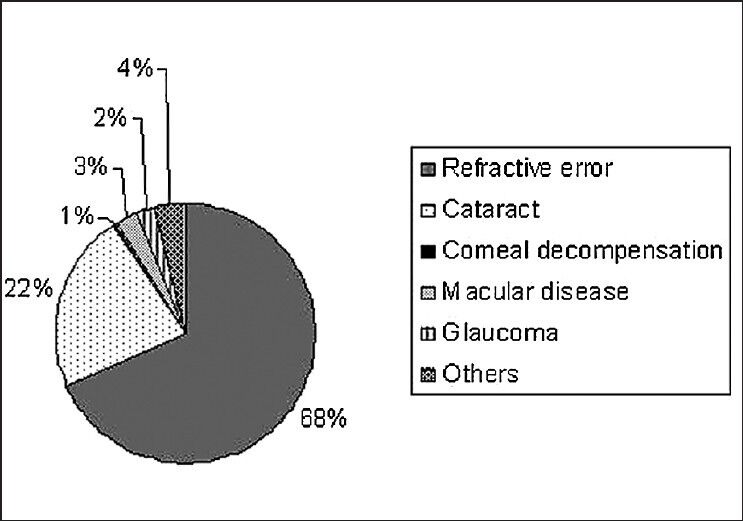
Of the 4800 enumerated subjects, 3850 subjects (1710 males, 2140 females) were examined (response rate, 80.2%). The prevalence of blindness was 0.85% (95% CI 0.6-1.1%) and was positively associated with age and illiteracy. Cataract was the leading cause (57.6%) and glaucoma was the second cause (16.7%) for blindness. The prevalence of low vision was 2.9% (95% CI 2.4-3.4%) and visual impairment (blindness + low vision) was 3.8% (95% CI 3.2-4.4%). The primary causes for low vision were refractive errors (68%) and cataract (22%).
In this urban population based study, cataract was the leading cause for blindness and refractive error was the main reason for low vision.
评估印度南部城市人群中低视力和失明的患病率及病因。
基于人群的横断面研究。在基地医院的一个专门机构对来自钦奈市的3850名40岁及以上的受试者进行了检查。
所有受试者均接受了包括最佳矫正视力在内的全面眼科检查。低视力和失明根据世界卫生组织(WHO)标准进行定义。使用多元逻辑回归评估年龄、性别、识字率和职业的影响。
采用卡方检验、t检验和多变量分析。
在4800名被调查的受试者中,3850名受试者(1710名男性,2140名女性)接受了检查(应答率为80.2%)。失明患病率为0.85%(95%可信区间0.6 - 1.1%),与年龄和文盲率呈正相关。白内障是失明的主要原因(57.6%),青光眼是第二大原因(16.7%)。低视力患病率为2.9%(95%可信区间2.4 - 3.4%),视力损害(失明 + 低视力)为3.8%(95%可信区间3.2 - 4.4%)。低视力的主要原因是屈光不正(68%)和白内障(22%)。
在这项基于城市人群的研究中,白内障是失明的主要原因,屈光不正为低视力的主要原因。