Faculty of Pharmaceutical, Biomedical and Veterinary Sciences, University of Antwerp, Antwerp, Belgium.
Gut Pathog. 2013 Apr 30;5(1):10. doi: 10.1186/1757-4749-5-10.
An altered gut microbiota composition has recently been linked to obesity. The principal aim of this study is to investigate and compare the gut microbiota composition in obese and lean children. Secondly, associations between analysed gut bacterial species, dietary compounds, energy intake and biochemical blood parameters are evaluated.
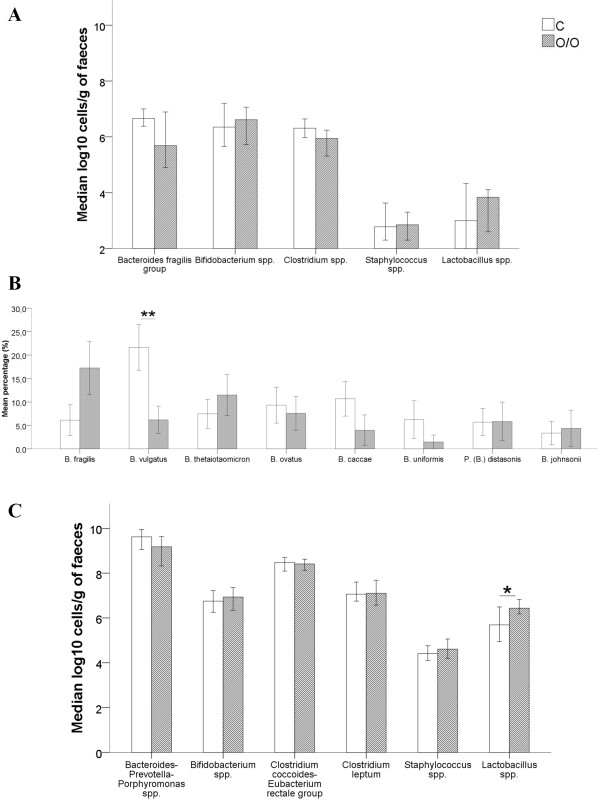
In this prospective cross-sectional study, 26 overweight/obese (mean BMI: 28.7 ± 6.5) and 27 lean (mean BMI: 16.5 ± 2.1) children aged 6 to 16 were included. Faecal samples were collected and subjected to selective plating and quantitative real-time PCR (qPCR) in order to determine the concentrations of bacterial species belonging to the genera: Bacteroides, Bifidobacterium, Clostridium, Staphylococcus and Lactobacillus. Matrix-assisted laser desorption/ionization time-of-flight mass spectrometry (MALDI-TOF MS) was applied for an in-depth identification of species of Bacteroides fragilis group. Differences in the concentrations of gut bacterial species between obese and lean children were statistically analysed using Mann Whitney U test. Subsequently, random forest analysis and multiple linear regression analysis were performed in order to test associations between gut bacterial species, dietary compounds and blood parameters.
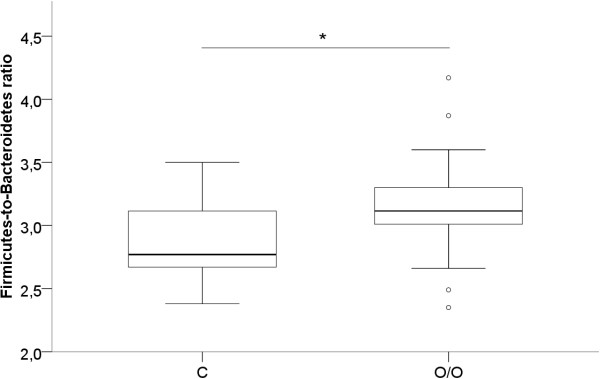
Obese children showed an elevated Firmicutes-to-Bacteroidetes ratio compared with lean children. Furthermore, low relative proportions of B. vulgatus and high concentrations of Lactobacillus spp. were observed in the obese microbiota. In all children, Staphylococcus spp. were positively associated with energy intake. Additionally, in obese children, Lactobacillus spp. were positively associated with plasma hs-CRP.
Our findings corroborate a significant difference in the gut microbiota composition of important bacterial species between obese and lean children. In future, non-invasive manipulation of gut microbiota composition in early infancy could offer a new approach to manage childhood obesity and associated disorders.
最近有研究表明,肠道微生物群落的组成发生改变与肥胖有关。本研究旨在调查和比较肥胖儿童和正常体重儿童的肠道微生物群落组成。其次,评估分析的肠道细菌种类、饮食化合物、能量摄入和生化血液参数之间的相关性。
在这项前瞻性的横断面研究中,纳入了 26 名超重/肥胖(平均 BMI:28.7±6.5)和 27 名正常体重(平均 BMI:16.5±2.1)的 6 至 16 岁儿童。收集粪便样本,进行选择性平板培养和定量实时 PCR(qPCR),以确定属于以下属的细菌种类的浓度:拟杆菌属、双歧杆菌属、梭菌属、葡萄球菌属和乳杆菌属。基质辅助激光解吸/电离飞行时间质谱(MALDI-TOF MS)用于深入鉴定脆弱拟杆菌群的物种。采用 Mann Whitney U 检验对肥胖儿童和正常体重儿童肠道细菌种类浓度的差异进行统计学分析。随后,进行随机森林分析和多元线性回归分析,以检验肠道细菌种类、饮食化合物和血液参数之间的相关性。
肥胖儿童的厚壁菌门/拟杆菌门比值高于正常体重儿童。此外,肥胖儿童的肠道微生物群落中 B. vulgatus 的相对比例较低,乳杆菌属的浓度较高。在所有儿童中,葡萄球菌属与能量摄入呈正相关。此外,在肥胖儿童中,乳杆菌属与血浆 hs-CRP 呈正相关。
本研究结果证实了肥胖儿童和正常体重儿童的肠道微生物群落组成中重要细菌种类存在显著差异。未来,早期非侵入性地改变肠道微生物群落组成可能为管理儿童肥胖及其相关疾病提供新的方法。