School of Biomedical Sciences, Faculty of Medicine, The Chinese University of Hong Kong, New Territories, Hong Kong Special Administration Region, Shatin, People's Republic of China.
BMC Microbiol. 2013 May 10;13:104. doi: 10.1186/1471-2180-13-104.
Avian influenza remains a serious threat to human health. The consequence of human infection varies markedly among different subtypes of avian influenza viruses. In addition to viral factors, the difference in host cellular response is likely to play a critical role. This study aims at elucidating how avian influenza infection perturbs the host's miRNA regulatory pathways that may lead to adverse pathological events, such as cytokine storm, using the miRNA microarray approach.
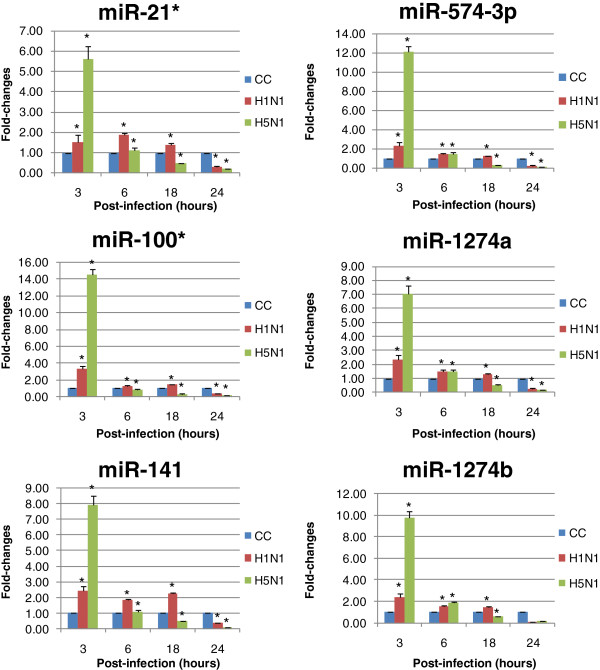
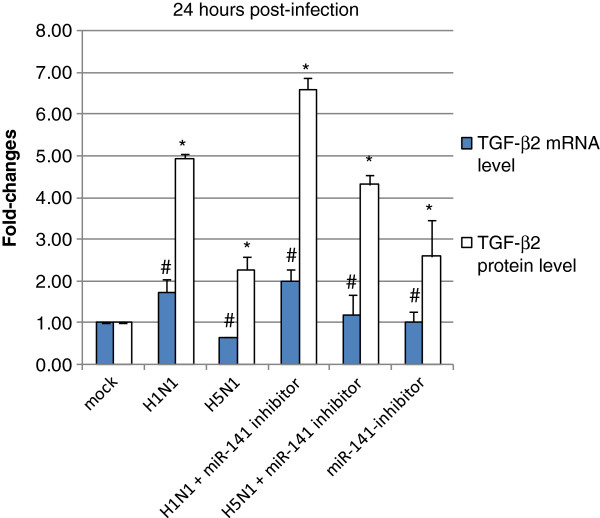
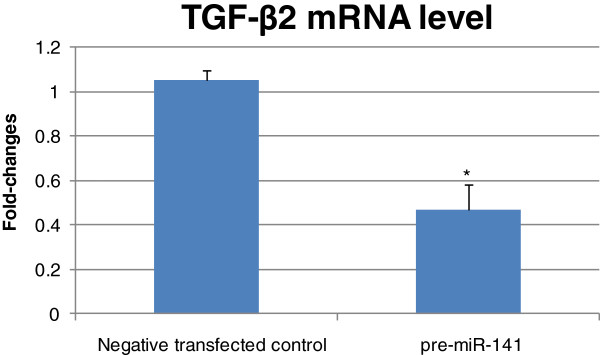
The results showed that dysregulation of miRNA expression was mainly observed in highly pathogenic avian influenza A H5N1 infection. We found that miR-21*, miR-100*, miR-141, miR-574-3p, miR-1274a and miR1274b were differentially expressed in response to influenza A virus infection. Interestingly, we demonstrated that miR-141, which was more highly induced by H5N1 than by H1N1 (p < 0.05), had an ability to suppress the expression of a cytokine - transforming growth factor (TGF)-β2. This was supported by the observation that the inhibitory effect could be reversed by antagomiR-141.
Since TGF-β2 is an important cytokine that can act as both an immunosuppressive agent and a potent proinflammatory molecule through its ability to attract and regulate inflammatory molecules, and previous report showed that only seasonal influenza H1N1 (but not the other avian influenza subtypes) could induce a persistent expression of TGF-β2, we speculate that the modulation of TGF-β2 expression by different influenza subtypes via miR-141 might be a critical step for determining the outcome of either normal or excessive inflammation progression.
禽流感仍然是对人类健康的严重威胁。不同亚型的禽流感病毒感染人类的后果有很大的不同。除了病毒因素外,宿主细胞反应的差异可能起着关键作用。本研究旨在通过 miRNA 微阵列方法阐明禽流感感染如何扰乱宿主的 miRNA 调节途径,从而导致细胞因子风暴等不良病理事件。
结果表明,miRNA 表达的失调主要发生在高致病性禽流感 A H5N1 感染中。我们发现,miR-21*、miR-100*、miR-141、miR-574-3p、miR-1274a 和 miR1274b 对流感病毒感染有差异表达。有趣的是,我们证明了 miR-141 在 H5N1 感染中比 H1N1 感染诱导的更多(p < 0.05),并且能够抑制细胞因子转化生长因子(TGF)-β2 的表达。这一观点得到了以下观察结果的支持:反义 miR-141 可以逆转这种抑制作用。
由于 TGF-β2 是一种重要的细胞因子,它可以通过吸引和调节炎症分子来发挥免疫抑制和促炎分子的作用,并且之前的报告表明只有季节性流感 H1N1(而不是其他禽流感亚型)可以诱导 TGF-β2 的持续表达,我们推测不同流感亚型通过 miR-141 对 TGF-β2 表达的调节可能是决定正常或过度炎症进展结果的关键步骤。