Department of Ophthalmology, Université de Montréal, Montreal, Quebec, Canada.
PLoS One. 2013 May 10;8(5):e63315. doi: 10.1371/journal.pone.0063315. Print 2013.
Using a world-wide, population-based dataset of adults, we sought to determine the frequency of far visual difficulty and its associated risk factors.
The World Health Survey (WHS) was conducted in 70 countries throughout the world in 2003 using a random, multi-stage, stratified, cluster sampling design of adults ages 18 years and older. Far vision was assessed by asking "In the last 30 days, how much difficulty did you have in seeing and recognizing a person you know across the road (i.e. from a distance of about 20 meters)?". Responses included none, mild, moderate, severe, or extreme/unable. The income status of countries was estimated using gross national income per capita data from 2003 from the World Bank. Prevalence and regression estimates were adjusted to account for the complex sample design.
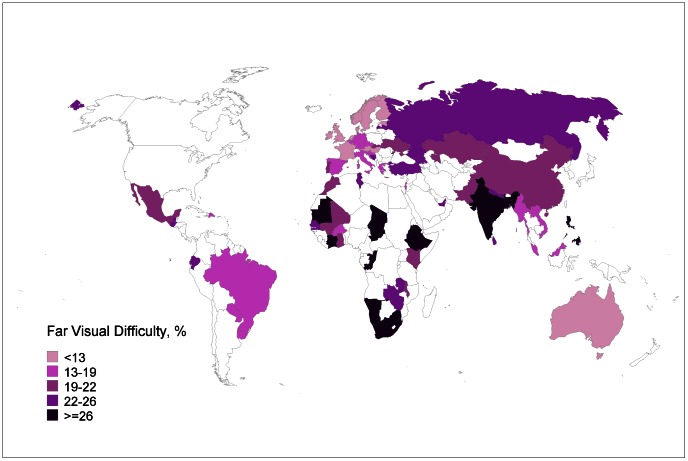
21% of adults reported any visual difficulty. The rate varied by the income status of the country with the percentage who had any visual difficulty being 24%, 23%, and 13% in low, middle, and high income countries, respectively. Five percent of people reported severe or extreme visual difficulty with rates in low, middle, and high income countries of 6%, 5%, and 2% respectively. Risk factors for visual difficulty included older age, female sex, poorer socioeconomic status, little to no formal education, and diabetes (P<0.05).
One out of five adults in the WHS reported some degree of far visual difficulty. Given the importance of vision to living an independent life, better access to quality eye care services and life course factors affecting vision health (e.g. repeated eye infections, diet lacking vitamin A) must receive adequate attention and resources, especially in low and middle income countries.
利用全球成年人的基于人群的数据集,我们旨在确定远视力困难的频率及其相关危险因素。
2003 年,使用随机、多阶段、分层、聚类抽样设计,在全球 70 个国家对 18 岁及以上成年人进行了世界卫生调查(WHS)。远视力通过询问“在过去 30 天里,您在看清和识别马路对面的熟人(即距离约 20 米)方面有多大困难?”来评估。回答包括无、轻度、中度、重度或极重度/无法。各国的收入状况使用世界银行 2003 年的人均国民总收入数据进行估算。使用复杂的样本设计调整了患病率和回归估计值。
21%的成年人报告存在任何视力困难。该比率因国家的收入状况而异,低收入、中等收入和高收入国家分别有 24%、23%和 13%的人有任何视力困难。5%的人报告有严重或极重度视力困难,低收入、中等收入和高收入国家的比例分别为 6%、5%和 2%。视力困难的危险因素包括年龄较大、女性、较低的社会经济地位、很少或没有正规教育以及糖尿病(P<0.05)。
WHS 中有五分之一的成年人报告存在某种程度的远视力困难。鉴于视力对独立生活的重要性,必须更加关注和投入资源,以提供优质的眼保健服务,并解决影响视力健康的全生命周期因素(例如反复眼部感染、缺乏维生素 A 的饮食),特别是在低收入和中等收入国家。