Department for Migration and Immuno-ecology, Max Planck Institute for Ornithology, Seewiesen, Germany.
PLoS One. 2013 May 15;8(5):e63582. doi: 10.1371/journal.pone.0063582. Print 2013.
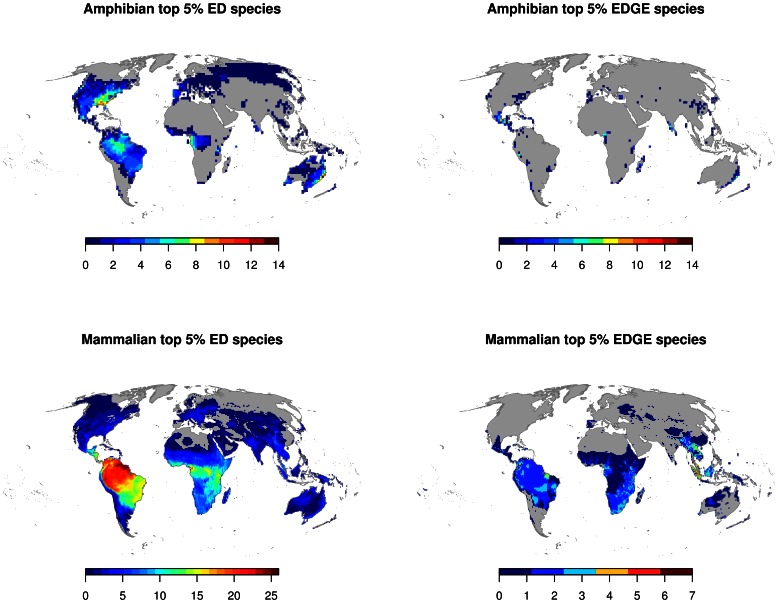
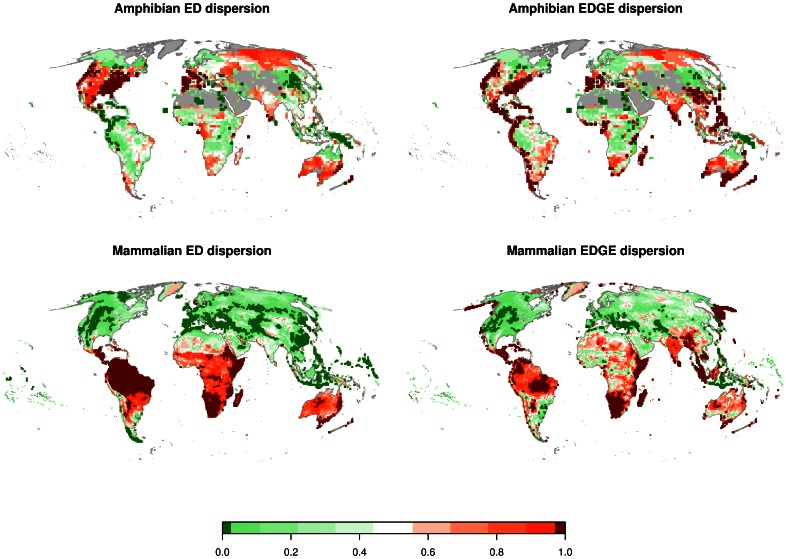
Conservation of phylogenetic diversity allows maximising evolutionary information preserved within fauna and flora. The "EDGE of Existence" programme is the first institutional conservation initiative that prioritises species based on phylogenetic information. Species are ranked in two ways: one according to their evolutionary distinctiveness (ED) and second, by including IUCN extinction status, their evolutionary distinctiveness and global endangerment (EDGE). Here, we describe the global patterns in the spatial distribution of priority ED and EDGE species, in order to identify conservation areas for mammalian and amphibian communities. In addition, we investigate whether environmental conditions can predict the observed spatial pattern in ED and EDGE globally.
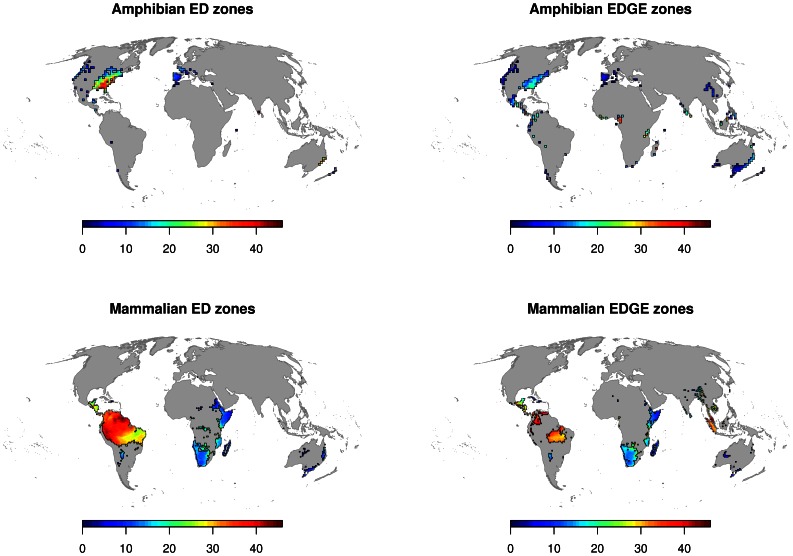
Priority zones with high concentrations of ED and EDGE scores were defined using two different methods. The overlap between mammal and amphibian zones was very small, reflecting the different phylo-biogeographic histories. Mammal ED zones were predominantly found on the African continent and the neotropical forests, whereas in amphibians, ED zones were concentrated in North America. Mammal EDGE zones were mainly in South-East Asia, southern Africa and Madagascar; for amphibians they were in central and south America. The spatial pattern of ED and EDGE was poorly described by a suite of environmental variables.
Mapping the spatial distribution of ED and EDGE provides an important step towards identifying priority areas for the conservation of mammalian and amphibian phylogenetic diversity in the EDGE of existence programme.
保护系统发育多样性可以最大限度地保留动植物区系中的进化信息。“濒危物种边缘”(EDGE of Existence)计划是第一个基于系统发育信息优先保护物种的机构保护倡议。物种通过两种方式进行排名:一种是根据其进化独特性(ED),另一种是将其列入国际自然保护联盟(IUCN)的灭绝状况、进化独特性和全球濒危状况(EDGE)。在这里,我们描述了优先 ED 和 EDGE 物种的全球空间分布模式,以便确定哺乳动物和两栖动物群落的保护区域。此外,我们还研究了环境条件是否可以预测全球 ED 和 EDGE 的观测空间模式。
使用两种不同的方法定义了具有高 ED 和 EDGE 分数浓度的优先区域。哺乳动物和两栖动物区域之间的重叠非常小,反映了不同的生物地理历史。哺乳动物 ED 区域主要分布在非洲大陆和新热带森林,而在两栖动物中,ED 区域集中在北美洲。哺乳动物 EDGE 区域主要分布在东南亚、南非和马达加斯加;对于两栖动物,它们主要分布在中美洲和南美洲。环境变量套件对 ED 和 EDGE 的空间模式描述不佳。
绘制 ED 和 EDGE 的空间分布图谱是确定濒危物种边缘计划中保护哺乳动物和两栖动物系统发育多样性的优先区域的重要步骤。