Institute for Bioengineering of Catalonia, Barcelona, Spain.
Compr Physiol. 2012 Oct;2(4):2369-92. doi: 10.1002/cphy.c110012.
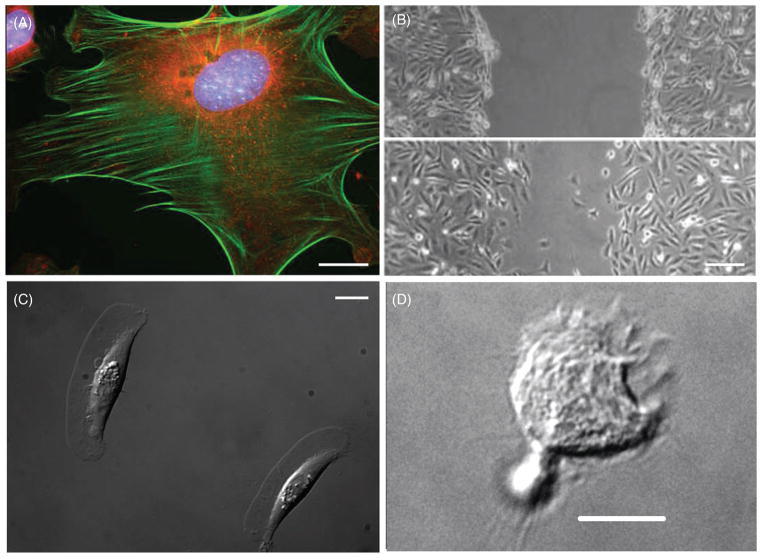
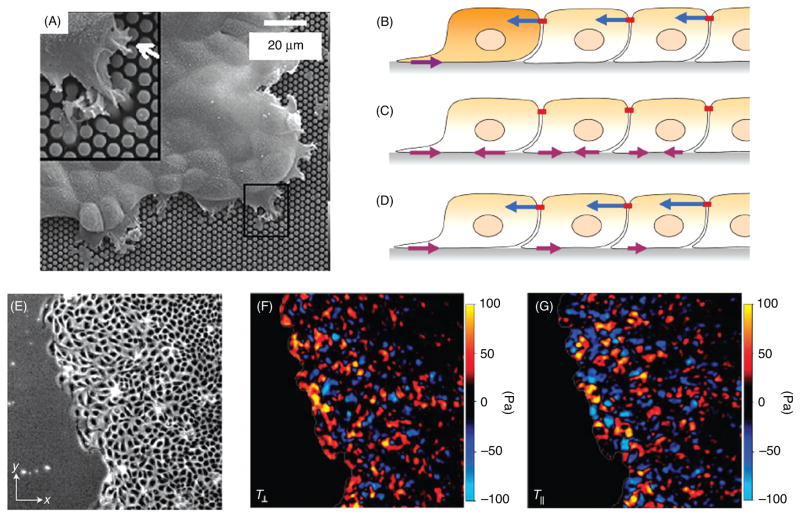
Cell migration is fundamental to establishing and maintaining the proper organization of multicellular organisms. Morphogenesis can be viewed as a consequence, in part, of cell locomotion, from large-scale migrations of epithelial sheets during gastrulation, to the movement of individual cells during development of the nervous system. In an adult organism, cell migration is essential for proper immune response, wound repair, and tissue homeostasis, while aberrant cell migration is found in various pathologies. Indeed, as our knowledge of migration increases, we can look forward to, for example, abating the spread of highly malignant cancer cells, retarding the invasion of white cells in the inflammatory process, or enhancing the healing of wounds. This article is organized in two main sections. The first section is devoted to the single-cell migrating in isolation such as occurs when leukocytes migrate during the immune response or when fibroblasts squeeze through connective tissue. The second section is devoted to cells collectively migrating as part of multicellular clusters or sheets. This second type of migration is prevalent in development, wound healing, and in some forms of cancer metastasis.
细胞迁移对于建立和维持多细胞生物的适当组织至关重要。形态发生可以部分看作是细胞运动的结果,从原肠胚形成期间上皮片的大规模迁移,到神经系统发育过程中单个细胞的运动。在成年生物体中,细胞迁移对于适当的免疫反应、伤口修复和组织动态平衡至关重要,而异常的细胞迁移则存在于各种病理中。事实上,随着我们对迁移的认识不断增加,我们可以期待例如阻止高度恶性癌细胞的扩散、延缓炎症过程中白细胞的侵袭,或促进伤口的愈合。本文分为两个主要部分。第一部分专门讨论单个细胞的迁移,例如白细胞在免疫反应中迁移或成纤维细胞穿过结缔组织时发生的迁移。第二部分专门讨论作为多细胞簇或片一部分的细胞集体迁移。这种第二种类型的迁移在发育、伤口愈合和某些形式的癌症转移中很常见。