Center for Translational Systems Biology and Department of Neurology, Mount Sinai School of Medicine, New York, NY 10029, USA.
BMC Bioinformatics. 2013;14 Suppl 6(Suppl 6):S1. doi: 10.1186/1471-2105-14-S6-S1. Epub 2013 Apr 17.
H1N1 influenza viruses were responsible for the 1918 pandemic that caused millions of deaths worldwide and the 2009 pandemic that caused approximately twenty thousand deaths. The cellular response to such virus infections involves extensive genetic reprogramming resulting in an antiviral state that is critical to infection control. Identifying the underlying transcriptional network driving these changes, and how this program is altered by virally-encoded immune antagonists, is a fundamental challenge in systems immunology.
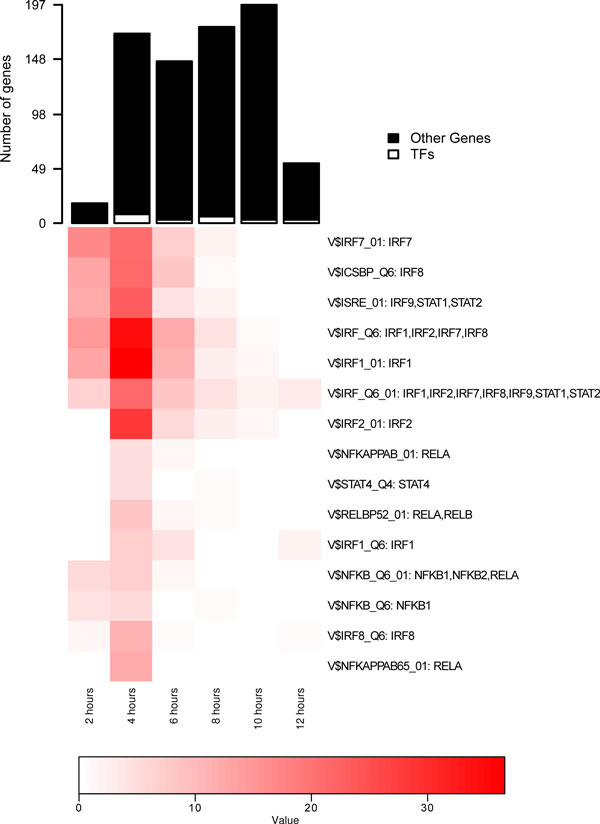
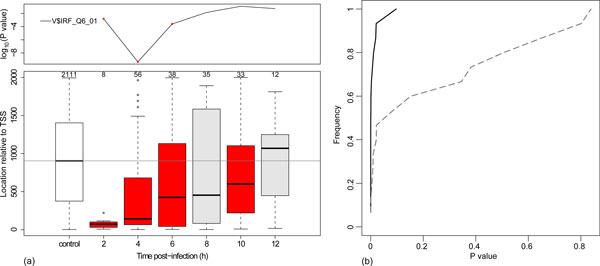
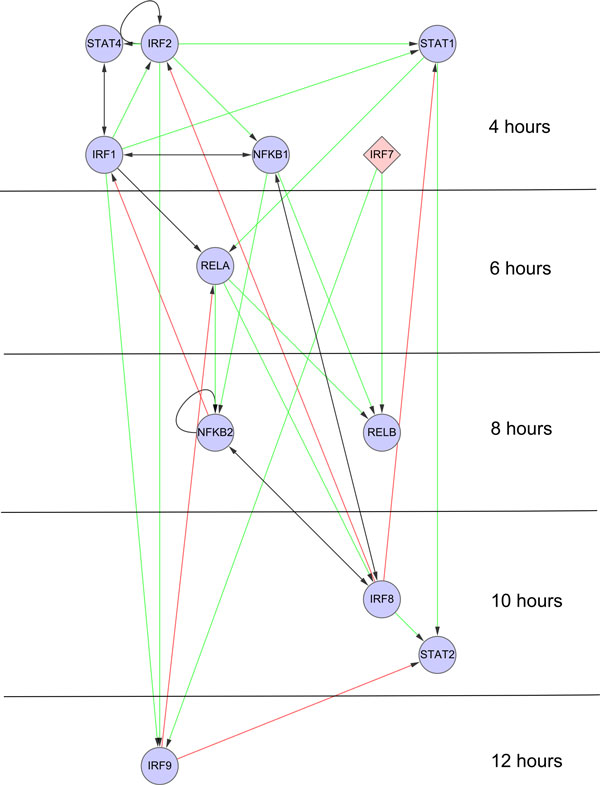
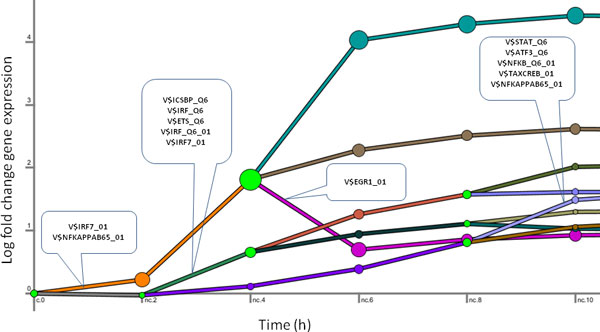
Genome-wide gene expression patterns were measured in human monocyte-derived dendritic cells (DCs) infected in vitro with seasonal H1N1 influenza A/New Caledonia/20/1999. To provide a mechanistic explanation for the timing of gene expression changes over the first 12 hours post-infection, we developed a statistically rigorous enrichment approach integrating genome-wide expression kinetics and time-dependent promoter analysis. Our approach, TIme-Dependent Activity Linker (TIDAL), generates a regulatory network that connects transcription factors associated with each temporal phase of the response into a coherent linked cascade. TIDAL infers 12 transcription factors and 32 regulatory connections that drive the antiviral response to influenza. To demonstrate the generality of this approach, TIDAL was also used to generate a network for the DC response to measles infection. The software implementation of TIDAL is freely available at http://tsb.mssm.edu/primeportal/?q=tidal_prog.
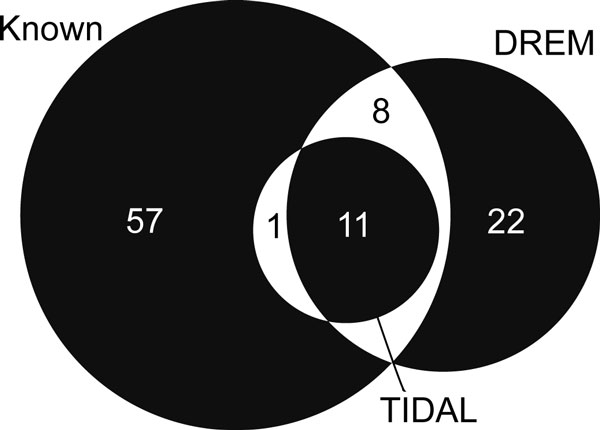
We apply TIDAL to reconstruct the transcriptional programs activated in monocyte-derived human dendritic cells in response to influenza and measles infections. The application of this time-centric network reconstruction method in each case produces a single transcriptional cascade that recapitulates the known biology of the response with high precision and recall, in addition to identifying potentially novel antiviral factors. The ability to reconstruct antiviral networks with TIDAL enables comparative analysis of antiviral responses, such as the differences between pandemic and seasonal influenza infections.
H1N1 流感病毒曾引发了 1918 年大流感,导致全球数百万人死亡,以及 2009 年大流感,导致约两万人死亡。细胞对这类病毒感染的反应涉及广泛的遗传重编程,从而产生抗病毒状态,这对感染控制至关重要。确定驱动这些变化的潜在转录网络,以及该程序如何被病毒编码的免疫拮抗剂改变,是系统免疫学的一个基本挑战。
我们在体外感染季节性 H1N1 流感病毒 A/New Caledonia/20/1999 的人单核细胞衍生的树突状细胞(DC)中测量了全基因组基因表达模式。为了提供感染后 12 小时内基因表达变化时间的机制解释,我们开发了一种统计上严格的富集方法,将全基因组表达动力学和时间依赖性启动子分析相结合。我们的方法,即时间依赖性活性链接器(TIDAL),生成了一个调控网络,将与反应每个时间阶段相关的转录因子连接成一个连贯的链接级联。TIDAL 推断出 12 个转录因子和 32 个调控连接,这些连接驱动了流感的抗病毒反应。为了证明这种方法的通用性,TIDAL 也被用于生成树突状细胞对麻疹感染反应的网络。TIDAL 的软件实现可在 http://tsb.mssm.edu/primeportal/?q=tidal_prog 上免费获得。
我们应用 TIDAL 重建单核细胞衍生的人类树突状细胞对流感和麻疹感染的反应中激活的转录程序。在每种情况下,这种时间中心网络重建方法的应用都会产生一个单一的转录级联,该级联以高精度和高召回率再现反应的已知生物学特性,此外还确定了潜在的新型抗病毒因子。TIDAL 重建抗病毒网络的能力使我们能够对抗病毒反应进行比较分析,例如大流行流感和季节性流感感染之间的差异。